
Monkey Position Alexander Technique: A Plain Guide
What the monkey is in Alexander Technique, how teachers describe it, and a Feldenkrais® way to explore the same everyday bend through small, curious movements.
In short
The monkey position in Alexander Technique is a soft, balanced bend. The knees ease forward, the hips fold, and the torso tilts as one unit while the head and neck stay free. Teachers call it the position of mechanical advantage and use it for tasks like bending to a sink.

Prefer to ease in gently?
See a few gentle exercises for body awareness to try.
The monkey position in Alexander Technique is a soft, balanced way to bend, and it shows up in many Alexander lessons. As a teacher of the Feldenkrais Method®, I have a lot of respect for how clearly the Alexander tradition looks at everyday movement. This guide explains the monkey in plain words, then offers a different, gentler way to explore the same bend.
The monkey position in Alexander Technique, step by step
Despite the name, you do not need to look like a monkey. Picture standing with your feet about hip width apart. Now let your knees ease forward and out over your toes, a little like a skier or a goalkeeper waiting for the ball.
Next, the hips fold. The fold happens at the hip joints, where the thigh bones meet the pelvis, not at the waist. Your torso then tilts forward as one unit. The head and neck stay free, so the head can keep leading the line of the spine instead of dropping or pulling back.
Teachers call this the position of mechanical advantage. The idea is that your legs and hips share the work of the bend, so your back does not take all of it. It is not a pose to hold. It is a way of moving through a task.
Where teachers use the monkey
The monkey is meant for ordinary life. Common examples include:
- Bending over a sink to wash your face or brush your teeth.
- Working at a low counter or a desk where you lean in to read or write.
- Lifting a light box or a bag from a low shelf.
- Picking something up from the floor.
- Reaching into a car boot or a washing machine.
In a lesson, a teacher usually uses light touch on your head, neck and back. The touch gives information about effort you may not feel yourself.
The Alexander ideas behind the monkey
Three ideas explain why the monkey is taught the way it is.
Primary control. F. M. Alexander, who founded the method, noticed that the way the head and neck relate to the back influenced how the whole body moved. He called this relationship the primary control. In the monkey, the aim is to let the head and neck stay free in relation to the back, rather than stiffening or collapsing.
Inhibition. In Alexander language, inhibition means pausing before you react. Before you bend, you stop for a moment and notice your usual habit, such as tightening the neck or locking the knees. The pause gives you a choice.
Direction. Direction means thinking a few simple wishes while you move, for example that the neck can be free and the back can lengthen and widen. These are thoughts, not muscle actions. They are not meant to be forced.
Our guide to Alexander Technique exercises shows where the monkey sits among the other procedures. The Feldypedia entry on the Alexander Technique gives the history.
What the research says
Most research on the Alexander Technique looks at the method as a whole, not the monkey alone. The best known trial followed 579 adults with long lasting or repeated low back pain. People in the normal care group still had pain on a median of 21 days in every four weeks after one year. For those offered 24 lessons, that count was roughly 18 days lower (Little et al., BMJ, 2008). That result is about back pain and one to one teaching, so it does not prove what a single position does.
How you might explore the monkey position at home
A teacher is the best guide, but you can try a light version near a kitchen counter. Go slowly and keep everything small.
Stand with the counter in front of you. Pause, as an Alexander teacher would, and notice how you usually start to bend. Do your shoulders rise? Does your breath hold? There is nothing to change yet. You are just looking.
Then let the knees soften a little, and let the hips fold so your body tilts toward the counter. Keep your eyes soft and your neck unhurried. See if you can feel your weight travelling through the feet. Come back up the same slow way. Try three or four times, then rest.
If your knees or hips object, make the movement smaller, or skip it. Comfort is the guide here.
A Feldenkrais® angle on folding forward
The Feldenkrais Method works through a different mechanism. Instead of keeping one shape and thinking directions, you explore many small variations and notice what changes. The question is less "am I in the right position" and more "what do I discover when I move this way?"
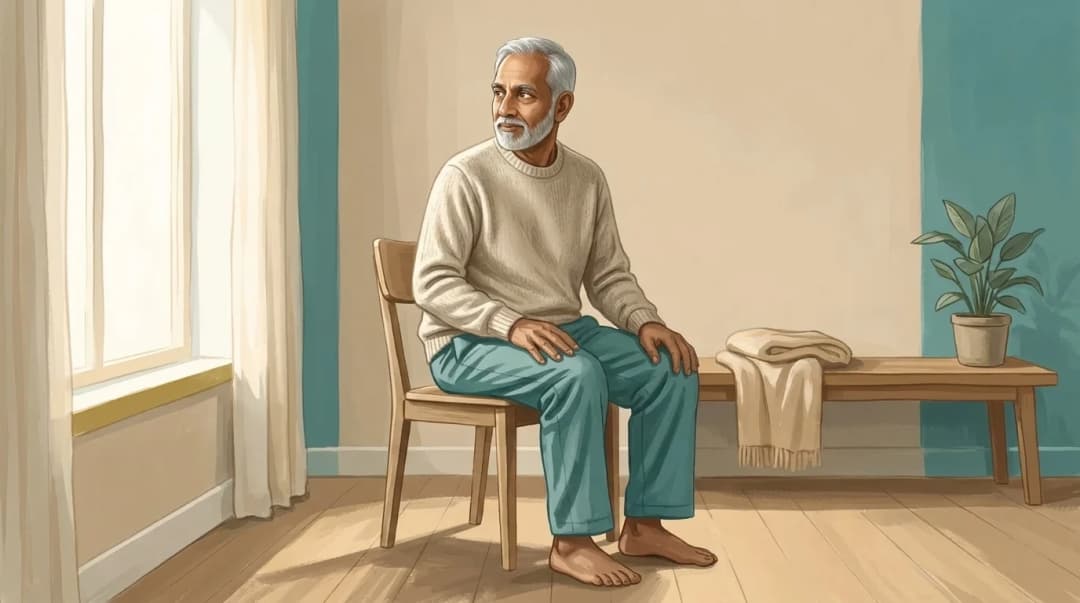
Here is a small experiment, ideally sitting on a firm chair. Place your hands on the creases at the front of your hips, where the legs meet the pelvis. Roll your pelvis a little forward and back, and feel the hip joints move under your fingers. Now bring your head into it. As the pelvis rolls back and your lower back rounds a little, let your head tilt down slowly. As it rolls forward again, let the head come back up. Can you feel pelvis and head moving together, like two ends of one curve?
Try it again with a tiny movement, then a larger one, then a different speed. In a Feldenkrais® Awareness Through Movement® lesson, this kind of variation is the whole point. Many people find that after exploring the hips, a forward bend feels less like a job for the back alone. If you want to try this at home, the lesson on somatic exercises for beginners is a good place to start. Feldy offers short audio lessons in this spirit, and you can start with the 7 day free trial.
Learning from an Alexander teacher
The monkey is hard to learn from words alone, because so much of it depends on effort you cannot easily feel. A certified Alexander teacher can guide your head, neck and back with their hands and give you feedback in real time. Professional societies such as STAT in the UK and AmSAT in the United States keep lists of qualified teachers. If the monkey interests you, a few in person lessons are likely the best route.
Next to clinical care and other methods
Your doctor or physiotherapist offers something different from this kind of movement learning, and the two can run side by side. If bending hurts, a clinician who knows your history is the right person to guide treatment.
Other movement methods are different options with different mechanisms. Strength training builds capacity in chosen muscles, and yoga and Pilates each have their own ways of working with the hips and spine. The Alexander Technique and Feldenkrais® both focus on attention and habit, and many people enjoy one, the other, or both. Our comparison of Feldenkrais and Alexander Technique goes into the differences, and the body awareness program shows how Feldy shapes its lessons.
Learn to listen to your body
Now for the practice that trains it. The Feldy program sharpens your attention through slow, attentive Feldenkrais® lessons, so everyday movement feels lighter and more your own. Gentle, guided, and self-paced.
Start my free 7-day trialNo credit card needed.
Common Questions about the monkey position in Alexander Technique (FAQ)
Is the monkey position safe to try?
For most people it is a gentle, low load way to bend, since you stay upright and the knees do part of the work. Keep the bend modest and ease off if you feel a sharp twinge. Go carefully with knee or hip problems, osteoporosis, or recent surgery, and check with your clinician beforehand. Numbness, a weak leg, or any change in bladder or bowel control means getting medical help promptly.
How often should I practise the monkey?
A few slow tries a day is plenty, ideally during real tasks such as washing your hands or picking up a bag. There is no set number of repetitions. Teachers describe it as a way of doing ordinary actions, so brief moments of noticing count more than a long session.
How long until the monkey feels natural?
Many people notice something in the first few tries, such as a bend that feels lighter in the back. Making it a habit usually takes weeks, because you are changing how you do things you have done for years. Progress is rarely steady, and that is normal.
How is the monkey different from a squat or a hip hinge?
A squat lowers the hips a long way down, and a strength training hinge builds effort in the legs and back. The monkey is a smaller, softer version that is meant for daily tasks and keeps attention on the head and neck staying free. Different methods use each for different aims, and none is better than another.
How is the Alexander Technique different from Feldenkrais?
They share an interest in habit, but the mechanism differs. Alexander lessons are often taught upright with a teacher's guiding hands and a focus on the head, neck and back. Feldenkrais lessons are usually long sequences of small movements, often lying down, exploring how the whole body organises a movement.
Can I learn the monkey from a video or article?
You can get the idea, and trying it gently is fine. The finer points are hard to feel alone, because the method is about effort you may not notice. A certified Alexander teacher, found through a body such as STAT in the UK or AmSAT in the US, is the best source for learning it in person.
When should I see a professional about bending pain?
See a doctor if bending hurts after a fall or injury, or if pain comes with fever, unexplained weight loss, or waking at night. Urgent help is needed for numbness, a weak leg, or trouble controlling your bladder or bowels. Pain that steadily grows should also be looked at.
Learn to listen to your body
See the programRelated resources
Alexander Technique Exercises: What They Actually Are
People search for Alexander Technique exercises and find almost nothing that looks like exercise. That is not an accident, and this page explains what is taught instead.
Feldenkrais® vs the Alexander Technique: How They Differ
Feldenkrais vs Alexander Technique: both are gentle movement-awareness methods, but they teach in different ways. Here is a clear, balanced comparison.
Shoulders turned further after a slow, varied lesson than after repeating one twist
Ready to start moving better?
Gentle, guided lessons for your body. Try your first one free, no credit card required.