
Pain on Outer Foot When Walking: Causes and What Helps
The common reasons the outer edge of a foot hurts on walking, the signs that need a scan rather than a stretch, and how weight distribution comes into it.
In short
Pain on the outer foot when walking most often comes from the peroneal tendons behind the outer ankle, irritation of the small joints along the outer edge, or a foot that habitually rolls outward and loads that border on every step. Sudden pain after a twist, or pain you cannot walk on, needs imaging to rule out a fracture.

Prefer to ease in gently?
See a few gentle exercises for body awareness to try.
Before you begin. This page is general education, not a diagnosis. Outer foot pain that began after a twist or fall, that you cannot comfortably walk on, or that comes with focal bony tenderness, bruising, or marked swelling needs prompt assessment, because a fracture of the fifth metatarsal presents this way. Also see a clinician for numbness, pins and needles, or pain that wakes you at night.
Pain on the outer foot when walking is one of those complaints that gets far less attention than it deserves. Most foot advice online is about the heel and the arch, for understandable reasons: plantar fasciitis turns up in roughly 10 percent of the general population, peaking between the ages of 40 and 60 (StatPearls, 2023). The outer border of the foot has its own set of causes, and they need telling apart before anything else.
The usual suspects along the outer border
Peroneal tendons. Two tendons run down behind the bony bump on the outside of your ankle and continue along the outer foot. They control rolling outward and steady you on uneven ground. When they are irritated, the pain sits behind and below the outer ankle bone and often runs forward along the edge, worse on walking, worse on slopes.
The small joints of the outer edge. Between the heel bone and the little toe sit several joints that most people never think about. They can become irritable and locally sore, especially after a period of more walking than usual, or after an ankle sprain changed how the foot lands.
A foot that rolls outward. Some people habitually keep their weight along the outer border rather than spreading it. Every step then lands on the same narrow strip. Look at the heels of an old pair of shoes: if the outer corner is worn flat while the inner edge looks new, this is likely part of your story.
An old ankle sprain. Sprains are usually inversion injuries, meaning the foot rolled under. Many leave behind a slightly unsteady joint and a habit of guarding, both of which land more work on the outer structures for years afterwards.
Bone. The fifth metatarsal, the long bone leading to the little toe, is a common site for stress fractures and for acute breaks. This matters because it changes the plan completely, which is why the red flags below come before any exercise.
What needs a scan, not a stretch
Get the foot assessed promptly if the pain began at one identifiable moment, particularly after a twist or a fall. Get it assessed if you cannot walk on it comfortably, if pressing one precise spot on the bone reproduces the pain sharply, or if there is bruising or noticeable swelling. Those are the ways a fifth metatarsal fracture announces itself, and it is not a thing to explore gently at home.
Numbness, pins and needles, pain that wakes you at night, or a foot that keeps deteriorating week after week also belong in a clinic. Everything that follows is for the gradual, grumbling, load related version.
Where walking habits come into it
Assuming the bone is fine, the honest question is not what is torn but what keeps getting loaded. A tendon that is asked for the same job several thousand times a day will complain, and the way to change that is to change the distribution rather than to attack the sore tissue.
That distribution is set higher up more often than people expect. A hip that does not extend behind you shortens your step and changes where the foot lands. An ankle that does not bend freely makes the foot roll outward to get over it. Even a habit of walking with the toes turned out puts the landing on the outer edge. Our Feldypedia entry on gait changes and walking difficulty covers how these adjustments accumulate quietly over the years.
A gentle place to begin
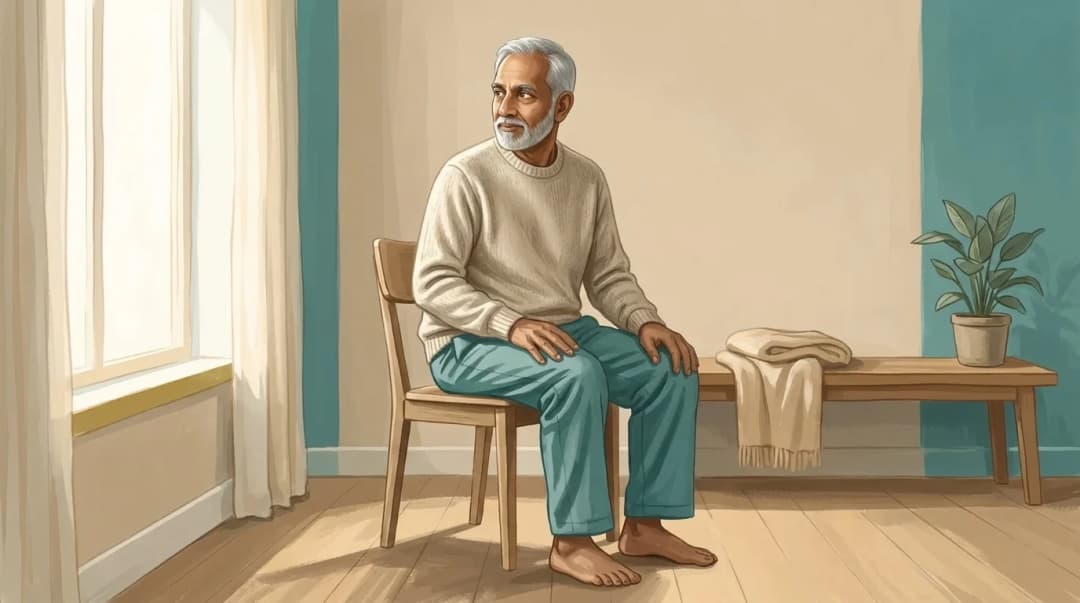
Sit with both feet flat on the floor and no shoes. Without lifting the foot, let your weight drift very slightly toward the big toe side, then toward the little toe side, then back into the heel. Move a few millimetres, not centimetres. The question is not how far you can go but how much of your sole you can actually feel.
Most people discover they can feel the heel and the ball clearly and have almost no sensation along the outer border, or the reverse. That blank area is the useful finding, because a part of the foot your nervous system cannot feel well is a part it cannot share load with intelligently.
This is the kind of work the Feldenkrais Method® is built for: not treating the painful tissue, but improving the picture your brain has of the part, so the load spreads without you managing it consciously. In my work with clients, feet often start distributing weight differently within a couple of sessions of this sort of quiet sensing. Our somatic exercises for beginners teach the same skill in a full lesson.
Practical things worth checking
Look at your shoes before anything else. Worn outer heel corners tip you further onto the painful side with every step, and replacing a pair that has flattened is the cheapest intervention available. A slightly wider shoe helps if the little toe joint is the sore spot.
Reduce hills and uneven ground while it settles, since both ask the peroneal tendons for more. Keep walking on the flat if you can do it without limping, because a tendon that stops working entirely does not get happier.
And if the pain sits somewhere other than the outer border, the causes differ. Our guides to pain on top of the foot and foot arch pain cover those regions.
Learn to listen to your body
Now for the practice that trains it. The Feldy program sharpens your attention through slow, attentive Feldenkrais® lessons, so everyday movement feels lighter and more your own. Gentle, guided, and self-paced.
Start my free 7-day trialNo credit card needed.
Common Questions about pain on the outer foot when walking (FAQ)
What causes pain on the outer edge of the foot when walking?
The frequent culprits are the peroneal tendons, which run behind the outer ankle bone and along the outer foot, and irritation of the small joints on that border. A habit of rolling weight to the outside of the foot loads the same area on every step. Less often it is a stress fracture of the fifth metatarsal, an old ankle sprain that left the joint unsteady, or nerve irritation.
How do I know whether it is serious?
The pattern matters more than the intensity. Pain that came on gradually, eases with rest, and moves around a little is usually a soft tissue and loading problem. Pain that started at a single moment, sits on one precise point of bone, brings bruising or swelling, or stops you bearing weight should be imaged, since that is how a fifth metatarsal fracture behaves.
Is it safe to keep walking on it?
If you can walk without limping and it settles overnight, gentle walking is usually fine and often helpful. If it makes you limp, if it hurts more with each day of walking, or if it hurts at rest, stop loading it and get it looked at. Pushing through outer foot pain is the one approach that reliably makes it worse.
What is the best exercise for outer foot pain when walking?
Slow, unloaded weight sensing while seated is the best starting point. Rest the foot flat, then shift your weight a few millimetres between the big toe side, the little toe side, and the heel, and simply notice which parts of the sole you can feel. It costs the sore border nothing and it addresses the distribution habit that keeps loading it.
What should I avoid with pain on the outer foot?
Avoid rolling the sore border hard on a spiky ball, avoid calf and ankle stretches that pull into the painful area, and avoid new hill walking or long distances while it settles. Also avoid worn shoes whose outer heel edge has flattened, since they tip you further onto the side that already hurts.
How long does outer foot pain take to settle?
A tendon irritation that you stop aggravating often quietens over two to six weeks. A change in how you distribute weight while walking takes longer, usually a couple of months of short daily attention. A bony stress injury runs on a different and longer timetable and needs proper guidance.
How is awareness work different from orthotics or stretching?
Orthotics change the surface under your foot from the outside and can be genuinely useful. Stretching pulls at a tissue for a moment. Awareness based movement works on how you distribute weight and how the hip and ankle take part in a step, so the outer border is asked to carry less. The approaches sit together comfortably.
Learn to listen to your body
See the programRelated resources
Pain Inside Side of Foot: Common Causes and What Helps
Five common reasons the inner edge of the foot aches, the signs that need a professional look, and a quiet way to notice how your weight travels through the foot.
Foot Ache Pain Relief: Gentle Ways to Ease Aching Feet
Aching feet are usually a load story, not a damage story. Gentle, attentive ways to ease the ache, and the signs that mean it is time to ask a clinician.
Shoulders turned further after a slow, varied lesson than after repeating one twist
Ready to start moving better?
Gentle, guided lessons for your body. Try your first one free, no credit card required.