
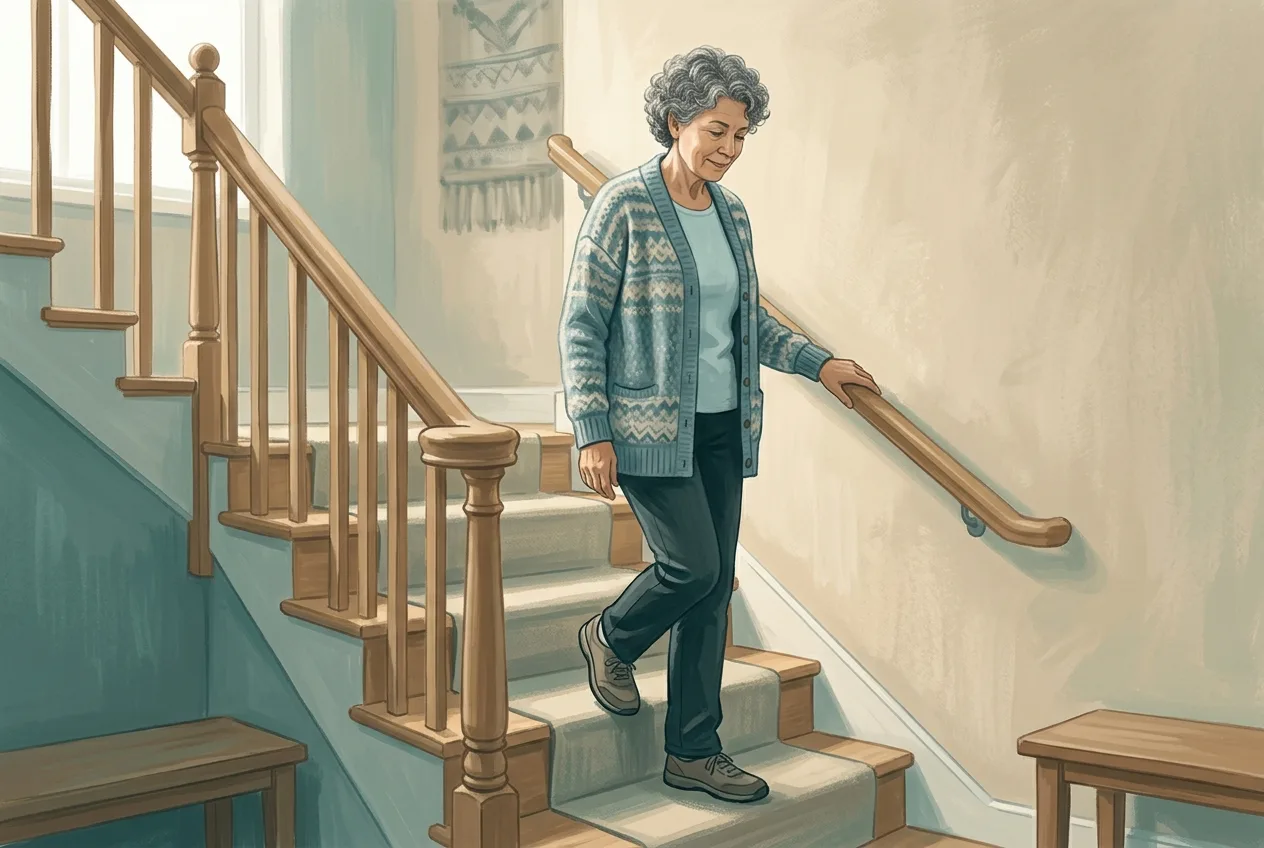
Descending Stairs: Why Going Down Is Harder Than Going Up
Descending stairs asks the front of the thigh to lengthen under your whole weight, which is why knees complain going down long before they complain going up.
In short
Descending stairs is harder than climbing because the front of the thigh has to lengthen while holding your whole body weight, which loads the kneecap several times more than walking on the flat. Going down slower, letting the hip fold, and using the handrail all reduce that load.

Prefer to ease in gently?
See a few gentle exercises for knees and hips to try.
Before you begin. This page is general information, not medical advice. A knee that is hot, swollen, locking, giving way or newly painful after a fall needs a clinician before you experiment with anything here. If your legs have felt unreliable on the way down, or you have already had a fall on stairs, please arrange a proper balance assessment rather than practising alone, and use the handrail every time.
Almost everyone with an unhappy knee discovers the same thing: descending stairs is the part that hurts, and climbing them is comparatively fine. It is a strange asymmetry the first time you notice it, since going up feels like the effortful direction. The explanation is straightforward mechanics, and once you know it, several things you can actually do about it follow directly.
Going up, your thigh muscles shorten to lift you, which is what muscles find easiest. Going down, those same muscles have to lengthen while still holding your entire weight, controlling a fall in slow motion, one step at a time. That kind of lengthening under load is where a knee feels the most pressure, and it is why the joint that managed a flight of stairs upward without comment starts talking on the way back down.
Knees are the most common place for this to show up as a lasting problem. Of all the joints osteoarthritis touches, the knee is by far the most affected, accounting for roughly 365 million cases around the world (WHO, 2023). Stairs are often where people first meet it, long before flat ground gives them any trouble at all.
Why descending stairs asks so much of one joint
Think about what actually happens on a single step down. You lower one foot into empty space, and for a moment your whole weight is held by one leg that is slowly bending. The knee on that standing leg is the hinge managing the descent, and if the hip above it and the ankle below it are not participating, the knee runs that operation more or less alone.
That is the crux of it. In a leg that moves well, the hip folds, the knee bends, and the ankle allows the shin to travel forward, and the three of them divide the work of lowering you. In a leg where the hip has quietly stopped folding, which is extremely common after decades of chair sitting, the same descent still has to happen. It just happens with the knee doing a bigger share of it, several thousand times a year. Our Feldypedia entry on knee stiffness after 60 covers how that redistribution tends to creep up.
There is a second thing going on, which is that stairs demand fine information about where your foot is. You cannot see the tread you are stepping onto once your body is over it, so you are placing that foot from sensation alone. When that sense dulls, and it does dull with age and with inactivity, the body's sensible response is to tense up and move stiffly, which unfortunately makes the descent harder rather than safer.
How to make descending stairs easier
Slow down more than feels necessary. A descent taken slowly gives the muscles time to control the lowering. Most people go down stairs at a speed inherited from a body they had twenty years ago.
Let the hip fold. As you lower yourself, allow the hip of the standing leg to bend, so your weight travels down through a leg that is folding in three places rather than one. This is the single change with the most effect, and it is also the hardest to feel at first.
Use the whole foot. Where the tread is deep enough, put more of the foot on it rather than perching on the front. A foot with more contact gives the ankle more to work with.
Use the rail, properly. Not as a formality. A hand on the rail lets the arm take a genuine share of your weight, which subtracts real load from the knee.
Turn sideways on a hard flight. Going down at an angle, leading with one leg, reduces how much the knee has to bend on each step. It is a legitimate technique, not a concession.
The part you practise off the stairs
The advice above changes what you do on a staircase. What changes how much your knee has to absorb in the first place is worked out somewhere quieter, lying on the floor with nothing to balance and nothing at stake.
This is the domain of the Feldenkrais Method®, and its logic is simple enough. A hip that has not folded properly in years will not suddenly start folding because you told it to on the third step down. But lying on your back, sliding a foot slowly along the floor, feeling the hip take part with no weight to carry, the movement becomes available again, and it tends to show up later in the places you did not practise. Our knee proprioception exercises work directly on the sense of where the leg is, which is exactly what stairs draw on, and stretches for knee pain offer a shorter lying down option. If you would like a voice guiding you through it, Feldy teaches these lessons as a program you follow at home.
I want to be clear about the boundaries. Clinical care sits alongside this and does not get replaced: if stairs have become genuinely difficult, a physical therapist can assess the knee, the hip and your balance far better than any web page. Strength work and awareness work run on different logic, one building capacity through load and the other changing distribution through attention, and there is no reason to pick a side. And if your legs have ever felt unreliable on the way down, please treat that as a balance question deserving a professional opinion, not a movement puzzle to solve alone.
Find where to start
If the way down has become the part of the day you brace for, the useful place to begin is not on the stairs at all, but with a hip learning to fold again where nothing is at risk. The Feldy program for knees and hips is built around that redistribution.
Not sure how to begin? Take the two minute Movement Match quiz, four quick questions that name the movement method for you.
Kinder movement for knees and hips
Understanding the strain is half of it. The Feldy program helps knees and hips carry less of it by reorganising how the whole body moves, through Feldenkrais® lessons. Gentle, guided, and self-paced.
Start my free 7-day trialNo credit card needed.
Common Questions about descending stairs (FAQ)
Is it safe to practise on stairs if my knees or balance are uncertain?
Only with a handrail, only on a short flight, and ideally with someone nearby the first few times. If your legs have ever buckled on the way down, or you have already had a fall on stairs, arrange a balance assessment before practising alone. A knee that is hot, swollen, locking or giving way belongs with a clinician first. Practising the same weight shift on a single low step, with a rail, is a much safer place to start than a full staircase.
How often should I practise this?
You practise it every time you use stairs, which is the useful thing about it. Rather than setting aside a session, pick one flight a day, usually a quiet one at home, and go down it deliberately slowly with your attention on the hip. A few mindful descents a day teach more than one long drilling session, and there is nothing to recover from.
How long until going down stairs feels easier?
The pace change helps immediately, since a slower descent simply gives the leg longer to control the drop. Changes that come from the hip taking a larger share tend to appear over two to six weeks of regular short practice, usually noticed first as less noise from the knee rather than as a dramatic improvement. If stairs are getting steadily harder rather than easier, that is worth raising with a clinician.
How is this different from the quad strengthening a physio prescribes?
Strengthening work builds the capacity of the muscle to hold that load, with progressive repetitions, and it has a solid evidence base for knee pain on stairs. This is about distribution instead: whether the hip and ankle are taking any share at all, or leaving the knee to do the job alone. Strength gives you a bigger engine, distribution means fewer parts are redlining. Both are useful and they do not compete.
What is the best way to go down stairs with knee pain?
The best approach for a painful knee is to go down slowly, use the handrail properly rather than as decoration, and lead with the more comfortable leg so the sore knee is the one being lowered onto rather than the one lowering you. Keep the whole foot on each tread where the stair depth allows. On a steep or unfamiliar flight, turning slightly sideways and going down at an angle takes real load off the knee and is not a defeat.
What should I avoid when going down stairs?
Avoid hurrying, carrying anything that blocks your view of the treads, and going down with hands in pockets or full of shopping when a rail is available. Skip the habit of landing on the ball of the foot and letting the heel drop late, which hands the whole job to the front of the thigh. Slippery socks on wooden stairs are a genuinely common cause of falls and deserve more respect than they usually get.
Kinder movement for knees and hips
See the programRelated resources
The High Knee Exercise, Made Gentle: Slow Mindful Marching
A gentle take on the high knee exercise: slow, supported marching with attention, where the knee floats only as far as feels easy, no cardio required.
Jumper's Knee: What It Is and Why Rest Alone Rarely Settles It
Pain at the tendon just below the kneecap, worse on stairs, squats and landings. What patellar tendinopathy is, what settles it, and where landing habits fit in.
Ankle and Hip Mobility Exercises: The Two Ends of a Leg
Ankle and hip mobility exercises work best together, because a leg turns as one piece. A short floor lesson that lets both ends move without stretching either.
Ready to start moving better?
Gentle, guided lessons for your body. Try your first one free, no credit card required.