
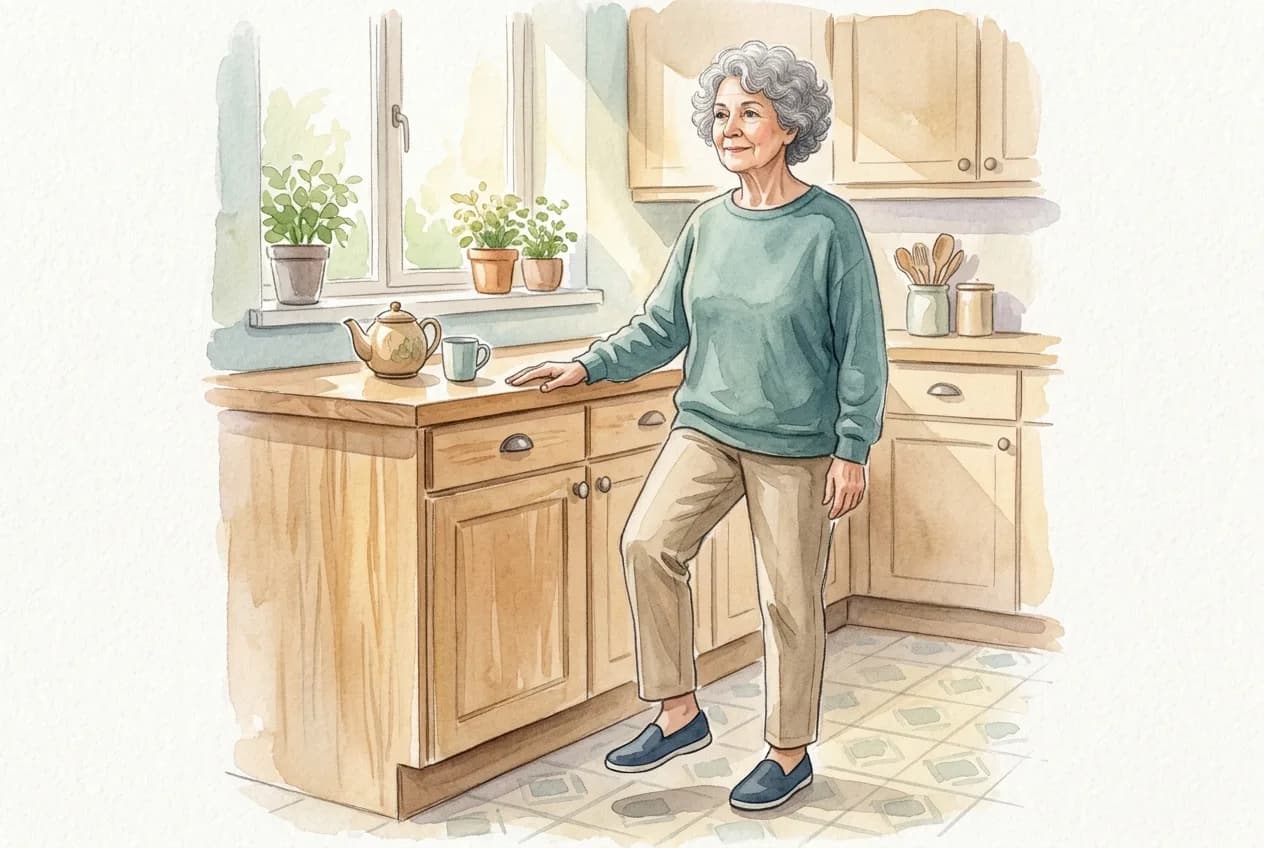
The High Knee Exercise, Made Gentle: Slow Mindful Marching
A gentle take on the high knee exercise: slow, supported marching with attention, where the knee floats only as far as feels easy, no cardio required.
Before you begin. This is gentle movement education, not medical care. Keep a steady chair or counter within reach if your balance is uncertain, and choose the seated version whenever standing feels unsafe. See a clinician for knee or hip pain with swelling, locking, giving way, or after a fall or injury, and before starting if you have had a recent joint replacement.
The lesson
About 5-10 minutes. Move slowly, do less than you can, and stay well below any pain. Rest whenever you need to.
Prefer to listen than read?
Feldy voices gentle lessons like this for knees and hips, so you can close your eyes and follow along.
- 1
Standing with a hand resting. Stand beside a sturdy chair or counter and let one hand rest on it lightly. Feel both feet on the floor: where does your weight sit, more in the heels or the toes?
- 2
Weight drifting side to side. Let your weight ease slowly toward one foot and back to the middle, then toward the other, several times. Which foot seems to carry you more willingly?
- 3
A heel floating up. As your weight settles onto one leg, let the other heel float off the floor while the toes stay resting. Then set it down and let the weight travel back. A few times each side, then pause.
- 4
The knee rising a little. This time let one foot leave the floor entirely, the knee floating up just a hand's width, nowhere near your waist. How much of the lift can happen without holding your breath?
- 5
The other knee's answer. Let the second knee take its own small lifts, just as slow. Does this side organize itself differently, in the foot, the hip, or somewhere unexpected?
- 6
An unhurried march. Now alternate, one easy lift at a time, like the slowest march ever recorded. Rest whenever you like; the pauses are part of it.
- 7
Standing quietly. Let both feet settle and simply stand for a moment. How does standing feel now, compared with when you began?
Let Feldy guide you, eyes closed
You just read these steps. In the Feldy program, a calm voice guides you through each gentle move, so your attention can stay in your body instead of on the screen.
Try Feldy Free for 7 daysNo credit card needed.
The high knee exercise usually appears in workout videos as a breathless sprint on the spot, which rules it out for almost everyone with a sensitive knee or hip. That is a shame, because underneath the cardio costume hides one of the most useful everyday movements there is: shifting your weight fully onto one leg and lifting the other freely. This lesson keeps that treasure and discards the sprint. Done slowly, with a hand resting on a counter and attention doing the hard work, it becomes a quiet study in balance and easy hip movement, in the spirit of the Feldenkrais Method®.
Knees earn their caution. The knee is the joint most often affected by osteoarthritis, involving about 365 million people worldwide (WHO, 2023), and a knee that aches soon teaches its owner to march nowhere at all. The slow version offers those knees a way back into the movement without the impact that scared them off.
What the high knee exercise is really practicing
Every step you take begins with an invisible negotiation: your weight travels across one foot, the pelvis adjusts, and only then does the other leg become light enough to lift. Fast high knees blur straight past this negotiation. The slow version turns a spotlight on it. When you let your weight drift, float a heel, and lift a knee a mere hand's width, you are rehearsing the exact skill that stairs, curbs, and uneven pavements quietly demand, and you are doing it with enough time to feel how it works.
Height, it turns out, is the least important ingredient. A small lift done with a clear, comfortable weight shift teaches more than a dramatic one done with a hoisted hip and a held breath. If your knees have been stiff for a while, the Feldypedia entry on knee stiffness after 60 explains how that caution builds, and why unforced movement is the friendlier way out of it. If your scans have come back clear and the ache is still there, our post on what to make of it when everything looks fine on the MRI looks at how that kind of caution can outlast what imaging shows.
Making the high knee exercise kind to your knees and hips
Keep three comforts in place. First, support: a hand resting on a chair back or counter lets your balance relax enough to actually learn. Second, size: the knee floats up only as far as stays entirely easy, and a few centimeters genuinely count. Third, pace: one lift at a time, with rests, never chasing a burn. If standing is not comfortable today, sit tall in a firm chair and let each knee float up a little from there; the same negotiation happens, just with more help.
For neighbouring practices, our knee exercises for seniors stay in the same gentle register, and exercises for stiff knees works on the bending side of the story.
A word of proportion: if a knee or hip is swollen, locking, giving way, or freshly injured, it needs a clinician before it needs a lesson. For the ordinary stiff, careful joint, though, this kind of slow, attentive practice pairs naturally with the fuller path in the Feldy program for knee and hip pain, where short lessons build the same ease lying down, sitting, and standing. The free 7 day trial is an easy way to feel whether it suits you.
Find where to start
Some knees want to begin lying down, where nothing presses on them, while others are ready for standing work like this. If you are not sure which is yours, a quick match can open the right door.
Not sure where to start? Take the Movement Match quiz, four quick questions in about two minutes, and find the movement method that fits you.
Whichever lesson greets you first, keep that steady support within reach.
Common Questions about the high knee exercise (FAQ)
What is the best high knee exercise for seniors or sensitive knees?
A slow, supported version: standing beside a counter with one hand resting, lifting each knee only a hand's width, and paying attention to the weight shift rather than the height. That variation keeps all the useful ingredients, the balance practice, the hip movement, the confidence, while dropping the impact and speed that trouble sensitive joints. Done seated in a firm chair, it becomes gentler still and remains well worth doing.
Do high knees have to be fast to count?
Only if your goal is cardio. Fast high knees are a running drill for raising the heart rate, and that is a fine goal for the bodies that enjoy it. Slow high knees train something different and arguably rarer: the weight shift, balance, and easy hip motion that walking, stairs, and curbs quietly depend on. For most people with tender knees or hips, the slow version delivers far more of what daily life actually asks for.
What should I avoid when doing the high knee exercise?
Skip the jumping, jogging version if your knees or hips are sensitive, and resist hauling the knee toward your chest to make the movement look complete. Avoid practicing on a slippery floor or in socks, holding your breath, and gripping the support hard, which usually means the movement has grown too big. If a lift pinches in the hip or knee, make it smaller or switch to the seated version.
Is this exercise safe, and who should check first?
The slow, supported form is low risk for most people, and the seated form even more so. Check with a clinician first if you have had a recent hip or knee replacement, a fall, or an injury, and if your balance is poor, keep the support hand resting throughout rather than hovering. Pain, swelling, or a joint that locks or gives way is a reason for assessment, not for more repetitions.
How often should I do it, and when will I feel a change?
Daily, in small doses, works beautifully: a couple of unhurried minutes while the kettle boils, or beside the bathroom counter. Many people feel steadier and lighter on their feet within the first session or two. More reliable changes, smoother stairs, easier curbs, less thought given to every step, tend to gather over three to six weeks of regular practice.
When should I see a professional about knee or hip pain?
See a doctor or physiotherapist if pain is severe or worsening, if the joint swells, locks, or buckles, if pain follows a fall or twist, or if it keeps waking you at night. Gradual stiffness that steadily narrows your life is also worth assessing rather than enduring. Gentle movement can accompany professional care, and it works best when the two point in the same direction.
Kinder movement for knees and hips
See the programRelated resources
Ankle and Hip Mobility Exercises: The Two Ends of a Leg
Ankle and hip mobility exercises work best together, because a leg turns as one piece. A short floor lesson that lets both ends move without stretching either.
Descending Stairs: Why Going Down Is Harder Than Going Up
Descending stairs asks the front of the thigh to lengthen under your whole weight, which is why knees complain going down long before they complain going up.
Gentle Exercises for Stiff Knees That Involve the Whole Leg
A short lying down lesson for knees that feel stiff and reluctant after sitting, inviting the whole leg, hip and pelvis to share the work of bending.
Ready to start moving better?
Gentle, guided lessons for your body. Try your first one free, no credit card required.