
Menopause Muscle Aches: Why They Arrive and What Eases Them
The diffuse, everywhere ache that shows up around menopause is common, poorly explained, and genuinely responsive to gentle regular movement. Here is what is known.
In short
Menopause muscle aches are a common, usually diffuse soreness that arrives as oestrogen falls, affecting muscles rather than specific joints. They are not a sign of damage. Gentle, regular movement, sleep, and warmth tend to help more than rest, and persistent or one sided pain deserves a medical opinion.

Prefer to ease in gently?
See a few gentle exercises for menopause to try.
Before you begin. Aching muscles around menopause are common and usually not serious, but they are not the only explanation for widespread pain. See a doctor if the ache is one sided, comes with swelling, fever, marked weakness, unexplained weight loss, or a rash, if it began after starting a new medication such as a statin, or if it steadily worsens. Thyroid disorders, vitamin D deficiency, and inflammatory conditions can look similar and are worth ruling out. Gentle movement sits alongside medical care and does not replace it.
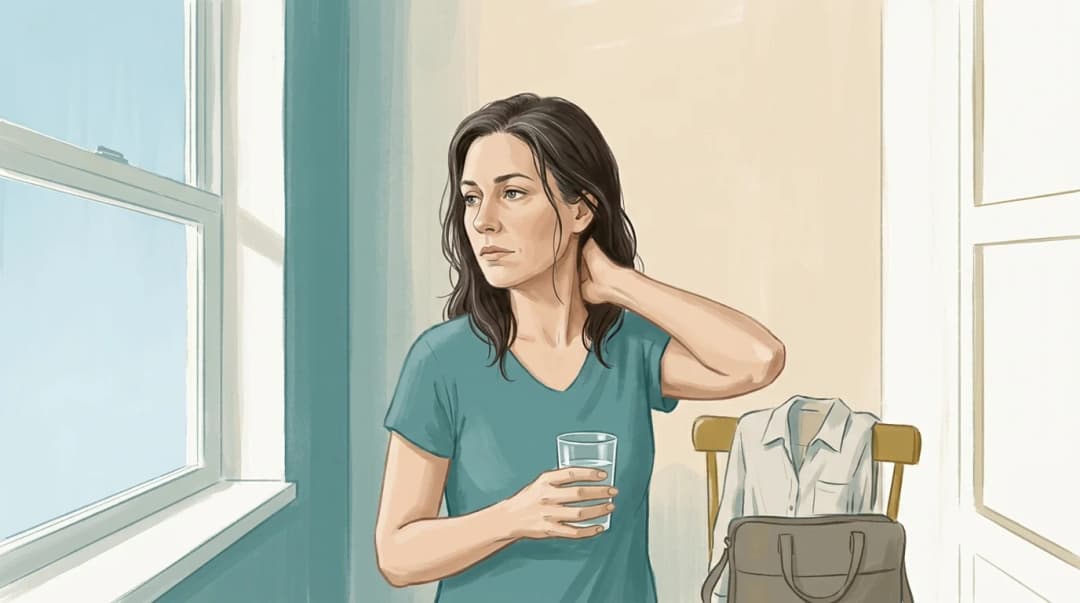
Menopause muscle aches are one of the most commonly reported and least well explained parts of the transition: a diffuse, everywhere soreness that feels like the aftermath of exercise you never did. It is usually worse in the morning, tends to move around rather than settling in one place, and is distinct from the more localised joint pain that often accompanies it. It is not a sign of damage, and it responds to gentle regular movement more reliably than it responds to rest. In one study of over 1,000 perimenopausal women in Shanghai, fatigue was the most commonly reported symptom at 54.24% (Medicine (Baltimore), 2016), and the aching and the tiredness tend to travel together.
Why menopause muscle aches arrive when they do
The position is that the mechanism is not fully settled. Oestrogen receptors are present in muscle, tendon, and connective tissue, and oestrogen appears to play a part in how those tissues repair, how inflammation is regulated, and how pain is perceived. When levels fall and then fluctuate unpredictably, as they do through perimenopause, several of those systems shift at once.
Three other things usually compound it. Sleep becomes broken, often by night sweats, and poorly slept muscles ache more and recover more slowly. Activity levels frequently drop, sometimes because of the aching itself, which produces more stiffness rather than less. And the transition often coincides with a decade of considerable life load, which raises baseline muscle tension in a way that is easy to overlook.
None of this makes the ache imaginary. It makes it multi causal, which is also why single interventions tend to disappoint and why several small changes together tend to work better than one large one. Our Feldypedia entry on menopause and physical changes sets out the wider picture.
Muscle ache or joint pain
Worth separating, because they behave differently. Menopause muscle aches are diffuse: a whole shoulder region, both thighs, the upper back generally. Joint pain points somewhere specific, often the knees, hands, or hips, and typically comes with stiffness after sitting and discomfort on particular movements.
Many women have both. The distinction is useful mainly for a clinician deciding what to investigate, and for you deciding what to try, since diffuse muscle ache usually responds well to warmth, movement, and sleep, whereas a single persistently painful joint deserves a proper assessment. Our guide on how to ease menopause joint pain covers that second category.
What actually eases menopause muscle aches
Movement, in small regular doses. This is the most consistent finding and the least appealing one when you already feel sore. The distinction that matters is dose: aching muscles do badly with long stillness and badly with sudden hard effort, leaving a wide comfortable middle of walking, easy mobility work, and slow floor based movement. Ten quiet minutes most days beats an hour on Sunday.
Warmth. Baths, showers, heat packs. Unglamorous, temporary, and genuinely useful for getting a stiff morning body moving enough to do anything else.
Sleep, to whatever extent it is available. Night sweats make this hard, and it is worth raising with a doctor rather than absorbing. Muscle soreness and broken sleep reinforce each other in both directions.
Talking to a clinician about the whole picture, including hormone therapy where appropriate. Menopause care is a medical conversation, and movement education sits alongside it rather than in place of it.
Where an awareness approach fits
The Feldenkrais Method®, which is what Feldy teaches, is useful here for a specific reason: it asks for almost no effort. Awareness Through Movement® lessons are done lying down, slowly, with movements deliberately kept small enough that a sore body can do them on a bad day. The work is attentional rather than exertional, which means it does not add load to muscles that are already complaining about load.
That is a different mechanism from yoga or Pilates, which build strength and range through practised repeated forms and which many women find valuable in their own right. It is also different from clinical care, which assesses and treats. If your muscles ache too much to face a class, this is often what remains possible.
A concrete place to start is our lesson set for exercises for perimenopause, and our guide on perimenopause aches and pains covers the earlier stage of the transition. The full approach is on our menopause page.
Softer movement through menopause
Now, the gentle way to work with it. The Feldy program eases the stiffness and tension of these years through slow Feldenkrais® lessons made for a changing body. Gentle, guided, and self-paced.
Start my free 7-day trialNo credit card needed.
Common Questions about menopause muscle aches (FAQ)
Are menopause muscle aches normal?
They are common enough to be considered an ordinary part of the transition for many women, though common is not the same as inevitable, and plenty of people go through menopause without them. The typical pattern is a diffuse soreness or heaviness that moves around, is often worse in the morning, and does not settle in one joint. That said, widespread aching has other causes too, so a new or severe pattern is worth taking to a doctor rather than assuming.
What is the difference between menopause muscle aches and joint pain?
Muscle ache tends to be diffuse, spread across a region, and described as soreness, heaviness, or a feeling of having overdone it when you have not. Joint pain is usually more local, points to a specific place such as a knee or a thumb, and often comes with stiffness after rest or discomfort on particular movements. Many women experience both at once during the transition, and the distinction matters mainly because it changes what a clinician looks for.
Does exercise help or make menopause muscle aches worse?
Gentle regular movement generally helps, while sudden increases in intensity generally do not. Aching muscles respond badly to long stillness and badly to overload, which leaves a fairly wide middle ground of walking, easy mobility work, and slow floor based movement. The common trap is resting until the ache subsides, then returning at the old intensity, which restarts the cycle. Building back gradually works better.
How often should I move if my muscles ache?
Most days, briefly, is a more useful target than a few long sessions a week. Ten to twenty minutes of easy movement, done regularly, gives aching muscles the circulation and variation they respond to without the load that provokes them. On a bad day, doing a shorter and smaller version is far better than skipping entirely, because the pattern is easier to maintain than to restart.
How long do menopause muscle aches last?
There is no fixed timeline, and sources say so. For many women the aching is most noticeable through perimenopause and the first years after the final period, then eases, but the range of individual experience is very wide. What responds sooner is the day to day severity: people who move regularly often report the ache becoming less dominant within weeks, even while the underlying transition continues.
When should I see a doctor about aching muscles?
Go promptly if the ache is one sided, accompanied by swelling, fever, a rash, marked muscle weakness, dark urine, or unexplained weight loss, or if it began soon after starting a new medication such as a statin. Also worth a visit is aching that steadily worsens, wakes you consistently, or comes with morning stiffness lasting more than an hour, which can point to an inflammatory condition. Thyroid problems and low vitamin D produce similar symptoms and are simple to test for.
Softer movement through menopause
See the programRelated resources
Feldenkrais® for Menopause: What It Helps With
It will not touch your hormones and it will not build bone. What it can offer is a way to keep moving when joints ache and the body feels unfamiliar.
Feldenkrais® for Pelvic Floor: Not Every Floor Is Weak
Not every pelvic floor problem is a weak one. How Feldenkrais lessons compare with pelvic health physiotherapy, Kegels, Pilates, hypopressives, and yoga.
Severe symptoms while your cycles still look normal, and what to raise with a doctor
Ready to start moving better?
Gentle, guided lessons for your body. Try your first one free, no credit card required.