
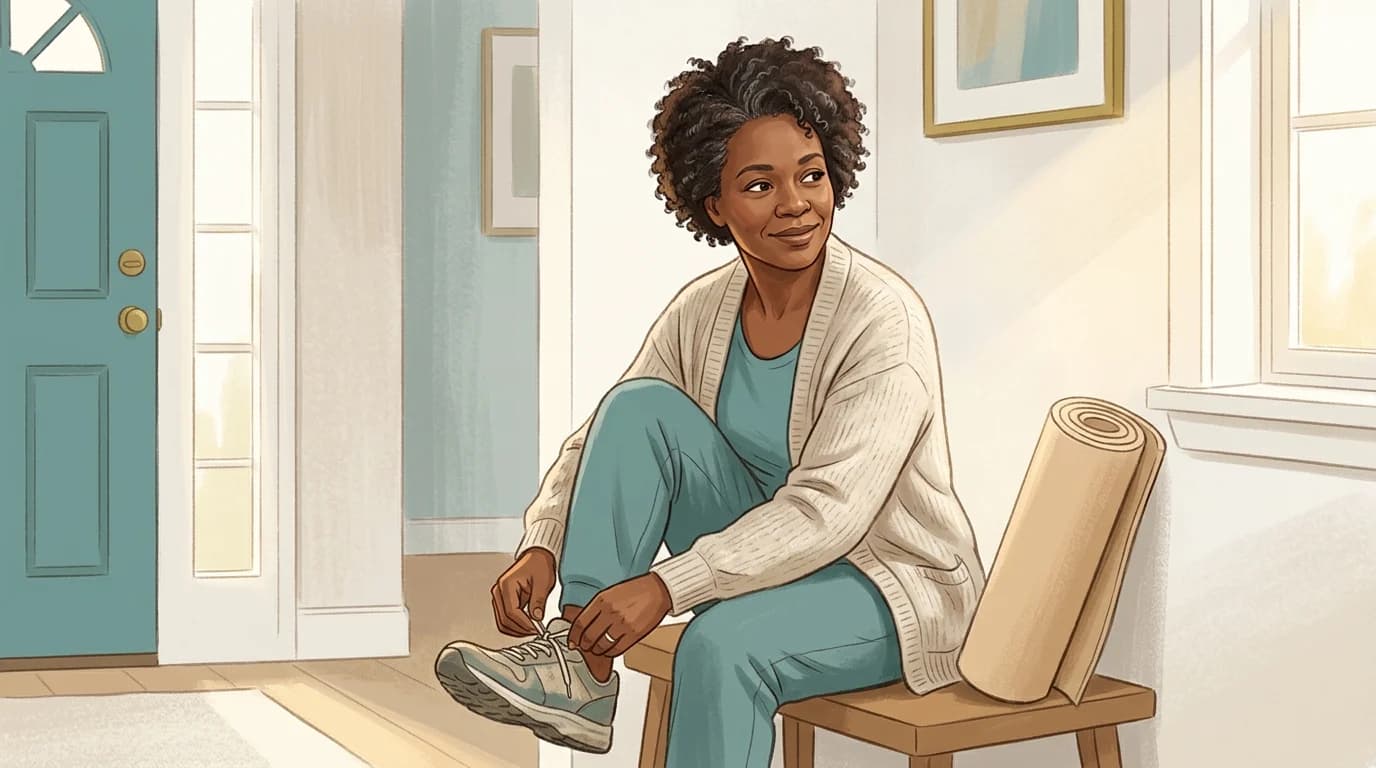
Walking or yoga for low mood in menopause? Twelve trials suggest each helps its own way
How you feel through the menopause years colours the decade after them. Brisk movement and slow mind body practice both pointed the right way, which leaves the choice with you.
As a Feldenkrais® practitioner, I hear one sentence from women in their late forties and fifties more often than almost any other. It isn't about hot flashes. It's some version of "I don't feel like myself anymore," said quietly, often at the very end of a long list of physical complaints, as if the mood part were somehow less legitimate than the aching hips or the broken sleep that arrived alongside it.
Low mood. A shorter fuse. A flatness that turns up without a reason.
Then comes the practical question. If movement is supposed to help, which kind? Something brisk that gets the heart going, or something slow on a mat? A review published on 13 October gives the clearest answer I've seen so far, and it is less of a contest than the question suggests.
What the review compared
A team at University College London, led by Simone Saidel with Aimee Spector as senior author, pooled 12 randomized trials covering 1,003 women aged 40 to 65 in perimenopause or the first years after the final period (Menopause, 2026). The trials ran in seven countries, from Brazil and Tunisia to Korea and the USA.
They sorted the programs into two families. According to a summary of the study, aerobic activity covered walking, dance, Zumba, general aerobics and even Taekwondo; mind body practice covered yoga, tai chi, Pilates and stretching (News-Medical, 2026). Then the team asked what each family did for depression, anxiety, mood, stress, thinking and quality of life.
What each option changed
Brisk, aerobic movement. This family showed the clearest effect on depressive symptoms, and it also lifted everyday mood and overall quality of life. Between the two families, this was where the clearest shifts showed up.
Mind body practice. Yoga, tai chi and their cousins did something different. They improved what researchers call psychological quality of life: how settled, capable and at ease women felt in themselves. Their effect on depression scores alone was less clear in this set of trials.
Across both. Taken together, physical activity eased depressive symptoms in perimenopause and in early postmenopause, with the other gains showing most clearly after the final period. The published summary reports no clear result for anxiety, stress, or memory and thinking, even though the team set out to measure them.
The authors also point out something easy to miss: most of these programs ran in groups. Some of what helped may have been the company.
How much weight it can carry
Twelve trials is a modest base. The programs differed a lot from one another, many trials were judged at high risk of bias, and the authors themselves call for larger studies with clearer menopause staging. The depression effect looks large on paper. I'd take that as a good reason to pay attention, not as a promise that every woman who starts walking will feel better. Some trials compared one activity with another rather than with doing nothing, which blurs the families further.
It also isn't the first review to land here. A different team pooled 12 trials in July and found a similar lean for mood and quality of life. Two teams, overlapping evidence, the same direction.
Who each tends to suit
If the low mood is the heavy part (the flat mornings, the loss of interest, the sense that everything has become harder work), then movement that raises your breathing for a while has the strongest evidence in this review. A brisk walk counts. So does putting on music and dancing around the kitchen.
If what you've lost is more a sense of being at home in yourself, then yoga, tai chi and Pilates showed their strength exactly there. They're self practiced methods, each with its own mechanism and its own strengths, and the Feldenkrais Method® is another of them: very gentle and soft, working through attention rather than effort. The review didn't rank one family above the other on every outcome, and it didn't test the Feldenkrais Method at all.
Many women end up wanting both. That isn't indecision; it may be the most sensible reading of the data.
The Feldenkrais angle
What the Feldenkrais Method adds here is a question about how you go, rather than which class you pick. A walk done while bracing against the day is a different walk from one where the arms are allowed to swing and the breath finds its own pace. The physical changes of menopause often lead women to hold themselves more tightly, and holding is tiring.
So whatever you choose, try one small experiment: can you do it with a little less effort than yesterday? Not slower, not easier. Just without the effort you don't need.
That tends to be what keeps a practice alive over months. A perfect program you drop after three weeks can't do much for your mood; one that quietly becomes part of your week can.
What to take from it
Low mood in the menopause years is common, and it isn't a failing. Decisions about hormone therapy, antidepressants or talking therapy belong with your doctor, and movement sits alongside that care rather than replacing any of it. If your mood is very low, persistent, or getting in the way of your life, that conversation comes first.
Within that bigger picture, this review offers something freeing: you can choose movement partly by what you actually like. Brisk or slow, alone or with others.
What I keep turning over is the point about groups. How much of a lifted mood was the walk, and how much was the woman walking beside you?
Let Feldy guide you, eyes closed
A calm voice walks you through gentle moves so your attention stays in your body, not on the screen.
Try Feldy Free for 7 daysNo credit card needed.
Sources
Movement Pulse is informational, not medical advice. See our editorial policy.
Move better with Feldy
See the programMovement Pulse Weekly
The week's best research, in your inbox Tuesday.
Movement science, gentle-practice ideas, and a practitioner's read on what's new. Free.
More from Movement Pulse
Why the movement practice you keep through menopause is usually the one you enjoy
Eighteen women aged 40 to 60 describe building their own menopause toolkits, and what decided which parts they kept was not the evidence.
Sep 1, 2026
Menopause aches now have a name. What to ask your doctor
A growing wave of research is naming the joint aches and stiffness of perimenopause. A 93,000-woman analysis maps where it climbs, and what is worth asking.
Jun 24, 2026
Severe symptoms while your cycles still look normal, and what to raise with a doctor
A Climacteric analysis of 1,478 women across twelve countries finds symptom severity and job satisfaction shift before the periods stop, not after.
Sep 20, 2026Ready to start moving better?
Gentle, guided lessons for your body. Try your first one free, no credit card required.