

Sleeping Positions for Mid Back Pain: What Truly Helps
How to arrange side, back and front lying so a sore thoracic spine can rest, what the thin research supports, and which night symptoms need a clinician.
In short
The kindest sleeping positions for mid back pain are usually side lying, with a pillow that keeps the head level with the spine and a cushion between the knees, or back lying with support under the knees. Comfort is a legitimate guide: the position you actually fall asleep in wins.

Prefer to ease in gently?
See a few gentle exercises for stress and sleep to try.
Before you begin. This is general comfort guidance, not medical advice. Mid back pain that is consistently worse at night, wakes you night after night, or arrives with fever, unexplained weight loss, chest pain, breathlessness, or a history of cancer or osteoporosis needs a clinician's assessment, not a new pillow.
Sleeping positions for mid back pain matter for a reason most advice skips: the mid back is the thoracic spine, the twelve vertebrae your ribs attach to, so it never fully clocks off. It moves a little with every breath you take, all night, and each position you rest in loads it differently. Side lying folds the ribcage slightly toward the mattress, back lying spreads the load across the whole back of the ribs, and front lying holds the region in a sustained arch with the head turned away. None of these is forbidden. The question is which arrangement lets your particular mid back do its quiet breathing work with the least effort, and a few pillows usually decide it.
Aching between the shoulder blades and the waist is common enough to take seriously without alarm. A systematic review of studies on thoracic spine pain found that in adult populations, between 15 and 27.5 percent of people reported it over the course of a year (Briggs et al., 2009). Most of it behaves like ordinary musculoskeletal ache: it varies with position, eases with movement, and responds to small, patient adjustments of the kind below.
Side lying, often the easiest sleeping position for mid back pain
Lying on your side asks three things of your setup. First, pillow height: the head should rest level with the rest of the spine, which for most side sleepers means a fuller pillow that fills the whole gap between the point of the shoulder and the ear. Too flat and the head hangs toward the mattress, tugging on the upper ribs all night; too tall and it is propped away, which loads the same region from the other direction. Second, a cushion between the knees keeps the upper leg from sliding forward and rotating the pelvis, a rotation the thoracic spine ends up absorbing as a long, slow twist. Third, and least known: if there is a visible hollow between your waist and the mattress, a small folded towel there can stop the ribcage from side bending into the gap for hours. Lie down, take three breaths, and notice whether the ribs on your upper side feel free to move. That felt sense is your best measuring tool.
Back lying with a sore mid back
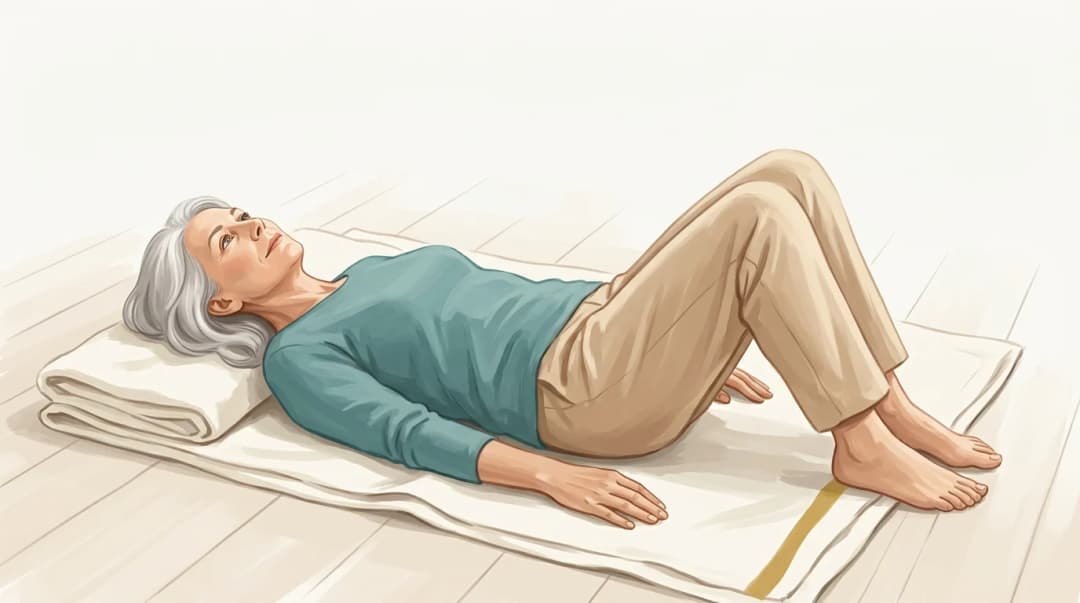
On your back, the load spreads widely, which many sore mid backs appreciate. Two supports refine it. A pillow or rolled blanket under the knees lets the legs soften, which in turn lets the whole spine settle toward the mattress instead of being held in a shallow bridge. And the head pillow deserves more attention than it gets: one that is too thick pushes the head and neck forward, and the mid back pays for that by rounding to accommodate it. Aim for the slimmest pillow that still feels restful, so your nose points at the ceiling rather than at your feet. If breathing feels roomier in this shape, that is a good sign the thoracic spine has stopped working overtime.
Front lying, the demanding one
Sleeping on your front is the hardest arrangement for a tender mid back. The neck turns fully to one side, the arch of the back is sustained for hours, and the ribs are pressed between body weight and mattress, which can make the first breaths of the morning feel stiff. If you can fall asleep another way, this is a reasonable position to drift away from gradually. If you truly cannot, do not spend your nights fighting it. Make it kinder instead: a slim pillow under the hips and lower belly softens the arch considerably, and a very flat head pillow, or none, reduces the bend at the neck. Falling asleep matters more than positional theory ever will.
What the research says about sleeping positions for mid back pain
Here is the part most pillow guides leave out. The research on mattresses, pillows and sleep posture for back pain is thin, made up of small studies, and mostly low certainty. Nobody can tell you with confidence which firmness, height or shape will quiet your mid back, because the evidence simply is not there yet. That is oddly freeing. It means comfort is not a lazy shortcut but a legitimate guide, and the position that lets you actually fall asleep beats the theoretically ideal one you lie awake rehearsing. Experiment for a few nights at a time, keep what your mornings vote for, and hold every rule on this page, including ours, lightly.
Getting into and out of bed with a sore mid back
The twinge many people blame on the night actually happens at its edges. Arriving: sit on the edge of the bed, lower your ear and shoulder toward the pillow while your legs float up in the same motion, keeping breastbone and nose aimed the same way so the trunk travels as one unit, then settle onto your back or stay on your side. Leaving reverses it: draw the knees up, turn the whole trunk together to face the edge, then let the weight of the lower legs dropping toward the floor act as a counterweight while your arms push the torso upright. Sit for a breath before standing. The mid back is a twisting region by design, and it will twist happily later in the day; it just prefers not to be wrung out cold at 6am.
When night pain needs more than a pillow
Most mid back ache at night is positional and improves within a couple of weeks of gentler arrangements. Some is not, and the pattern matters. Pain that is consistently worse at night than during the day, that wakes you every night, or that comes with fever, unexplained weight loss, chest pain, breathlessness, numbness or weakness deserves a clinician's assessment rather than a new pillow. So does new mid back pain in anyone with a history of cancer or osteoporosis, because the thoracic spine is a region doctors examine with particular care in those situations. This is not a reason for alarm; it is a reason for a proper look, and everything on this page can then sit alongside whatever your clinician advises. Our Feldypedia article on waking with stiffness and pain explains the more ordinary morning variety.
Helping your mid back arrive at bedtime ready to rest
Position is half the story; the state of your back when you lie down is the other half. Because the thoracic spine moves with the breath, a ribcage that has spent the day held tight tends to keep gripping through the night regardless of how well the pillows are arranged. This is where the Feldenkrais Method® has something distinctive to offer: slow, small movements, done lying down with attention, that remind the ribs and mid back they are allowed to move with each breath. Our guided somatic exercises for sleep are a practical way in, and Feldy turns that into short audio lessons you can do in bed. If the ache sits higher, between the shoulder blades, our guide to a sore upper back after sleeping picks up that thread, and our broader guide to posture while sleeping surveys the whole body's options. If stretching or yoga already helps you unwind in the evening, this works through a different mechanism, attention rather than lengthening, and the two can share the hour before bed comfortably.
A calmer body, easier nights
Understanding it is calming, moving with it more so. The Feldy program is meditation in movement, slow Feldenkrais® lessons that help a busy body settle so sleep can arrive on its own. Gentle, guided, and self-paced.
Start my free 7-day trialNo credit card needed.
Common Questions about sleeping positions for mid back pain (FAQ)
What is the best sleeping position for mid back pain?
For most people, side lying with the head level and a cushion between the knees, or back lying with the knees supported, lets the thoracic spine rest with the least effort. But no position has strong evidence behind it, and bodies differ. The genuinely best position is the one in which you personally fall asleep and wake feeling reasonable, so treat comfort as real information rather than a compromise.
How high should my pillow be if my mid back hurts?
High enough that your head sits level with the rest of your spine, no higher and no lower. On your side, that usually means a fuller pillow that spans the distance from shoulder to ear. On your back, it means a slimmer one, so the head is not pushed toward the chest, which drags the mid back into a deeper curve for hours. Test it by sensing whether your neck feels like a continuation of your back or a bend in the road.
Can I still sleep on my front with mid back pain?
You can, though it asks the most of a sore thoracic spine: the neck turns fully to one side and the mid back is held in an arch all night. If front lying is the only way you fall asleep, keep it and make it gentler, with a slim pillow under the hips and lower belly to soften the arch, and a flat or absent head pillow. A night of sleep in a demanding position beats a night awake in an ideal one.
Do I need a new mattress for mid back pain?
Not necessarily. Studies of mattresses and back pain are few, small, and mostly low certainty, so nobody can promise that a particular firmness will settle your mid back. Before spending money, experiment with what you have: pillow height, a cushion between or under the knees, a folded towel under the waist. If the mattress visibly sags or you consistently sleep better elsewhere, that is more persuasive than any label.
Why does my mid back hurt more at night than during the day?
Often it is mechanical: the thoracic spine is attached to the ribs, so it moves subtly with every breath, and a position that holds it twisted or arched leaves it working when it should be resting. Daytime tension carried into bed adds to the effect. That said, pain that is reliably worse at night, rather than simply present, is one of the patterns clinicians like to hear about, so mention it if it keeps happening.
When should I see a doctor about mid back pain at night?
See one if the pain wakes you night after night, is steadily worsening, follows an accident or fall, or comes with fever, unexplained weight loss, chest pain, breathlessness, numbness, or weakness. A history of cancer or osteoporosis moves the conversation to a clinician promptly, since the mid back is a region they will want to check carefully. Position changes sit alongside that assessment, never in place of it.
A calmer body, easier nights
See the programRelated resources
Sore Upper Back After Sleeping: Why and What Helps
Why you wake with a sore upper back after sleeping, what tends to cause it, and a gentle morning lesson plus simple setup tweaks to ease the stiffness.
Posture While Sleeping: A Gentle Guide to Comfort
A gentle guide to posture while sleeping: comfortable positions, pillow ideas, and a slow wind-down to help your body settle before bed.
Lying down is not the same as resting, and researchers have now measured the difference
Ready to start moving better?
Gentle, guided lessons for your body. Try your first one free, no credit card required.