
Sleeping Relaxation Techniques: A Gentle Guide
A plain guide to the main sleeping relaxation techniques: slow breathing, tensing and letting go, body scans, gentle movement in bed, and who each one tends to suit.
In short
Sleeping relaxation techniques all share one aim: to give your attention something small and comfortable to do, so you stop trying to fall asleep. Slow breathing, a body scan, tensing and letting go, and gentle movement in bed all count. Pick whichever feels easiest.

Prefer to ease in gently?
See a few gentle exercises for stress and sleep to try.
Before you begin. General information, not medical advice, and not a treatment for insomnia or a sleep disorder. Please see a doctor or a sleep service once sleep trouble has run on for more than a few weeks, with loud snoring that pauses the breath, with sleepiness by day that reaches your driving, or when low mood or anxiety is part of the picture.
Sleeping relaxation techniques are the small things people do in bed to help the body settle: slow breathing, tensing and letting go of muscles, a body scan, gentle movement, or resting attention on something plain. None of them is sleep. They lower the effort in your body so sleep has room to arrive on its own. The Feldenkrais Method®, the gentle movement approach I teach, offers one version, and it starts where all the others start. You stop working at sleep, and give attention something comfortable to do instead.
If you are reading this at midnight, you have company. About one third of adults, roughly 30 to 36 percent, report at least one symptom of insomnia (StatPearls, NCBI, 2023). No relaxation practice is a cure for a sleep disorder, and I would be wary of anyone who says otherwise. What these practices can do is take some pressure out of lying awake.
What sleeping relaxation techniques actually ask of you
Every practice below is doing one job. It offers your attention something small and comfortable to rest on, so your mind has somewhere to be that is not tomorrow's list. The mechanism is modest, and nobody can tell you exactly how much any of it shifts your sleep. There is a second job, and it may matter more. A technique gives you something to do besides trying, and trying is effort that keeps a body alert. Rest without sleep still counts. Tension and poor sleep travel together in both directions, which is why the body is a useful place to begin, as our Feldypedia entry on sleep disruption and physical tension explains.
The main sleeping relaxation techniques, one by one
Slow breathing with a longer out breath
This asks for a few minutes of letting the breath out take a little longer than the breath in. No counting is needed, though some people enjoy a count. It suits anyone who wants a clear anchor and no movement at all. Where it can backfire: pushing or holding the breath leaves you short of air and more awake, so keep it lazy. If you live with a breathing condition, or watching your breath makes you uneasy, choose something else.
Progressive muscle relaxation, tensing then letting go
Here you tense one group of muscles lightly, hold a few seconds, then let go, moving through the body group by group. The contrast makes letting go easier to feel, which suits people who cannot tell whether they are holding on. Where it can backfire: tensing hurts with arthritis, joint pain or a tendency to cramp, and it can feel stirring rather than settling if you carry trauma. You can drop the tensing and simply visit each area, as our progressive muscle relaxation for sleep lesson does.
A body scan, moving attention slowly through the body
A body scan walks your attention from the feet upward, or from the head down, pausing wherever it lands. Nothing is changed. You notice weight, warmth, and contact with the mattress. It suits people who already feel fairly settled and want somewhere quiet to put the mind. Where it can backfire: if you are very wired, a slow scan feels like waiting in a queue, and frustration builds. On those nights a little movement lands better. Our body scan for sleep page has the version I use. If a scan keeps finding the same clench in your jaw, our post on jaw tightness looks at why it can be so slow to let go.
Gentle movement in bed
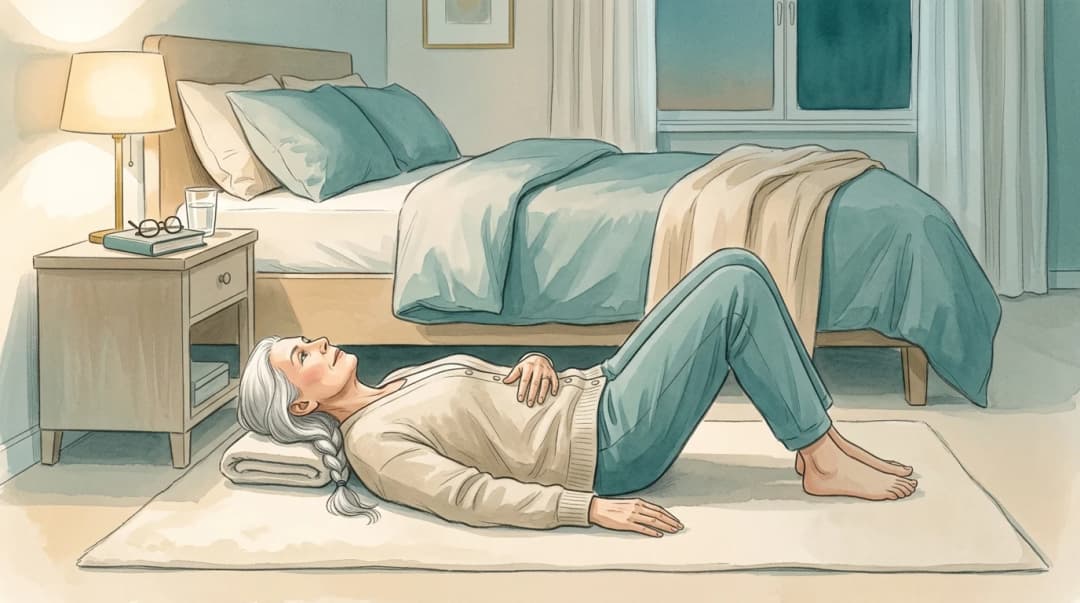
This is the Feldenkrais angle. Very small movements, done lying down: a pelvis rocking a few millimetres, knees swaying slowly from side to side, a head that rolls a short way and drifts back. It suits people who find pure stillness unbearable, and anyone whose legs get restless under the covers. Movement gives attention something clear to follow, and slow small movement rarely rouses the body. Where it can backfire: if the movements grow big or brisk, you wake yourself up. Our somatic exercises for sleep lesson is the place to start.
Simple attention practices for a busy mind
These give a churning mind somewhere plain to go: naming three sounds in the room, counting slowly and losing count on purpose, or letting each thought arrive and pass without arguing. They suit people whose bodies are tired while the head keeps talking. Where it can backfire: anything that becomes a performance. If you are grading how well you empty your mind, you have made more work. Our guide on how to relax your mind to sleep goes further.
Choosing among sleeping relaxation techniques without turning it into a test
The same practice does not suit everyone, and it may not suit you every night. Someone who loves a body scan may find breath counting airless. Someone who needs to move may get nothing from lying perfectly still. That variety is normal, and it is not a sign that you are doing anything badly.
Two things help. First, choose by comfort rather than reputation. If a practice feels pleasant within the first minute, it is a candidate. If it feels like homework, let it go and try another. Second, do not run a technique as a test of whether it works. Lying there checking on your own sleepiness is just another task, and it keeps you awake as reliably as worry does. Do the practice because the ten minutes are pleasant, and let sleep be a side effect it may or may not bring tonight.
Gentle self care of this kind sits alongside clinical care, never in place of it, so keep your doctor, your sleep service or your CBT I course exactly where they are. Yoga nidra, meditation and breathwork are different in mechanism, each with its own way of working. At Feldy we build the movement version into short bedtime lessons, with a free 7 day trial if you would like to feel what that is like, no credit card needed.
A calmer body, easier nights
Understanding it is calming, moving with it more so. The Feldy program is meditation in movement, slow Feldenkrais® lessons that help a busy body settle so sleep can arrive on its own. Gentle, guided, and self-paced.
Start my free 7-day trialNo credit card needed.
Common Questions about sleeping relaxation techniques (FAQ)
What is the best relaxation technique for sleep?
There is no single best relaxation technique for sleep, and no study has crowned one. Slow breathing, progressive muscle relaxation, body scans and gentle movement each help some people and do very little for others. The more useful question is which one you find comfortable enough to repeat most nights. Comfort is what keeps you going, and repetition is where the value sits.
Are sleeping relaxation techniques safe, and should anyone avoid them?
For most people they carry little risk, since you are lying still and moving very little. A few cautions apply. Deliberate tensing can hurt with arthritis, joint pain or a tendency to cramp, so keep the effort tiny or skip it. Breath focused practice can feel unsettling if you have a breathing condition or a history of panic, and turning attention inward can be uncomfortable after trauma. In those cases pick a technique that keeps you looking outward, or ask a clinician what suits you.
How often should I do this, and when might I notice a change?
Most nights, for five to ten minutes, at roughly the same point in your evening. Some people feel calmer on the first night. For many it takes two or three weeks before the body starts reading those minutes as a sign the day has ended. Even then, expect a softer wind down rather than a dramatic change in how long you sleep.
How does this compare with yoga nidra or meditation?
Those practices work through a different mechanism. Yoga nidra usually follows a set script, and many meditation styles ask you to hold attention in one place. Both can be lovely. The bedtime practices here ask for less: attention that is allowed to be lazy and to drift, with nothing to hold and nothing to achieve. Neither approach ranks above the other. They suit different people, and different nights.
What should I avoid at bedtime if I want to relax?
Avoid checking the clock and doing the sums on how much sleep is left. Avoid scrolling in bed, since a screen keeps the mind in company. Avoid running a technique as an exam you could fail. And avoid deciding, after one poor night, that nothing helps. Sleep is uneven by nature, and a single rough night is not a verdict.
When should I see a professional about sleep?
Please see a doctor or a sleep service once poor sleep has run on for more than a few weeks. Loud snoring with pauses in the breath deserves a look too, as does sleepiness by day that reaches your driving, or a stretch where low mood or worry fills the hours. For long running insomnia, cognitive behavioural therapy for insomnia, often shortened to CBT I, has the strongest evidence behind it. Gentle bedtime practice sits alongside that care rather than standing in for it.
A calmer body, easier nights
See the programRelated resources
Bedtime Relaxation Routine: A Gentle Wind Down in Bed
A short routine you do lying in bed: feel your weight, move a little, notice your breath, and let a slow body scan end the day.
How to Relax Your Mind to Sleep: Start With the Body
A racing mind at night almost always comes with a tense body. Settling the jaw, the breath, and the weight of the head is often the easier way in.
After 60, some of what movement does for your memory may happen while you sleep
Ready to start moving better?
Gentle, guided lessons for your body. Try your first one free, no credit card required.