
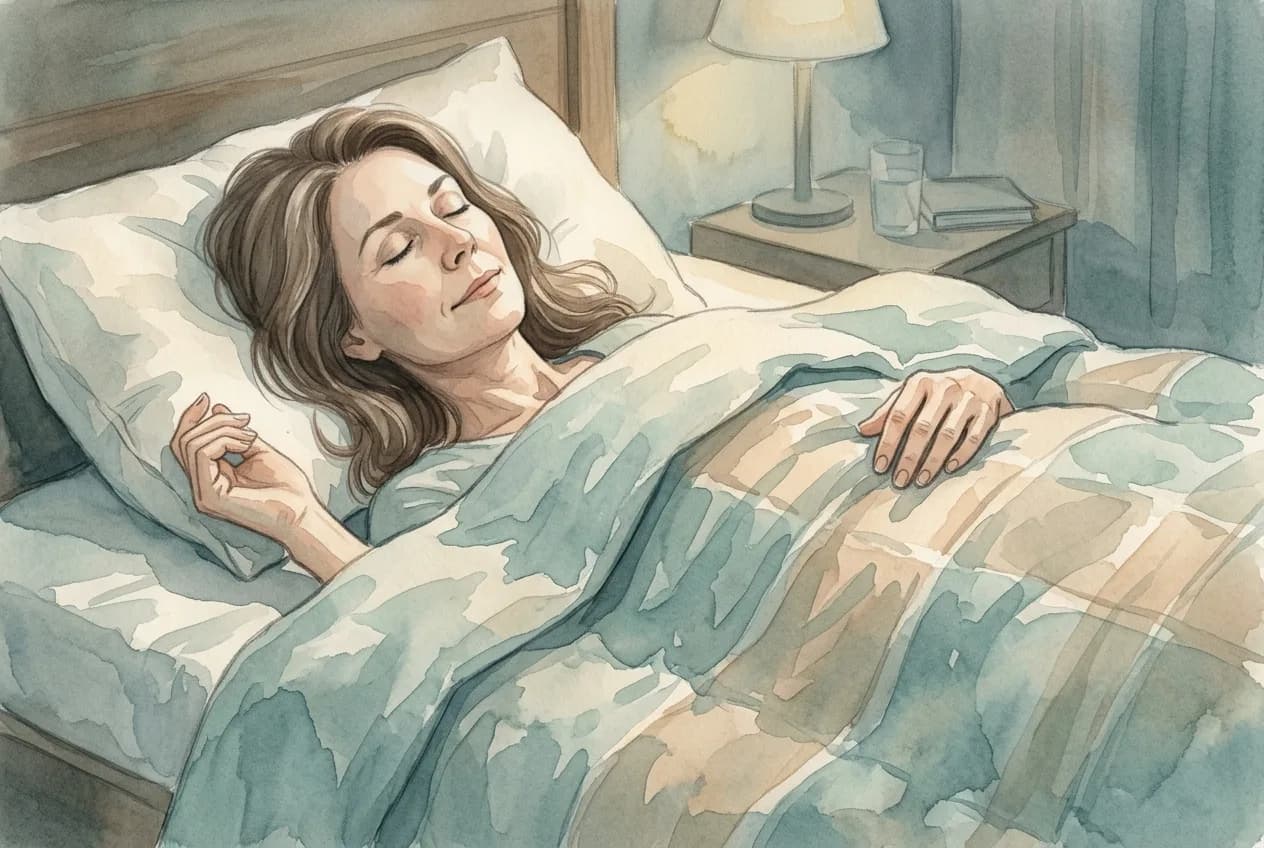
Progressive Muscle Relaxation for Sleep: Tense, Then Let Go
A guided progressive muscle relaxation lesson for bed: mildly tense each muscle group, let go fully, and notice the contrast that helps a braced body settle.
Before you begin. This is a self settling practice, not a treatment for insomnia, anxiety, or any other condition. Sleeplessness that persists for weeks, or that leaves you struggling during the day, deserves a clinician's attention. If you have a history of trauma, deliberately tensing the body can feel activating; you are welcome to skip the tensing entirely and simply move your attention from area to area instead. If you are prone to muscle cramps, have high blood pressure, or are recovering from a recent injury, keep the effort very light or leave those areas alone.
The lesson
About 10-15 minutes. Move slowly, do less than you can, and stay well below any pain. Rest whenever you need to.
Prefer to listen than read?
Feldy voices gentle lessons like this for stress and sleep, so you can close your eyes and follow along.
- 1
Arriving on your back. Please lie on your back in bed and let the mattress carry your full weight. Which parts of you press down clearly, and which barely touch?
- 2
The hands, at quarter strength. Gently curl both hands into loose fists, using maybe a quarter of your strength, and stay there for a slow count of five. Then let go all at once and notice what your hands feel like now.
- 3
The shoulders, briefly. Draw your shoulders a small amount toward your ears, stay for a few quiet seconds, then let them drop and rest. Where do they lie now compared to before?
- 4
The face, lightly. Softly squeeze your eyes and press your lips together for a moment, then let the whole face grow soft. If tensing feels unpleasant anywhere, make it smaller or simply imagine it.
- 5
The legs and feet. Let your heels sink into the bed with a light press, or point your toes gently, for a few seconds. Then stop entirely and feel your legs from the inside.
- 6
A rest with the breath. Do nothing for a few breaths and let each exhale take its time. Where in your body do you feel the breath moving now?
- 7
One last travel through. Visit each area again without tensing anything, just passing your attention from hands to shoulders to face to legs. What, if anything, feels different from when you lay down?
Let Feldy guide you, eyes closed
You just read these steps. In the Feldy program, a calm voice guides you through each gentle move, so your attention can stay in your body instead of on the screen.
Try Feldy Free for 7 daysNo credit card needed.
Progressive muscle relaxation for sleep is built on one small move: gently tense a group of muscles for a few seconds, let go completely, and feel the difference before travelling on to the next area. The lesson above walks you through a mild version tonight, from your hands to your feet. Edmund Jacobson, an American physician, developed the technique in the 1930s, and it endures because it gives a restless body something concrete to do. I teach it here through a Feldenkrais® lens: as in Awareness Through Movement® lessons, the light effort is not the point; the noticing it makes possible is.
Many bodies arrive at bedtime already braced. Diagnostic interview data put the yearly rate of anxiety disorders among adults in the United States at an estimated 19.1% (NIMH), and muscles that held on through an alert afternoon tend to keep holding after the lights go out. That carrying of the day into the dark is the territory of sleep disruption and physical tension, and exactly where a contrast practice earns its keep.
Why progressive muscle relaxation for sleep works
Relaxing on command is strangely difficult. Most of us have no idea what to actually do, because the tension we carry has become our normal and we can no longer feel it. Jacobson approached the problem from the other side: tense a hand deliberately, then stop, and the letting go starts from a level of effort you can clearly feel. The contrast is like turning a sound up briefly so you can hear how quiet the room becomes when it stops.
Two notes. This account is plausible rather than proven, and the research on relaxation techniques and sleep is encouraging but not overwhelming, with modest effects that vary between studies. Hold the practice lightly, then; it still costs nothing, takes minutes, and carries little risk when the effort stays small.
Keep the tensing mild
Many versions of this technique ask for a strong squeeze. I suggest the opposite: perhaps a quarter of your strength, sometimes less. Mild effort is safer at night, when a hard clench can invite a cramp, and it is also more informative. When background effort is low, small changes stand out, which is why in Feldenkrais work we make movements lighter when we want to feel more, not stronger. One boundary is worth keeping: please do not tense around an area that hurts or is healing. Let your attention visit it kindly, and leave the effort out.
How it differs from a body scan
A body scan moves attention through the body without asking anything of the muscles: you visit the feet, the legs, the belly, and simply observe. Progressive muscle relaxation adds a physical event to respond to. For people who find pure observation slippery, the mild tensing anchors attention and gives you something definite to feel when you stop. If stillness suits you better, our lesson on somatic exercises for sleep stays with slow movement and weight instead, and breathing exercises to fall asleep works through the breath alone.
The tense and let go approach suits people who like a clear procedure, whose minds race when asked to do nothing, or who genuinely cannot tell whether their shoulders are tight.
Making progressive muscle relaxation for sleep a habit
The practice pays best as a nightly ritual rather than a rescue for desperate nights: the same order of muscle groups each evening, lights low, until the sequence itself signals that the day is over. If you wake in the night, a shortened round, hands and shoulders only, can help you settle again. If you would rather be guided by a voice, Feldy's audio lessons take the same gentle approach to evenings; the 7 day free trial lets you try them from your own pillow.
Find where to start
Some people settle fastest through their muscles, others through their breath. If you would like a pointer instead of trial and error, start here.
Wondering which method suits you? Take the Movement Match quiz, four quick questions in about two minutes, to find your movement method.
Common Questions about progressive muscle relaxation for sleep (FAQ)
Is progressive muscle relaxation safe for everyone?
For most people, yes, when the tensing stays mild. If deliberate effort feels distressing, which can happen with a history of trauma, skip it and use attention alone. With cramps, high blood pressure, or a recent injury, keep the effort very light or leave those areas out.
How often should I practise it?
Nightly, if you can; repetition turns the sequence into a familiar signal that the day is done. A few minutes in bed is plenty.
How long until my sleep improves?
Some people feel a difference the first night, simply because letting go from a clear contrast is easier than trying to relax cold. Steadier changes tend to show up across a few weeks of practice; the reading of the research is that effects are real but modest.
How is it different from a body scan or meditation?
A body scan and most meditation styles are purely observational: attention travels while the body stays passive. Progressive muscle relaxation is participatory, using a brief physical effort to make the quiet that follows easier to feel. Some people need that anchor; others find it disruptive.
What is the best way to do progressive muscle relaxation in bed?
Lie on your back, keep every tensing at about a quarter of your strength for roughly five seconds, and let go on an exhale. Travel in a consistent order from hands to feet or feet to hands, and rest for a breath or two between areas.
What should I avoid while practising?
Avoid clenching hard, holding your breath, and tensing any area that is painful, cramping, or healing. Avoid treating it as a performance too; if you notice yourself striving, make everything smaller.
When should I see a professional about my sleep?
If poor sleep persists for several weeks, drags on your mood or your days, or comes with loud snoring, gasping, or long pauses in breathing, please talk to a doctor. A settling practice can accompany good clinical care, but it is not a substitute for it.
A calmer body, easier nights
See the programRelated resources
How to Fall Asleep Fast: Gentle Body-Based Ways to Settle
How to fall asleep fast by letting the body let go rather than forcing sleep: a longer exhale, releasing tension from feet to face, and feeling heavy and held.
Bedtime Stretches in Bed: A Short Wind-Down
A few slow bedtime stretches in bed to help a busy body settle for sleep. Small, gentle, and beginner-friendly, so you can do the whole set lying down.
The deep sleep number your tracker reports was not the one that matched how people felt
Ready to start moving better?
Gentle, guided lessons for your body. Try your first one free, no credit card required.