

Before Bedtime Stretches: A Gentle Floor Wind Down
A short floor wind down of slow, gentle movement for the half hour before bed. Nothing to achieve, nothing to hold, just a quieter body to carry to sleep.
Before you begin. Gentle evening movement is kind company for sleep, not care for a sleep disorder or for persistent low mood or anxiety. Long standing insomnia, loud snoring with pauses in breathing, or daytime sleepiness that does not lift is worth raising with a clinician.
The lesson
About 5 to 10 minutes. Move slowly, do less than you can, and stay well below any pain. Rest whenever you need to.
Prefer to listen than read?
Feldy voices gentle lessons like this for stress and sleep, so you can close your eyes and follow along.
- 1
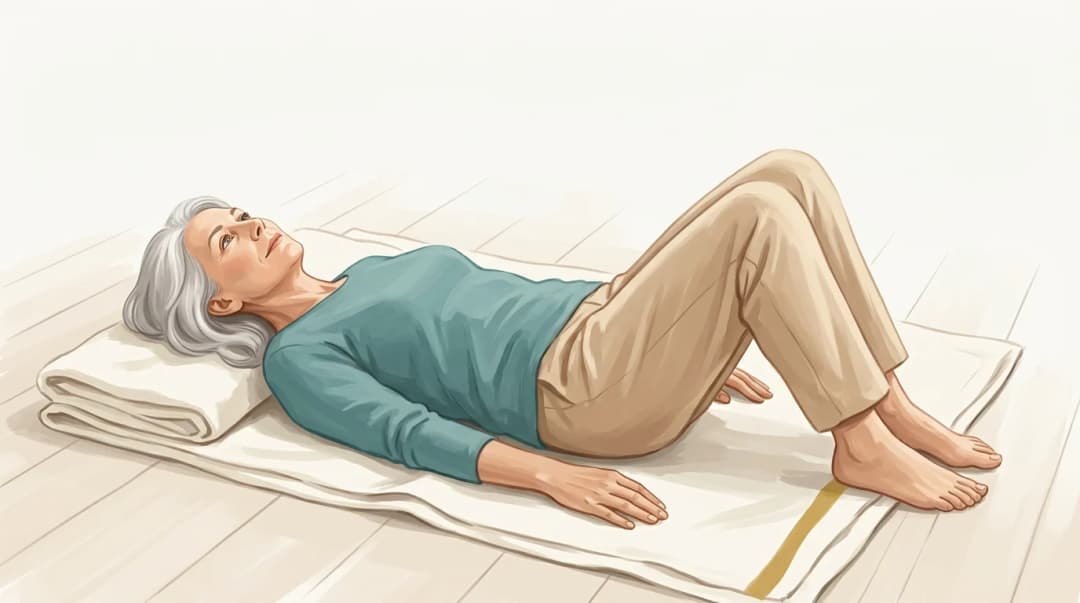
Arriving on the floor. Sometime in the half hour before bed, lie on your back on the floor or a rug, still dressed, lights low, knees bent if that is more comfortable. Let the floor hold you for a moment before anything else happens.
- 2
Noticing where the day still sits. Let your attention travel from your heels up to the back of your head, noticing which parts press into the floor and which barely touch it. Where does your body still feel busy?
- 3
Small rocking of the pelvis. Slowly roll your pelvis a tiny way toward your feet and back again, as if the base of your spine were quietly nodding. Keep it small and unhurried, then pause and let everything be still.
- 4
Knees swaying side to side. With your knees bent and feet standing, let both knees lean a little toward one side and return, then the other, far short of any effort. When you have had enough, rest with your feet standing or your legs long.
- 5
A soft turn of the head. Allow your head to roll gently a small way to one side and back, then the other, as slowly as you can bear. Can the floor carry its weight while it turns?
- 6
A longer, softer exhale. Let a few breaths leave you slowly, each exhale a little longer than usual, with no pushing at all. Then let the breath find its own rhythm again.
- 7
Resting, then to bed. Lie quietly for a few more breaths, noticing how you meet the floor now compared with when you arrived, and when you are ready, rise slowly and carry this quiet with you to bed. What, if anything, feels different from when you first lay down?
Let Feldy guide you, eyes closed
You just read these steps. In the Feldy program, a calm voice guides you through each gentle move, so your attention can stay in your body instead of on the screen.
Try Feldy Free for 7 daysNo credit card needed.
The best before bedtime stretches are not really stretches at all, at least not in the pulling, lengthening sense of the word. They are a short spell of slow, small, undemanding movement in the half hour before you get into bed, done on the floor or a rug, still dressed, lights low. The short lesson above is exactly that. It grows out of the Feldenkrais Method®, and its aim is not to make muscles longer before sleep. Its aim is to help you stop rehearsing the day. Attention needs somewhere quiet to go at night, and a body that has just been asked to do very little settles far more easily than one that has just been worked hard.
Why before bedtime stretches should be slow and small
An evening body usually carries the day in it. The shoulders remember the desk, the jaw remembers the conversation, and the mind keeps replaying both. This is ordinary: the American Psychological Association's Stress in America survey has found, year after year, that stress shows up physically for most US adults, as muscle tension, fatigue, or trouble sleeping (APA, Stress in America). A body holding that kind of residue does not respond well to being stretched hard at 10pm. Effort and intensity are daytime signals, and they tend to leave you more awake, not less.
Slow, small movement sends the opposite message. When you rock your pelvis a tiny amount, or let your knees sway an easy few centimeters, there is nothing to brace against and nothing to achieve, so the low hum of readiness the body has kept up all day begins to fade. Just as usefully, the movement gives your attention a gentle occupation. Instead of circling back through tomorrow's list, it rests on the feeling of your back against the floor, and thoughts that have nowhere to land tend to thin out on their own. Our Feldypedia article on sleep disruption and physical tension goes deeper into how a held body and a busy mind keep each other awake.
Making your before bedtime stretches a real wind down
The setting matters almost as much as the movement. Do the lesson in the half hour before bed, with the lights already low and the screens already finished, so nothing between the floor and the pillow winds you back up. Stay in whatever you are wearing; changing, brushing teeth, and other small chores are better done first, so that after the lesson there is nothing left but getting into bed. The floor or a rug is ideal because a firm surface lets you feel your weight clearly, which is half the practice.
Keep the quality of the movement real. If you notice you are aiming at a sensation of stretch, you have drifted into daytime mode; make everything smaller until it feels closer to resting than exercising. If getting down to the floor and up again is hard for you at the moment, the same idea works lying down under the covers, and our routine of bedtime stretches in bed is built exactly for that. And if you would like a slightly different flavour of quiet evening practice, the somatic exercises for sleep lesson explores the same territory with more emphasis on sensing than on moving.
When sleep needs more than a wind down
A gentle evening routine is a lovely habit, and it also has limits worth naming. Insomnia that has gone on for months, loud snoring with pauses in breathing, or daytime sleepiness that does not lift however you slept are all reasons to talk with a clinician, because each can point to something that deserves proper assessment. The same is true of low mood or anxiety that keeps you company night after night; that is worth care in its own right, not just a calmer bedtime. None of this means the floor lesson is off the table. Quiet movement sits comfortably alongside whatever care you receive, it simply should not stand in for it.
For nights that are merely busy rather than troubled, though, this kind of wind down earns its place quickly. If you find you settle more easily with a voice to follow, Feldy offers a free trial of guided audio lessons in the same unhurried style, and the stress and sleep program strings these short practices into an evening rhythm you can keep.
Find where to start
The lesson on this page is one good evening; a matched starting point makes the habit easier to keep. If you are not sure whether to begin with this wind down or something else, let a few quick questions point the way.
Wondering which method suits you? Take the Movement Match quiz, four quick questions in about two minutes, to find your movement method.
Wherever you begin, an evening that ends on the floor tends to end quietly.
Common Questions about before bedtime stretches (FAQ)
What are the best stretches to do before bed?
The most helpful ones are barely stretches at all: slow, small, undemanding movements like the floor lesson above, gentle pelvic rocks, easy knee sways, a soft head turn, a longer exhale. The measure of a good evening movement is not how much length you gain but how much quieter you feel afterward. If a movement leaves you calmer and a little heavier, it was the right one.
What should I avoid doing before bed?
Vigorous or deep stretching that leaves you feeling alert, anything that demands real effort or concentration, and pushing into any stretch that stings. Intensity of any kind tends to wake the body rather than settle it. If you catch yourself striving, make the movement smaller or simply stop and rest.
Is this routine safe for everyone?
The movements themselves are small, slow, and well within comfort, so most people can do them without concern. The main practical question is getting down to the floor and up again; if that is difficult or unwise for you right now, do the same kind of wind down lying in bed instead. If you are recovering from surgery or an injury, follow your clinician's guidance about floor work.
How often should I do stretches before bedtime?
Most nights, if you can. The value comes less from any single evening and more from your body learning that this quiet spell reliably precedes sleep. Five to ten minutes is plenty, and a shorter version on tired nights still counts.
How long until my sleep feels different?
Many people notice they get into bed feeling calmer from the first evening, since that is what the routine is for. Changes in how easily you fall asleep tend to build over a few weeks of regular practice, as the wind down becomes a familiar signal. Treat it as a nightly kindness rather than a technique you are waiting on.
How is this different from yoga stretches before bed?
Yoga works partly through held poses and sustained lengthening, which is a different mechanism, and many people enjoy it in the evening. This routine never holds a position or seeks length at all. It uses slow, repeated, easy movement and attention, so the nervous system has nothing to work at, which is a route some bodies find easier to fall asleep from.
When should I talk to a professional about my sleep?
If your insomnia has gone on for months, if your snoring is loud and seems to pause your breathing, or if you stay sleepy through the day whatever the night was like, bring it to a clinician. The same goes for persistent low mood or anxiety that colors your nights. A gentle wind down can sit comfortably alongside that care, but it is not a substitute for it.
A calmer body, easier nights
See the programRelated resources
How to Relax Your Mind to Sleep: Start With the Body
A racing mind at night almost always comes with a tense body. Settling the jaw, the breath, and the weight of the head is often the easier way in.
Progressive Muscle Relaxation for Sleep: Tense, Then Let Go
A guided progressive muscle relaxation lesson for bed: mildly tense each muscle group, let go fully, and notice the contrast that helps a braced body settle.
Lying down is not the same as resting, and researchers have now measured the difference
Ready to start moving better?
Gentle, guided lessons for your body. Try your first one free, no credit card required.