
Hypermobile and Always Bracing? Feeling Steady With Less Effort
Why hypermobile joints can feel tight, why stretching the tightness often doesn't help, and a gentle way to notice your bracing between physio sessions.
 Chava SoraniGuild Certified Feldenkrais Practitioner (GCFP)
Between Sessions, No. 4: the Feldenkrais Method® alongside physiotherapy.
Shoulders up. Belly held. Knees pushed back. Jaw a little tight. If you have hypermobile joints, you may know this feeling well: holding yourself together all day because it helps you feel safe.
Many people with hypermobility, including hypermobile Ehlers-Danlos syndrome (hEDS) and hypermobility spectrum disorder, describe something similar. A joint feels as if it could slip, so the muscles around it hold on. Your neck may feel locked after a small turn. Your back may feel tight, even though it bends further than most backs. And the tight feeling makes you want to stretch.
This post is about that bracing: why it may happen, why stretching it often isn't the answer, and how a gentle kind of attention can work alongside the care you get from your physiotherapist.
Why a loose joint can feel tight
Hypermobile joints move further than most. That part is easy to see. What is harder to see is how well you can feel where your joints are.
A review of five studies, with 254 people in total, found that people with joint hypermobility syndrome had a weaker sense of where their legs were than people without it (Smith and colleagues, 2013). For the arms, the results were less clear.
If you can't quite feel where a joint is, holding it still may be one way to feel safer. That may be part of why so many hypermobile people brace, although the studies didn't measure bracing itself. Bracing is not a mistake. It is one way your body may be trying to protect you. But held all day, it can be tiring, and it can leave your muscles feeling tight and sore.
Why stretching may not be the answer
When something feels tight, stretching can seem like the obvious thing to do. But in many hypermobile bodies, the muscle is not short. It is working hard. Pulling a loose joint further toward the end of its range may feel good for a moment, but it may also leave you feeling less steady afterwards.
This is why many physiotherapists who work with hypermobility focus on control and strength in the middle of your range, rather than on gaining more flexibility. Your physiotherapist knows your body and your plan, so ask them what fits you.
Our Movement Pulse piece on hypermobility as a sensing problem more than a strength one looks at more of the research.
Where Feldenkrais fits
I am not a physiotherapist. I am a Feldenkrais teacher, and many of the people in my classes, and many Feldy users, also see a physiotherapist.
A Feldenkrais lesson doesn't stretch and doesn't push. In an Awareness Through Movement® lesson, you move slowly and in small ranges, usually lying down, so the floor supports you and your muscles don't have to do as much. With that support, it can become easier to notice what you are doing. Where am I holding? Could this movement take a little less effort? Where does the movement actually happen?
For someone who braces, that "less" is the interesting part. Feeling steady with less effort is something you can explore, and it starts with noticing the effort you already use. A lesson doesn't replace your strengthening work. It can sit beside it, on the days between sessions.
You can read more in our guide to Feldenkrais for hypermobility and in Feldypedia on hypermobility and joint instability.
A small thing to try today
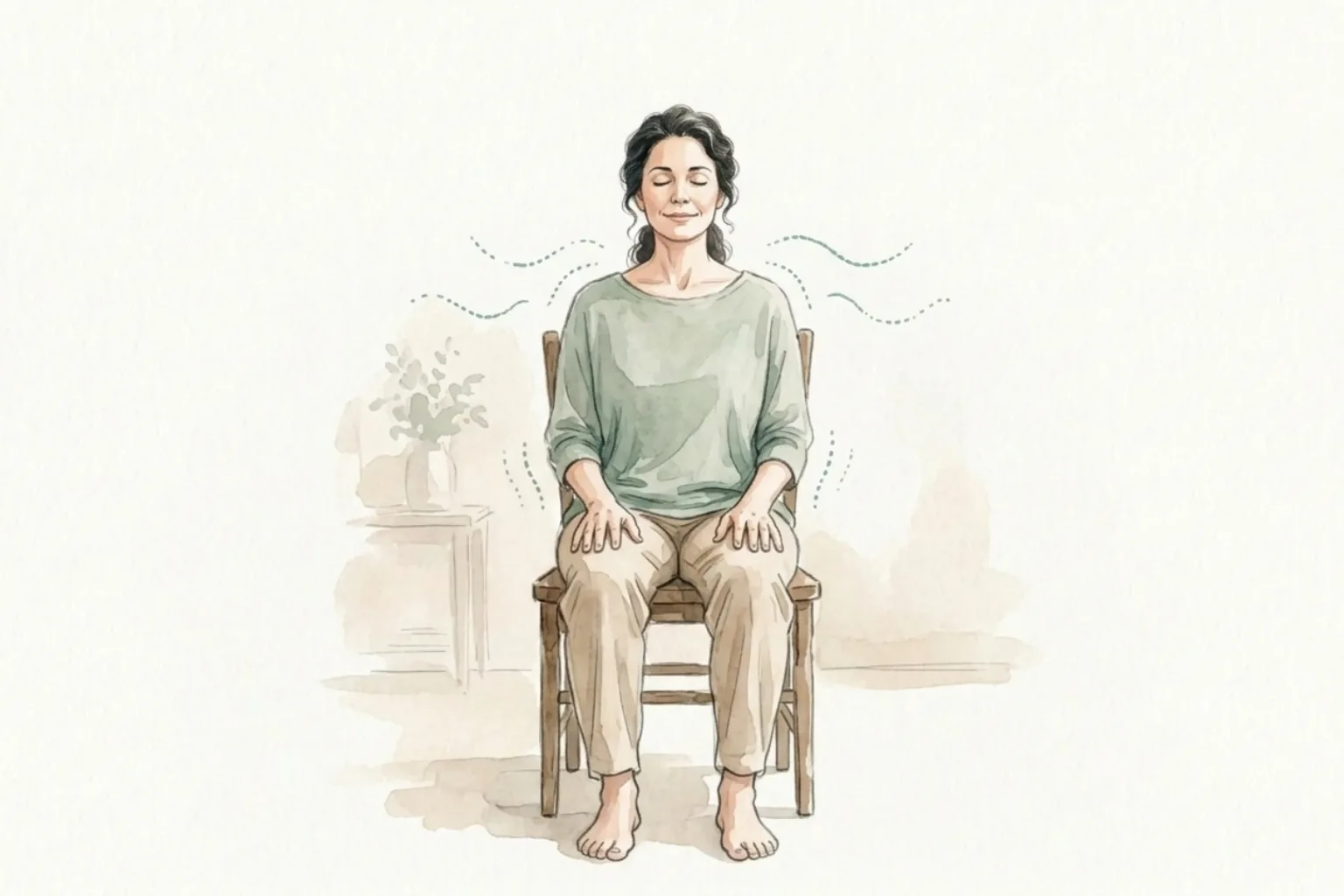
- Sit on a firm chair, close to its front edge, both feet on the floor. Keep every movement small, or only imagine it.
- Notice your weight on the chair. Is there more on one side? Where do your shoulders rest?
- Lift both shoulders a little toward your ears, then lower them slowly. Notice where the movement ends.
- Lift them again, and lower them even more slowly, in small steps. Where does the effort stop? Rest.
- Lift only your right shoulder a little, then lower it. Then the left. Is one side easier? Rest.
- Notice your weight on the chair again. How do your shoulders rest now? What has changed?
Who this is not for, and what to ask
A gentle lesson is not the place to start if a joint has recently dislocated or partly slipped and hasn't been checked, or if you have new numbness, weakness or pins and needles. If you often feel faint or dizzy when you stand up, tell your doctor. And if you have precautions after surgery, check with your surgeon or physiotherapist first.
Some questions for your next session:
- Which ranges should I avoid, or move into slowly?
- Is my bracing something we can work on together?
- Would a short, gentle lesson on the days in between fit my plan?
Most physiotherapists welcome these questions. They can help your plan fit your life between visits.
Gentle Lessons for Hypermobile Bodies
Try Feldy free for 7 days. Small, slow movements, mostly lying down, in a range that feels safe to you, alongside the program your physiotherapist set. No credit card needed.
See if Feldy fits you← Previous: Same Exercises, Plus Awareness: What Two Trials Added to Core Stabilization
Start your free 7-day trial
Start free trialMore Articles

Same Exercises, Plus Awareness: What Two Trials Added to Core Stabilization
Two small trials kept a stabilization program exactly as it was and added a Feldenkrais part. What changed, what did not, and what we still do not know.
Oct 19, 2026
Sore After Physical Therapy? What to Do the Next Day
Soreness after physical therapy is often a normal part of the work. What to watch for, and how gentle movement can sit alongside your program.
Oct 4, 2026
Four studies on thinking after 60 point to attention, not effort
Slow practice, balance work and unusual walks each gave thinking a lift in recent research. What they share is where the attention goes.
Oct 23, 2026Ready to Start Moving Better?
Try your first lesson for free. No credit card required.