
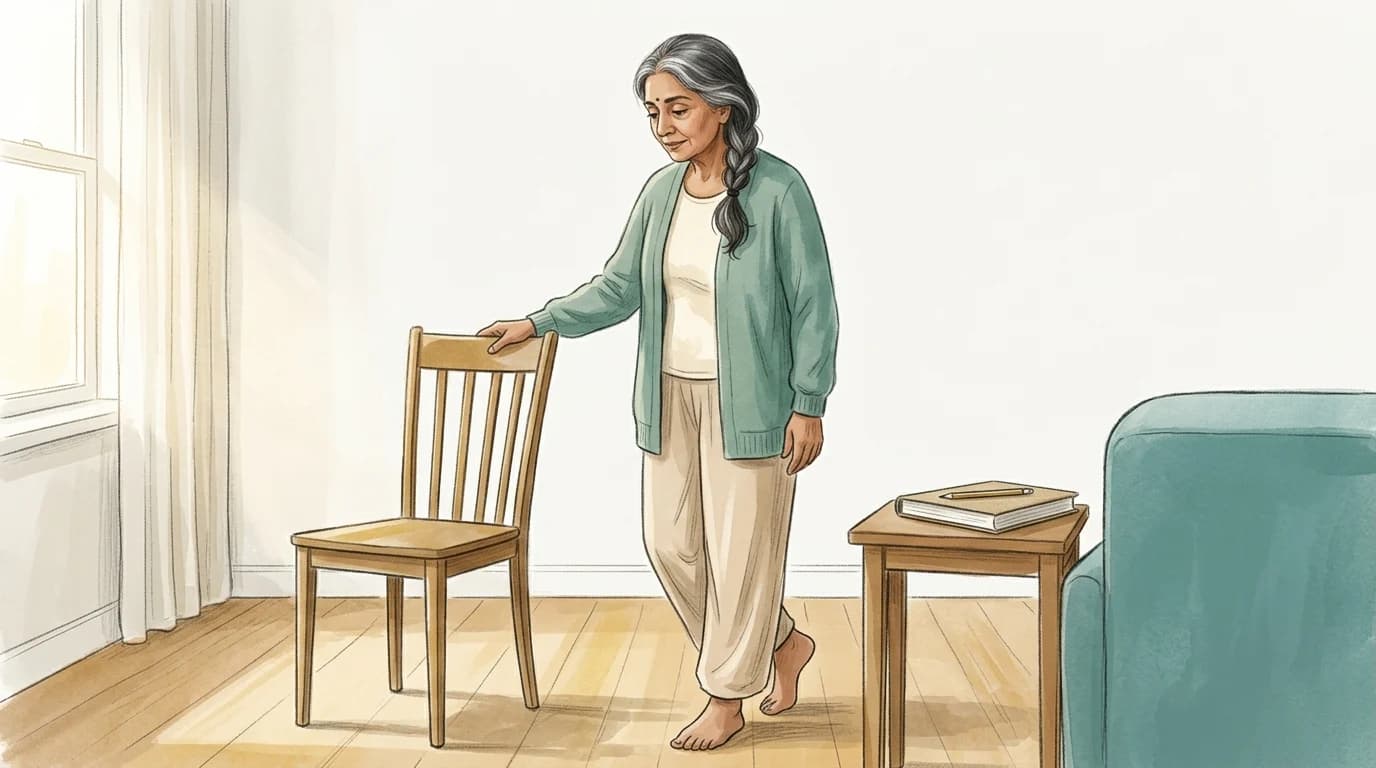
After 60, practising balance gave thinking a small lift, most clearly in mental speed
A review of 54 studies found that training to stay steady also nudged how quickly older adults think. A reason to give your balance practice your full attention.
Fifty four studies. 4,750 adults aged sixty and over. And one question that most research on the ageing brain has walked straight past: does practising your balance do anything for the way you think?
A review published in Archives of Gerontology and Geriatrics on 8 October says yes, a little. The lift was small, it showed most clearly in how quickly people take in information and respond, and it came from a kind of training that most brain health advice leaves out.
What the review gathered
Most of what we know about exercise and thinking in later life comes from aerobic work, the brisk walking and cycling kind, and from resistance training with weights or bands. A team led from the Division of Cognitive and Sensorimotor Aging at Stony Brook University in New York wanted to know about a third kind: the practice of staying upright while standing, shifting, turning and stepping (Archives of Gerontology and Geriatrics, 2026).
They searched four large medical databases, up to October 2025, for controlled trials of balance training in people aged sixty or over. Some trials enrolled people with no memory problems; others enrolled people already living with cognitive impairment. Every trial had to test some part of thinking before and after the training. The search turned up 54 articles covering 4,750 older adults, but only 17 of those studies reported their results in a form that could be pooled, and between them those 17 supplied 61 separate measurements of thinking.
What it actually showed
A quick headline would say balance training boosts brain power after sixty. The review is more careful than that, and the careful version is more useful.
Across the pooled studies, balance training improved thinking by a small amount. Small is the authors' own word, and it's the honest one: clear enough to stand apart from chance, modest enough that nobody should expect a balance class to change how sharp they feel by next month.
Processing speed gave the clearest result. There the effect was roughly one and a half times the size of the pooled one.
That doesn't mean balance training only touches speed. The trials also tested memory, attention and other skills, but those results didn't separate from one another clearly enough to rank them. So processing speed is best read as the place where the evidence was most convincing, not as the only part of thinking that moved.
The results weren't uniform either. The authors report that who took part, how the training was built and how much of it people did all changed the size of the benefit. The published summary names those three factors without spelling out which way each one cut, so it would be a stretch to read a prescription into it, whether that's more sessions, longer programmes or one particular group of people. The review also counted trials that weren't randomised alongside ones that were, and fewer than a third of the studies it found could be pooled at all.
Still. For a kind of exercise usually filed under fall prevention, a small and consistent effect on thinking is worth noticing.
A learning problem
Balance is mostly not a matter of strength. It's a constant, quiet exchange between the soles of the feet, the inner ear, the eyes and the brain, which keeps asking where the weight is now and what to do about it. In the Feldenkrais Method® we treat that exchange as something the nervous system learns and keeps relearning, rather than a muscle to build. When you practise shifting your weight, you learn to notice the movement before it becomes a wobble, and to answer it while it's still small. That is taking in information and responding quickly, practised on the floor instead of on a screen.
What to take from it
If you already practise balance for your hips, your walking or your confidence on the stairs, this review suggests your thinking may be getting a small share of the benefit too. And if the advice you've been given for keeping your mind sharp is crosswords and brisk walks, balance work is a different kind of practice that can sit alongside them.
What I see again and again in my classes is that the people who steady themselves most easily are rarely the strongest in the room; they're the ones who feel the weight arrive in their feet a moment earlier, before the body has to rescue itself with a grab or a stiffened knee. That moment of sensing is something you can practise at home, and you only go where it feels easy, pleasant, and comfortable. Stand at the kitchen counter with one hand resting on it. Let your weight drift slowly towards your toes and back towards your heels, and notice the exact moment your feet begin to work. You aren't trying to reach further or stand on one leg; you're only paying attention to what happens as your weight moves. That small listening is the same skill that tends to fade as coordination changes with age, and it's one of the quieter reasons movement can shrink in later life without anyone deciding it should. If a physiotherapist has given you a balance programme, this sits alongside it, not in place of it.
Across those 54 studies, thousands of people spent their sessions feeling their weight sway forward and back. Their minds, it seems, were listening too.
Let Feldy guide you, eyes closed
A calm voice walks you through gentle moves so your attention stays in your body, not on the screen.
Try Feldy Free for 7 daysNo credit card needed.
Sources
- The effect of balance training on cognitive function in older adults with and without cognitive impairment: A systematic review and meta-analysis— Archives of Gerontology and Geriatrics, 2026
- PubMed record (PMID 42868918)— PubMed
Movement Pulse is informational, not medical advice. See our editorial policy.
Move better with Feldy
See the programMovement Pulse Weekly
The week's best research, in your inbox Tuesday.
Movement science, gentle-practice ideas, and a practitioner's read on what's new. Free.
More from Movement Pulse
The kind of exercise that helped attention most was the slowest one in the set
One hundred and ten trials, 8,130 people over sixty. No exercise type won across the board. The winner changed with the mental skill being measured.
Sep 10, 2026
Brisk walking eased frailty more than strolling, and the stroll still helped nearly half
A Chicago trial in 14 retirement communities found a brisker pace moved more older adults out of frailty. Read the fine print and the casual walkers did better than the headline suggests.
Oct 5, 2026
What held up in two new reviews of yoga and qigong was not balance or strength
Twenty one yoga trials and twenty two qigong trials, published ten days apart. The physical scores wobbled once the missing studies were accounted for. Quality of life did not.
Sep 7, 2026Ready to start moving better?
Gentle, guided lessons for your body. Try your first one free, no credit card required.