
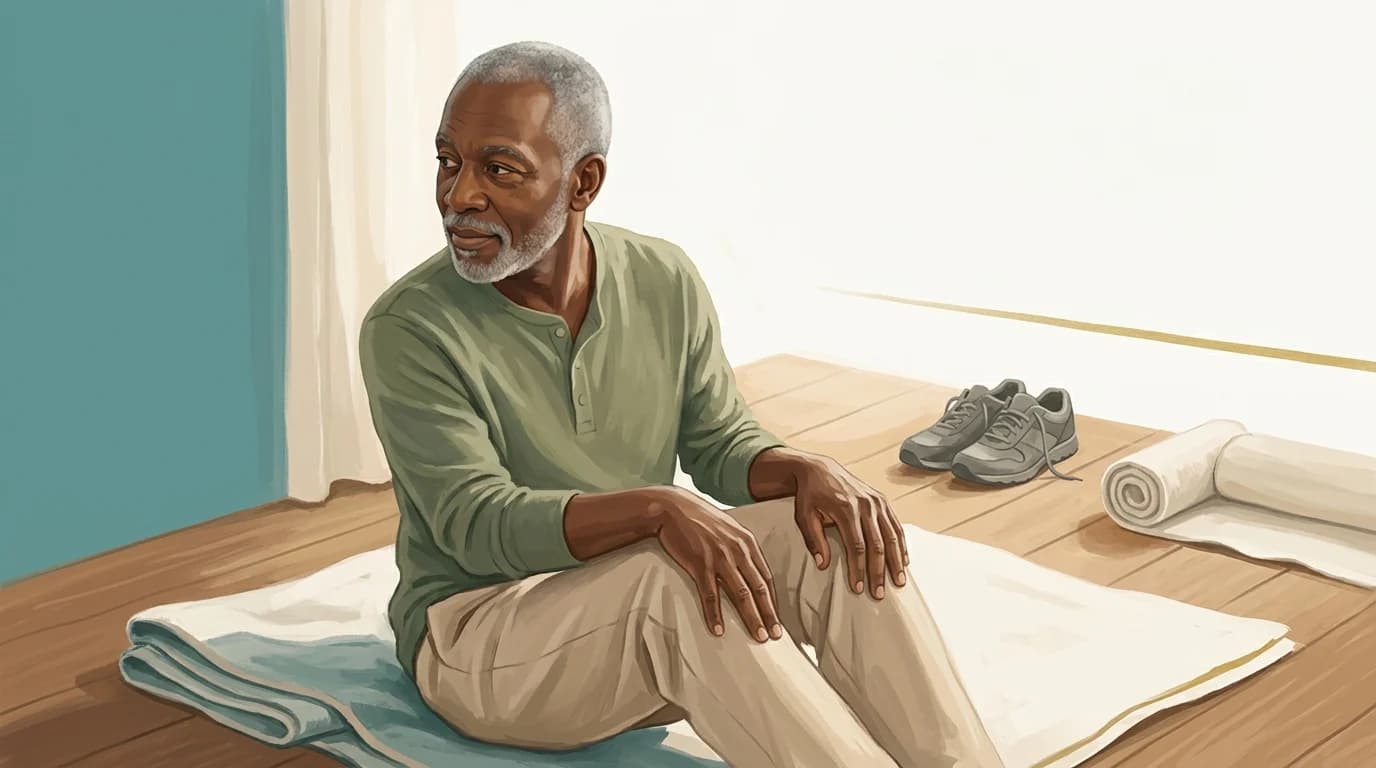
The kind of exercise that helped attention most was the slowest one in the set
One hundred and ten trials, 8,130 people over sixty. No exercise type won across the board. The winner changed with the mental skill being measured.
If you had to guess which kind of exercise does the most for an aging brain, you'd probably say the hard one. Something with a heart rate. A review published last week says the answer changes depending on which part of thinking you mean, and the category that came out on top three times over was the slowest one in the set.
The paper appeared in Maturitas on 3 September and pooled 110 randomized trials covering 8,130 adults aged sixty and over, every one of them cognitively healthy at the start (Maturitas, 2026). Instead of asking whether exercise helps thinking, which has been asked and answered often enough, the authors sorted the trials by exercise type and by which mental skill each trial actually tested, then compared the types inside each skill separately.
Six domains. Three different winners.
Mind body exercise, the bin that holds tai chi, yoga, qigong and Baduanjin, ranked highest for executive function, for processing speed, and for attention. Aerobic exercise ranked highest for global cognition and for language. High intensity interval training ranked highest for memory. The largest single estimate anywhere in the analysis belonged to aerobic work on global cognition. The attention result, the biggest of the three that mind body work led, also carried the widest uncertainty of any of them, which usually means fewer trials went looking for it.
Two things are worth holding steady before any of that turns into advice. Everyone in these trials was sixty or older and cognitively healthy at entry, so none of it speaks to what happens after a diagnosis. And in a network analysis of this kind, most of the head to head comparisons are not head to head at all. They get assembled indirectly, by routing each exercise type back through its own control group and letting the arithmetic meet somewhere in the middle.
The ranking is between categories, not between practices
This is the part that falls out when a finding like this reaches a headline. "Mind body exercise" isn't a practice. It's a bin, and the things inside it run on visibly different machinery.
Tai chi is almost entirely weight transfer, a slow continuous negotiation with the floor. Most yoga arrives at a shape and asks you to breathe inside it. Qigong is repetitive and largely vertical. Pilates, where it appears in this literature at all, tends to be graded loading with a coordination demand laid over the top. What they share is not the movement. It is that each one asks you to keep attention on your own body while the body is doing something, which is a different request from counting repetitions or watching a screen on a treadmill.
Whether the Awareness Through Movement® lessons I teach as a Feldenkrais Method® practitioner belong inside that bin or beside it, this paper does not say. It sorts by label. Nobody has sorted by mechanism yet, and until somebody does, a table ranking one gentle method above another is a table that cannot honestly be built.
What the six domains do not include
A retired accountant, seventy four, came to one of my lessons in August still doing his crossword every morning because a doctor had told him to. Three weeks in he mentioned, more or less as an aside, that reversing out of his own driveway had stopped being a two attempt job. He could turn and look now without his whole trunk following his head.
Executive function did not measure that. Neither did processing speed. Turning to look behind you is a coordination problem that reads as a cognitive one from the outside, and it is exactly the kind of thing that quietly leaves a life as movement gets narrower with age, long before anything shows up on a test.
So what might someone over sixty take from a paper like this? Not a switch. The most defensible reading is that the aerobic lane and the slow attentional lane are not competing for the same hour. They came out best at different things, in different trials, on different mechanisms, and a week has room for both of them. If your doctor or your physiotherapist has already set you walking or strength work, that keeps running exactly as it is. The slow attentional end sits alongside it rather than in place of it, and it is what the daily lessons in the Feldy online movement program are built from.
The accountant kept the crossword, incidentally. He just stopped believing it was the only thing he could do about his head.
Let Feldy guide you, eyes closed
A calm voice walks you through gentle moves so your attention stays in your body, not on the screen.
Try Feldy Free for 7 daysNo credit card needed.
Sources
Movement Pulse is informational, not medical advice. See our editorial policy.
Move better with Feldy
See the programMovement Pulse Weekly
The week's best research, in your inbox Tuesday.
Movement science, gentle-practice ideas, and a practitioner's read on what's new. Free.
More from Movement Pulse
After 60, practising balance gave thinking a small lift, most clearly in mental speed
A review of 54 studies found that training to stay steady also nudged how quickly older adults think. A reason to give your balance practice your full attention.
Oct 16, 2026
Back pain and the risk of losing daily independence
A large cohort study of nearly 19,000 adults found back or waist pain predicted later trouble with everyday tasks. Here is what to raise with your doctor.
Jul 14, 2026
After 65, brain fog eased as much with slow, varied walking as with mental puzzles added
Walking sideways, backwards and in slow figure eights already asks plenty of attention, so a quieter walk may be enough to start with.
Oct 23, 2026Ready to start moving better?
Gentle, guided lessons for your body. Try your first one free, no credit card required.