
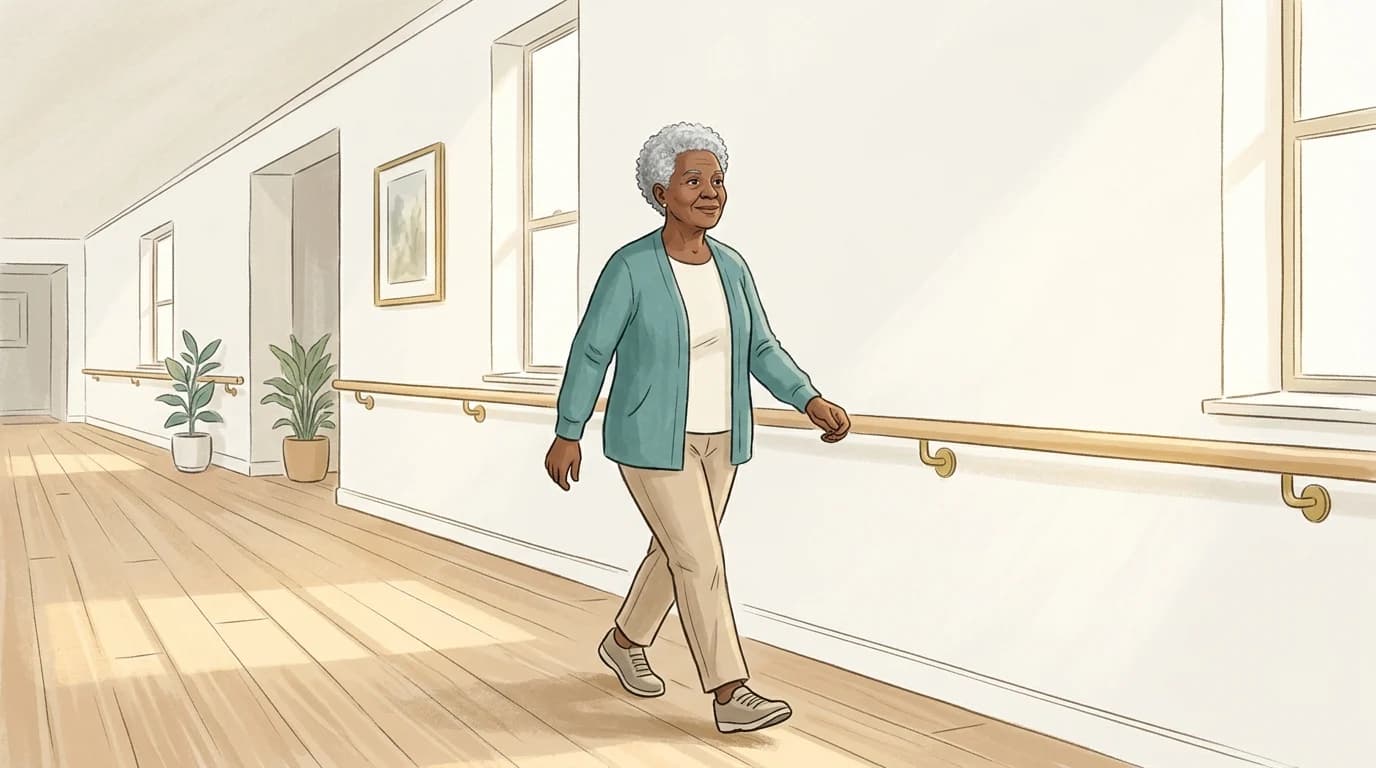
Brisk walking eased frailty more than strolling, and the stroll still helped nearly half
A Chicago trial in 14 retirement communities found a brisker pace moved more older adults out of frailty. Read the fine print and the casual walkers did better than the headline suggests.
Walking is the exercise most people over seventy actually do, so the question of how to walk is not a small one. A trial published on 30 September in PLOS One gives a fairly clear answer for people who are already frail or close to it: a brisker pace did more than a comfortable one. The part that will get less airtime is how much the comfortable pace did too.
What the trial did
Margaret Danilovich and colleagues at Northwestern University randomized 14 retirement communities around Chicago, rather than individual people, to one of two walking programs (PLOS One, 2026). Everyone enrolled was 60 or older and classed as prefrail or frail; the average age was 79, and most were women. Some could walk only ten feet with a little help at the start.
Both groups walked for 45 minutes, three times a week, for 16 weeks, one on one with a research assistant in the hallways of their own buildings. One group aimed for about 70% of their maximum heart rate by picking up the pace. The other walked at whatever speed felt natural, which kept them under 60%. An earlier analysis from the same trial put numbers on what that meant underfoot: a median of about 100 steps a minute in the brisk group against 77 in the casual one (PLOS One, 2025).
By the end, 32 of 46 brisk walkers (about 70%) had moved at least one step down the frailty scale, compared with 26 of 56 casual walkers (about 46%). The difference was unlikely to be chance. The brisk group also gained a little more in everyday walking speed and covered about 49 meters more in a six minute walk test.
What the headline will skip
"Walk faster to reverse frailty" is a fair summary of the main result. It also leaves several things out.
First, nearly half of the casual walkers improved as well. Three supervised walks a week at a comfortable pace, with someone beside you, was not nothing; for a group averaging 79, it was quite a lot. Both groups also cleared the threshold usually counted as a meaningful change on two standard mobility measures.
Second, balance did not separate the groups. On the Berg balance test, the Timed Up and Go, and a questionnaire about fear of falling, the brisk walkers did no better than the casual ones. So the extra pace seems to have built stamina and walking speed, not steadiness or confidence.
Third, "frailty" here was measured with a short tool called the SHARE frailty index, which combines grip strength with four questions about tiredness, appetite, trouble with stairs or a hundred meter walk, and how often a person is active. Moving down a category is real, but it is a step on that scale, not a different body.
Fourth, the people who finished were not everyone who started. Of 165 enrolled, 105 made it into the final analysis; the rest withdrew, were lost to follow up, or died, and the authors note that those who left were slightly older and had worse physical function at the start. The walks were also one on one and supervised, which may explain why attendance stayed so even between groups. Whether people would walk briskly three times a week on their own is a separate question the trial did not test.
On safety, the numbers were reassuring. There was one fall linked to the brisk walking, without injury, and adverse events of any kind came up in well under one percent of sessions.
The habit underneath
A self chosen pace is not neutral. For many older people it has been shaped, over years, by caution: a near fall on a wet step, a hip that complained once too often, a habit of watching the ground. The casual group's 77 steps a minute was likely not their limit so much as the speed that felt safe.
That is where I find the study most interesting from the Feldenkrais Method® side. Picking up the pace asks the whole person to trust the next step a little more, and trust is learned (slowly, through the ankles and hips and ribs as much as the legs). You haven't lost movement; you've often lost trust that movement will hold you.
Where that leaves you
If you or someone you care for is starting to slow down, this trial is a reasonable nudge toward walking a little more briskly when it feels possible, ideally with a physiotherapist or doctor helping set the pace, and with company. It also says the comfortable walk is worth doing in its own right. Gentle movement work sits alongside that kind of program rather than replacing it; in an Awareness Through Movement® lesson you only go where it feels easy, pleasant, and comfortable, and many people notice that a walk afterwards feels less effortful without their having tried to change it. If you want a feel for that gentler side first, these Feldenkrais exercises for seniors stay small and slow, and most of them happen lying down.
Twenty three more steps a minute. What would it take for the next step to feel safe enough to take a little sooner?
Let Feldy guide you, eyes closed
A calm voice walks you through gentle moves so your attention stays in your body, not on the screen.
Try Feldy Free for 7 daysNo credit card needed.
Sources
- A high intensity vs. casual speed walking intervention to reverse frailty among older adults: a cluster randomized controlled trial— PLOS One
- Walking cadence as a measure of activity intensity and impact on functional capacity for prefrail and frail older adults— PLOS One
- High Intensity Walking to Reduce Frailty (trial registration)— ClinicalTrials.gov
Movement Pulse is informational, not medical advice. See our editorial policy.
Move better with Feldy
See the programMovement Pulse Weekly
The week's best research, in your inbox Tuesday.
Movement science, gentle-practice ideas, and a practitioner's read on what's new. Free.
More from Movement Pulse
What held up in two new reviews of yoga and qigong was not balance or strength
Twenty one yoga trials and twenty two qigong trials, published ten days apart. The physical scores wobbled once the missing studies were accounted for. Quality of life did not.
Sep 7, 2026
What happens to your balance when you rehearse the movement in your mind first
A new review gathered nineteen studies of older adults practicing movement only in imagination. The results were mixed, but the mechanism is one Feldenkrais has used for decades.
Jul 28, 2026
What walking speed keeps telling us about aging
Fast walking in the 80s is tied to much lower cognitive risk. It is the latest in years of research showing gait speed reflects the whole body.
Jul 18, 2026Ready to start moving better?
Gentle, guided lessons for your body. Try your first one free, no credit card required.