
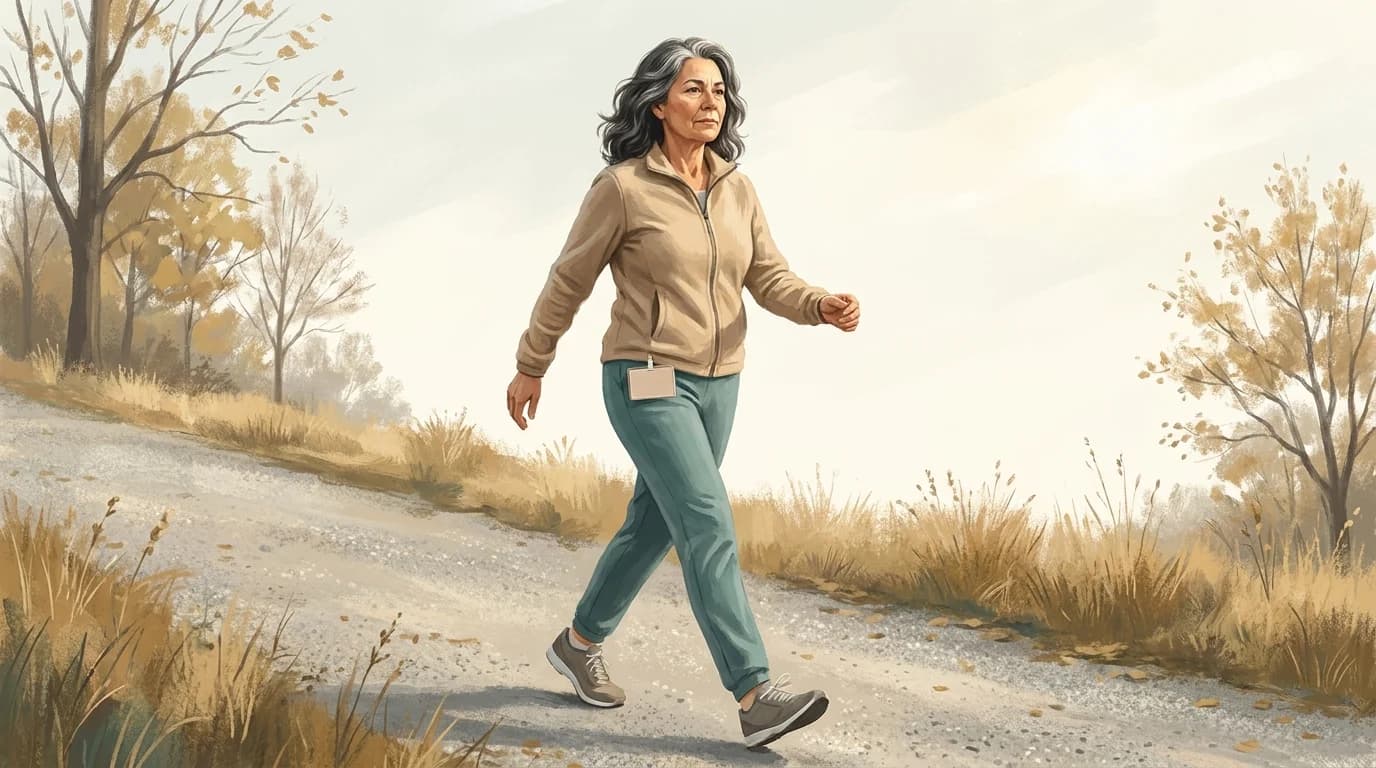
7,000 steps three days a week went with healthier bones before menopause, not after
Keep the walks. After menopause, the wider research keeps pointing to a brisker pace, some load and some variety beside them.
Most of the women in my classes are past menopause, and when bones come up, someone nearly always puts it the same way: I walk every day, so my bones should be fine. It's a reasonable thing to believe. A study published this week suggests it holds up better at forty than at sixty.
Researchers in Japan followed 3,529 women for about three and a half years (Osteoporosis International, 2026), counting their steps with pedometers. Before menopause, women who reached 7,000 steps on at least three days a week had about half the risk of their bone readings sliding into the osteoporosis range, compared with women who never reached 7,000 on any day. After menopause, the same walking habit made no clear difference.
Before menopause: a clear link
There were 1,013 women in the younger group. During the study, 70 of them saw their bone readings fall into the osteoporosis range.
What mattered was not the total number of steps. It was how often the women reached 7,000. Those who got there on three or more days a week had the lower risk; women who reached 7,000 steps on only one or two days a week showed no clear difference from the women who never did. Once or twice a week didn't seem to be enough to show up in the bones.
After menopause: steps alone fell short
The older group was larger, 2,516 women, and 662 of them crossed the line. Here the walkers and the non walkers ended up in much the same place. The authors' own conclusion is careful and worth quoting as written: for women after menopause, "walking alone may be an insufficient strategy."
That fits what is already known about these years. Bone loss usually speeds up after menopause as estrogen falls, and the skeleton may need a stronger signal than it did a decade earlier to hold its ground. You can read more about the wider body changes of this stage in menopause and the physical changes that come with it.
What the headline will miss
This was an observational study. Women who walk more may differ in other ways too, and although the researchers adjusted for many of them, a study like this can show a link, not prove that walking caused it.
The bone measure was an ultrasound of the heel (plus any osteoporosis diagnosis the women reported themselves), not the DXA scan of the hip and spine that doctors generally use to diagnose osteoporosis. Heel ultrasound is a useful screening tool, but it is not the same measurement.
And a pedometer counts steps. It can't tell a slow stroll to the shops from a brisk walk up a hill, so "7,000 steps" here says nothing about pace, impact or terrain.
The arc so far
I've written about bone and movement on this page many times since June, and the line running through those pieces is getting easier to see. In June, a ranking of aerobic programs found that the protocol that built the most bone was not the gentle one. In July, harder lifting built more strength but not more bone than moderate lifting, and another review restated that bone answers to how it is loaded. In September, 124 trials and 18,429 adults over forty put brisk walking or jogging near the top for the spine and hip, with a useful range of roughly two to three hours of brisk walking a week (The BMJ, 2026). Earlier this month, 17 trials of tai chi in women found a small gain at the spine.
Read together, and with all their caveats, these studies keep suggesting that after menopause the better question is not how many steps you took but what those steps asked of the skeleton (how fast, how much impact, whether you changed direction, whether you carried anything), which would explain why a plain count of 7,000 could track bone health at forty and lose its grip at sixty. That is a reading of the pattern, not a finding from any one trial. Still. It's where the arc points.
How a lesson would approach it
A Feldenkrais® lesson doesn't load bone the way a brisk walk or a set of squats does, and I won't pretend it does. What it can work on is the walk itself. In an Awareness Through Movement® lesson we might spend twenty minutes on how weight travels from heel to toes, or how the ribs and pelvis turn as one leg swings forward. Many people notice afterwards that walking feels lighter, and some find their pace picks up without any effort to speed up. A freer, more confident walk sits closer to what the bone research keeps rewarding, and it's easier to keep going out for when walking has started to feel uncertain.
What to keep, and what to add
If you're before menopause, the study gives a simple and encouraging message: spread your walking across the week, three days or more.
If you're after menopause, don't stop walking because a step count alone didn't show up in the bones here; walking does far more for a body than its bones. The questions about what to add belong with your doctor and, if you have one, your physiotherapist: whether a bone scan makes sense for you, and what kind of strength or impact work suits your body. Gentle movement sits alongside that care, not in place of it.
The pedometer counted 7,000 steps either way. What it couldn't count was how each one landed.
Let Feldy guide you, eyes closed
A calm voice walks you through gentle moves so your attention stays in your body, not on the screen.
Try Feldy Free for 7 daysNo credit card needed.
Sources
- Association between the frequency of achieving recommended daily step counts and a decline in quantitative ultrasound measurements in premenopausal and postmenopausal women: a 4-year prospective study of the Tohoku Medical Megabank Community-Based Cohort study— Osteoporosis International, 2026
- PubMed record (PMID 42909484)— PubMed
- Effect of exercise on bone health in middle aged and older adults: hierarchical network meta-analysis of randomised trials— The BMJ, 2026
Movement Pulse is informational, not medical advice. See our editorial policy.
Move better with Feldy
See the programMovement Pulse Weekly
The week's best research, in your inbox Tuesday.
Movement science, gentle-practice ideas, and a practitioner's read on what's new. Free.
More from Movement Pulse
Tai chi was called too gentle to touch bone, yet 17 trials in women found a small gain
If you love a slow standing practice, it may be doing a little for your spine as well as your balance. Keep the walking and the strength work beside it.
Oct 17, 2026
The bone research kept saying load it harder. The largest review added a quieter line
124 trials and 18,429 adults over forty. Brisk walking led at two of the three sites measured. The one result the authors rated most confidently was not a walking result.
Sep 16, 2026
Harder lifting built strength, but not more bone
A meta-analysis of 18 trials found heavier resistance training built more leg strength than lighter training, but the two came out about equal for bone density.
Jul 5, 2026Ready to start moving better?
Gentle, guided lessons for your body. Try your first one free, no credit card required.