
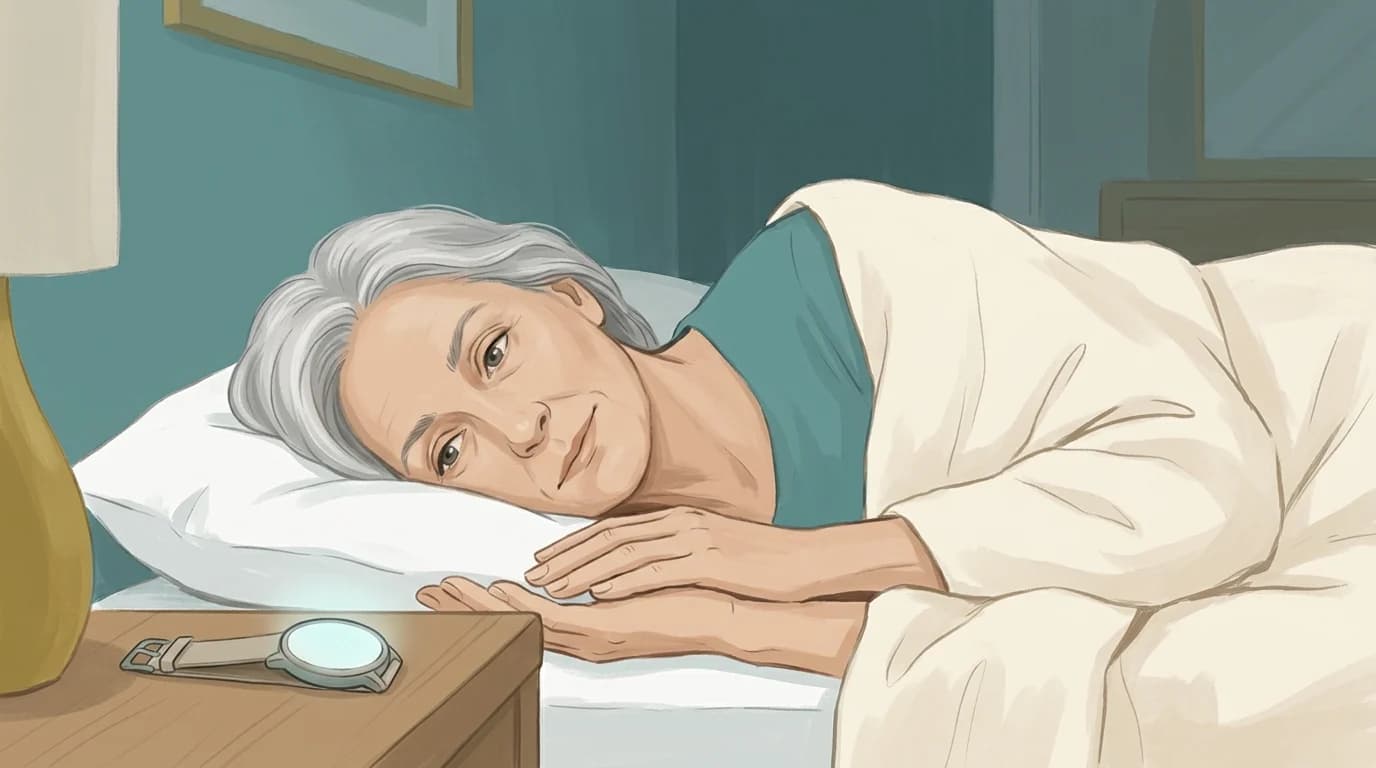
The deep sleep number your tracker reports was not the one that matched how people felt
A new analysis of 5,469 overnight recordings from the Sleep Heart Health Study separated how long people spent in deep sleep from how deep that sleep actually ran. Only one of the two had any relationship to how they rated their health, and it was not the one anybody is counting.
Almost every sleep tracker sold reports a deep sleep number, and almost everyone who owns one has a private opinion about theirs. A paper that went online on 18 September in Sleep Medicine took that number apart in 5,469 people who had spent a night wearing research grade electrodes, and could not connect it to how rested any of them said they were (Sleep Medicine, 2026).
The team worked with baseline recordings from the Sleep Heart Health Study, a cohort large enough that even small effects have somewhere to show up. From each overnight they pulled two things. The first is the familiar one: how many minutes the sleeper spent in N3, the stage everybody calls deep sleep. The second was a measure of how deep that sleep actually went, computed from the brain wave signal inside those same scored minutes, so that a shallow N3 and a profound N3 stopped being filed as the same thing.
Minutes of N3 lined up with nothing they checked. Not daytime sleepiness, not how participants rated their physical health, not their mental health. The depth measure did: people whose deep sleep ran shallower rated both their physical and their mental health lower, and that association held in models that accounted for duration and for the other factors the researchers included, and it held again when everyone with insomnia was removed from the analysis. When the cohort came back for the study's second wave, shallower deep sleep at the start still went with lower physical health ratings. Neither measure said anything about daytime sleepiness, which is its own small puzzle.
The finding that stopped me was quieter than any of that. Duration and depth had almost nothing to do with each other. A long stretch of N3 told you close to nothing about whether that stretch was deep. The number being counted, screenshotted and compared measures something real that happens not to be the thing people read it as.
What a headline version of this would miss
The differences were small. Less than a point on each of those health summary scores. Across 5,469 people a small, consistent difference is worth reporting; on one person's one night it is not a verdict about anything.
Direction is not established. This is a snapshot taken at the start of a cohort study, so shallower deep sleep might be wearing people down, or a body already carrying something might be the reason the sleep runs shallow. The design can't separate those, and the authors do not claim it can.
And the depth measure is not on your wrist. It comes from electrodes on the scalp and from software written for sleep laboratories. No consumer device computes it. So the devices that taught a generation of people to chase a deep sleep number are reporting the half of this picture that the study could not link to anything, and stay silent about the half it could.
What arrives in class with the number
People bring numbers now. That is new in the last five or six years, and it has changed the first few minutes of a class. Someone will tell me, before their shoes are off, that they only got thirty five minutes of deep sleep. Not offered as information. Offered as a confession.
The number has become one more thing the body is failing at, and now the failing gets measured nightly and filed.
What I keep noticing is what that does to the hour before bed. A person who expects to be graded on their sleep starts trying to sleep, and trying takes effort, and effort is precisely the ingredient that has to leave. They lie down braced for a result. Sleep disruption and physical tension feed each other in that state, and a tracker sitting on the nightstand is one more reason to stay half awake and check.
What is worth doing either way
None of this makes gentle movement a treatment for insomnia. Be exact about that. A joint position statement from six Australian sleep and primary care organisations, published this year in Sleep Advances, says two things plainly: general sleep hygiene advice on its own is not adequate for chronic insomnia, and multi component cognitive behavioural therapy for insomnia is the recommended first line treatment (Sleep Advances, 2026). If your sleep has been broken for three months or more, that is a conversation to have with a doctor, and it sits alongside anything you do in your own body rather than being replaced by it.
What the Feldenkrais Method® works on is narrower and, I think, more available. Not the sleep. The arriving. An Awareness Through Movement® lesson spends its whole length on discovering effort you did not know you were making, and then finding the movement works perfectly well without it. The skill being rehearsed is noticing holding that has no job left to do. That skill does not switch off when the lesson ends. It is the same skill a person needs at eleven at night with the jaw set and the shoulders still on duty, which is where chronic stress and muscle tension usually shows up first.
Whether any of that changes the depth of anybody's N3, nobody has tested, and I am not going to claim it. What I do see, again and again, is people who stop climbing into bed as though bed were another task on the list.
So the practical piece is smaller than a protocol. Keep the tracker if the weekly pattern tells you something useful, and stop reading the nightly figure as a report card, because researchers with far better instruments than your watch could not tie that figure to how anyone felt. Then give the last part of the evening to the body rather than to the screen: the weight of the head as the pillow takes it, the shoulders, the jaw, the places still holding something that has nothing left to hold. What does reach the first hours of the night is unglamorous and mostly subtraction: a steady wake time, no alcohol in the evening, a body that is not braced at lights out. I have written those out separately, together with what you cannot force.
There is something strange in the whole arrangement, and I keep circling it. Millions of people now receive a nightly grade on the one activity defined by the absence of effort, issued by a device that counts the minutes and cannot see the depth. Somewhere tonight, someone is lying very still, working hard at it, waiting to find out in the morning how well they rested.
Let Feldy guide you, eyes closed
A calm voice walks you through gentle moves so your attention stays in your body, not on the screen.
Try Feldy Free for 7 daysNo credit card needed.
Sources
- Not all N3 sleep is equal: EEG-defined N3 sleep depth and health-related quality of life in the sleep heart health study— Sleep Medicine (PubMed)
- Management of adult insomnia in Australia: a joint position statement of the Australasian Sleep Association, Sleep Health Foundation, Royal Australian College of General Practitioners, Australian Psychological Society, Pharmaceutical Society of Australia, and Australian Primary Health Care Nurses Association— Sleep Advances (PubMed)
Movement Pulse is informational, not medical advice. See our editorial policy.
Move better with Feldy
See the programMovement Pulse Weekly
The week's best research, in your inbox Tuesday.
Movement science, gentle-practice ideas, and a practitioner's read on what's new. Free.
More from Movement Pulse
Why moving in the evening may matter less for your sleep than how hard you move
A review of 25 comparative studies found no clear group level advantage for morning exercise. The signal that did survive was about intensity, not the hour.
Aug 24, 2026
Why more exercise can stop helping your sleep, and what the curve actually shows
Researchers mapped exercise dose against sleep quality and found a peak, not a ladder. Three questions worth bringing to your next appointment.
Aug 2, 2026
Yoga, tai chi, walking: movement and insomnia
A 2026 network meta analysis compared yoga, tai chi, and walking for insomnia. Different mechanisms, but a shared thread matters more than the ranking.
Jul 11, 2026Ready to start moving better?
Gentle, guided lessons for your body. Try your first one free, no credit card required.