
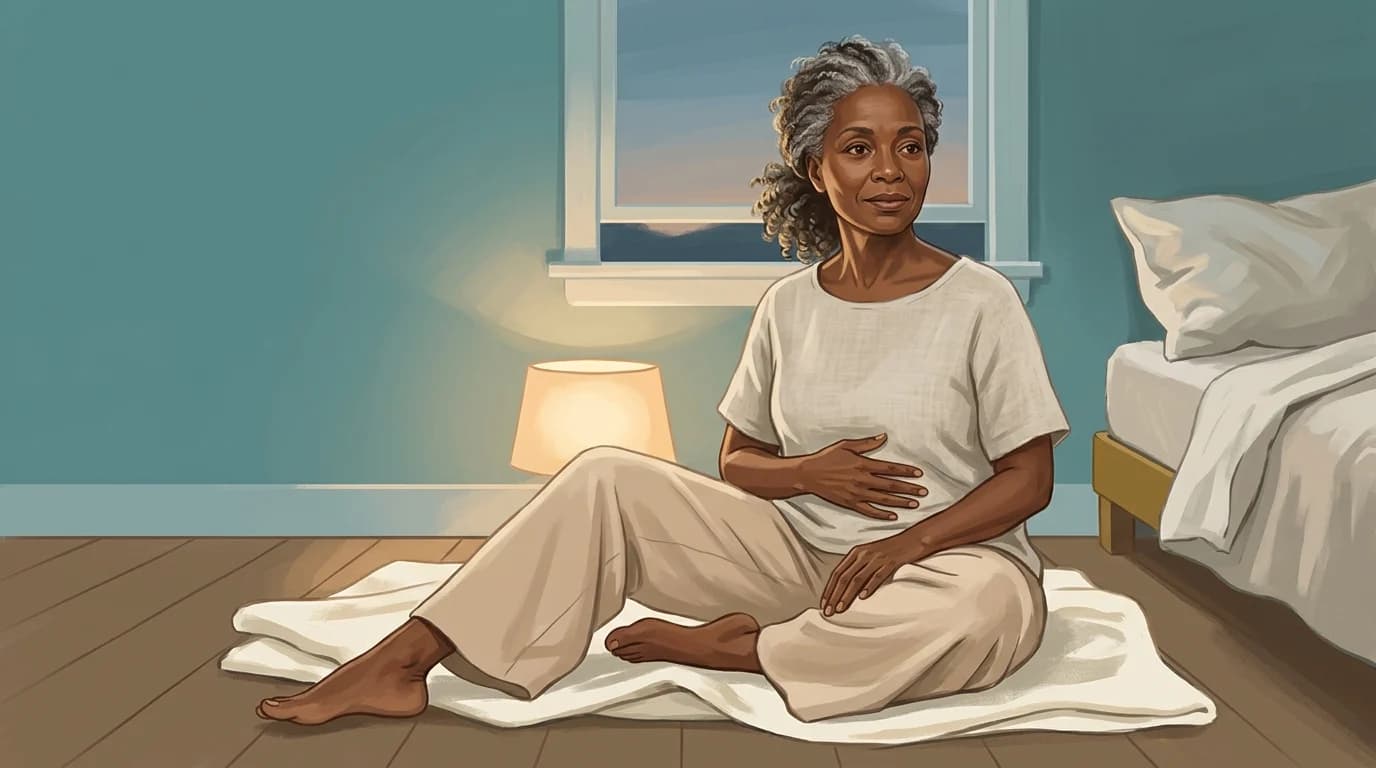
Why moving in the evening may matter less for your sleep than how hard you move
A review of 25 comparative studies found no clear group level advantage for morning exercise. The signal that did survive was about intensity, not the hour.
If you have ever talked yourself out of an evening walk because someone once told you it would keep you up, a review published this week is worth your attention. Researchers went looking for the evidence behind that rule, and at the group level they did not find much of it.
The paper appeared on 22 August in Sleep Medicine Reviews (Sleep Medicine Reviews, 2026). The team screened 1,111 records and kept 25 studies that compared morning exercise against evening or nighttime exercise within the same investigation. Eighteen of those were randomised controlled trials, and sixteen went into the meta analysis. The design matters here. Most of what we know about movement and sleep comes from studies asking whether people who exercise sleep better than people who do not. This one asked a narrower and more useful question: for the same person doing the same session, does the hour on the clock change anything?
For most sleep outcomes, the answer was no clear overall advantage for morning. One result did separate from the rest. Evening and nighttime exercise was associated with higher wake after sleep onset, meaning more time spent awake once sleep had already started. The pooled effect was moderate in size, a standardised mean difference of 0.51 in magnitude, with a confidence interval running from 0.12 to 0.89 in those same terms. The paper prints both figures with negative signs, which encodes the direction of the morning against evening comparison rather than any benefit of moving later. The authors also flag possible small study effects around this finding, their careful way of saying the true effect may be smaller than it looks. They also report that timing differences were more visible at higher exercise intensities.
Their own conclusion is unusually plain for a systematic review. They support flexible exercise timing that prioritises adherence and individual constraints, while noting that evening moderate to vigorous exercise may disturb sleep continuity.
What gets lost when this becomes a headline
The first thing is that "no clear advantage" is not the same as "no effect on anyone." A group average can sit flat while the individuals underneath it move in opposite directions, and the authors say plainly that identifying who responds how is the work still to be done. If evening movement reliably ruins your night, this review does not overrule what you know about yourself.
The second is which part of sleep the surviving signal touches. Wake after sleep onset is not the same complaint as lying awake at the start of the night. It is the stretch at three in the morning, the one where you were asleep and then you are not. That is a real problem for a lot of people, and it is the outcome carrying the timing effect rather than the time it takes to drop off.
The third is that the thing doing the work in this data was intensity and closeness to bed, not the hour itself. Harvard Health makes the same point, noting that traditional sleep hygiene advice discouraged evening exercise altogether while more recent work points to a cutoff of roughly three to four hours before bed rather than a blanket ban (Harvard Health Publishing). Read that way, the old rule was never really about evenings. It was about how hard you worked and how close to bed you stopped.
What I notice with people
I am a Feldenkrais® practitioner, and I work with people whose sleep has been unreliable for years. The evening is rarely a neutral time for them. By nine o'clock the day has usually settled somewhere specific: the jaw, the shoulders, a low background bracing they stopped noticing a long time ago. When someone in that state adds a demanding session, they often describe an odd combination afterwards. Tired, and also switched on.
What tends to land differently is movement that asks almost nothing. In Awareness Through Movement® the range stays small, the pace stays slow, and you only go where it feels easy, pleasant, and comfortable. People fairly often tell me they got heavy partway through, which is not what anyone expects from something filed under exercise. That is what people report to me, not a trial result, and I offer it as exactly that. If you are looking for a guided version of that kind of evening movement, our comparison of the best app for stress and tension relief looks at apps that work with the jaw and shoulders as well as the mind.
It does sit comfortably with the shape of this review, though. If the penalty in the data attaches to intensity and proximity rather than to evenings as such, then the kind of evening movement least likely to disturb sleep continuity is the kind that never raised your system much to begin with.
What might be worth taking from it
For most people the practical translation is simpler than the sleep hygiene rules made it sound. Move when you will actually move. A walk after dinner that happens is worth more than a morning walk that does not, and the review points that way itself.
If you do wake regularly in the night and you have been exercising in the evening, the dial worth testing first is intensity rather than the clock. It may be worth testing the same session at a lower effort for a couple of weeks before you rearrange your life around the hour. How your body is arranged in bed is worth a look too, since an unsupported top leg can keep the lower back working all night, and our guide to how to fix anterior pelvic tilt while sleeping covers a side setup that takes that drag off. And if tension you carry into the night or anxiety that settles into the body is part of your picture, timing was probably never the main variable anyway.
None of this is a treatment plan. If your sleep is badly disrupted, that belongs with your doctor or a sleep clinician, and gentle movement work sits alongside what they give you rather than in place of it. Yoga, Pilates, and tai chi each work with the body through their own mechanisms, and any one of them can occupy an evening well.
What I would hold onto is the direction the evidence has drifted. For years the advice was to protect sleep by subtracting movement from the evening. This review suggests the evening was rarely the problem. What you did with it might have been.
Let Feldy guide you, eyes closed
A calm voice walks you through gentle moves so your attention stays in your body, not on the screen.
Try Feldy Free for 7 daysNo credit card needed.
Sources
- Effects of morning versus evening exercise on sleep: a systematic review of comparative studies with a meta-analysis of randomized controlled trials— Sleep Medicine Reviews
- Does exercising in the evening affect sleep?— Harvard Health Publishing
Movement Pulse is informational, not medical advice. See our editorial policy.
Move better with Feldy
See the programMovement Pulse Weekly
The week's best research, in your inbox Tuesday.
Movement science, gentle-practice ideas, and a practitioner's read on what's new. Free.
More from Movement Pulse
Yoga, tai chi, walking: movement and insomnia
A 2026 network meta analysis compared yoga, tai chi, and walking for insomnia. Different mechanisms, but a shared thread matters more than the ranking.
Jul 11, 2026
Why more exercise can stop helping your sleep, and what the curve actually shows
Researchers mapped exercise dose against sleep quality and found a peak, not a ladder. Three questions worth bringing to your next appointment.
Aug 2, 2026
Better sleep, harder mornings: a sleep drug trial
A randomized trial of low dose quetiapine, often prescribed off label for sleep, found it improved sleep but impaired next day alertness and driving.
Jun 22, 2026Ready to start moving better?
Gentle, guided lessons for your body. Try your first one free, no credit card required.