
Massage or a foam roller for fibromyalgia? A six week trial saw pain ease with both
Forty women with fibromyalgia improved on every measure, and a physiotherapist's massage moved daily function further, though no untreated group was there to compare.
You live with fibromyalgia. Someone in your support group swears by a foam roller. Your physiotherapist has hands, and a waiting list.
So which one? A small trial from eastern Turkey, published online on 2 October in the Irish Journal of Medical Science, put those two options side by side (Elbasti and Baglan Yentur, 2026).
What the trial compared
Forty women with fibromyalgia, aged 18 to 65 under the trial's registration, were randomly split into two groups of about twenty. Both groups had twelve sessions: twice a week for six weeks.
One group received connective tissue massage from an experienced physiotherapist. It's a slow, pulling stroke along the skin and the layer beneath it, given while the person sits, and in this trial it started at the low back and worked upward, through the lower ribs and the shoulder blades, to the neck (trial registration).
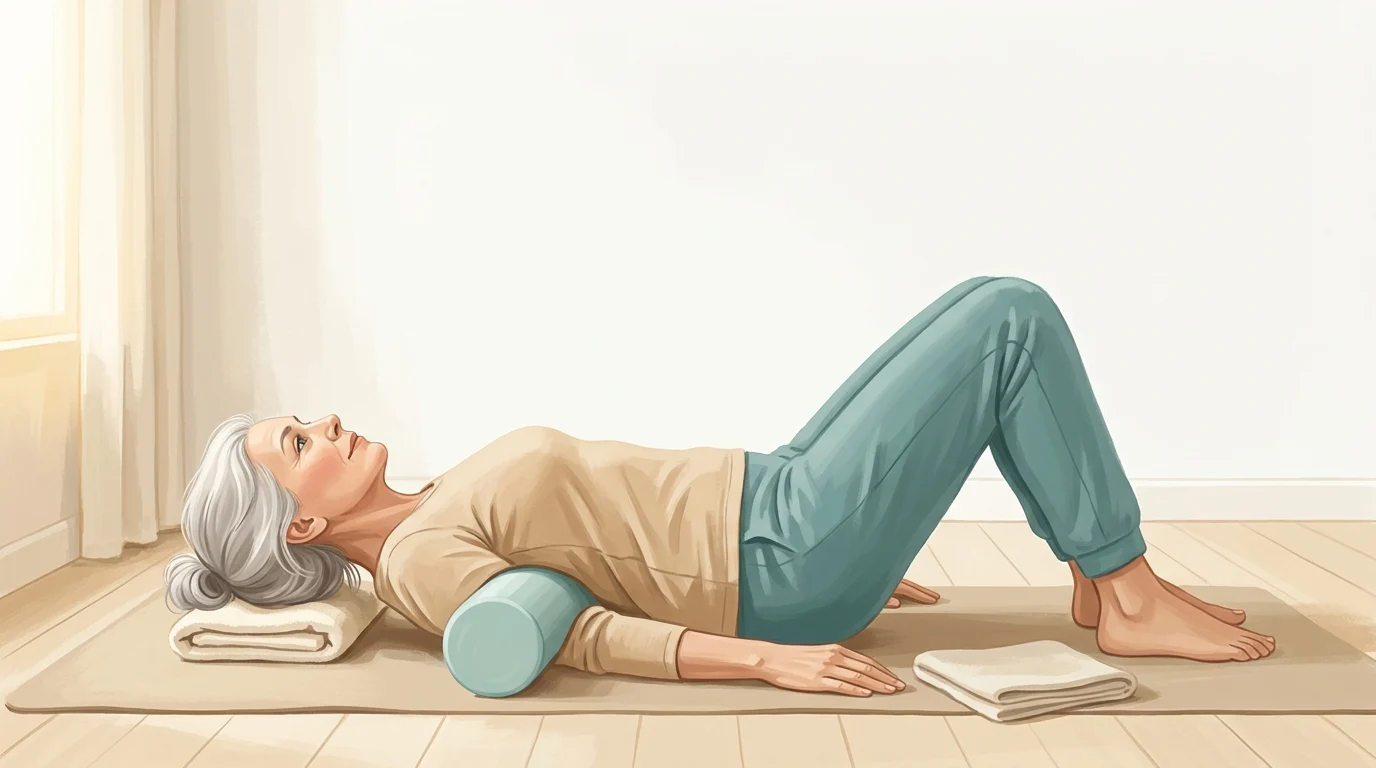
The other group used a foam roller on themselves. The registered position was lying on the back with the knees bent, hands clasped behind the neck, the roller placed between the shoulder blades.
The team measured pain on a 0 to 10 scale, a body map of where the pain was, sleep quality, everyday function, and the Fibromyalgia Impact Questionnaire, a score of how much the condition shapes a person's week.
What changed
Both groups improved on every measure, and the improvements were large enough that chance is an unlikely explanation. The massage group pulled ahead in three places: everyday function, the total fibromyalgia impact score, and how widely the pain spread across the body map. The published summary doesn't claim an advantage for the massage on pain intensity or on sleep.
What it can't tell you
There was no third group that received nothing, so the trial can't separate what the massage or the roller did from what six weeks of attention, routine and hope did on their own. That matters with pain. In a recent open label placebo trial for back pain, pain eased even in people who received no treatment at all.
It's also not quite a contest between two tools. One group sat with a trained person's hands on them twice a week for six weeks; the other managed a firm cylinder under their own weight. Forty women, one city (Elazığ), six weeks, no follow up reported after the sessions ended: a reason to read the result as a pointer rather than a ranking.
The better question
The trial asks which tool. The question I'd add is how you meet it.
Picture the roller position: hands laced behind the neck, the upper back resting on a firm edge. For a nervous system that already reads ordinary pressure as too much, the easy thing is to brace against it without noticing, the breath held high, the jaw set, the head lifted a little into the hands. In a Feldenkrais® lesson nobody would ask you to push through that. I'd ask whether the ribs can still move with the breath while you lie there, whether the feet feel the floor, whether a folded towel instead of the roller changes anything. You only go where it feels easy, pleasant, and comfortable. Less pressure, more noticing.
Three things to ask at your next appointment
1. Is connective tissue massage available to me, and from whom? It's a specific technique, taught to physiotherapists in some countries and not others. Asking for it by name gets a clearer answer than asking for "a massage". Care from a physiotherapist's hands sits alongside the rest of your physiotherapy plan; it doesn't replace it.
2. If I use a roller, how firm, how long, and what does a flare the next day tell us? Many people with fibromyalgia know the pattern where something feels fine in the moment and costs them the next morning. A softer roller, shorter time, or a different position are all fair things to plan with your physiotherapist before you start, and the trial's position (hands behind the neck) is only one way to lie on it.
3. What carries the change once the sessions stop? Twelve sessions end. This trial didn't report what happened afterward, which is exactly the part your week depends on. Ask what you can keep doing on your own, and how gently you can start.
The Feldypedia entry on fibromyalgia and widespread sensitivity explains why a sensitized system responds so strongly to pressure, and the one on sleep and physical tension picks up the sleep thread this trial measured. Short, audio guided practice like the Feldy online movement program can fill the days between appointments, and it works alongside physiotherapy, not in place of it.
Both groups got better, and the trial can't fully say why. So what would your upper back tell you if you lay on that roller for one minute, very slowly, and listened before you pressed?
Let Feldy guide you, eyes closed
A calm voice walks you through gentle moves so your attention stays in your body, not on the screen.
Try Feldy Free for 7 daysNo credit card needed.
Sources
- Comparison of the effect of connective tissue massage and foam roller in fibromyalgia patients— Irish Journal of Medical Science, 2026
- Comparison of the effect of connective tissue massage and foam roller in fibromyalgia patients (publisher page)— Springer
- Effects of Connective Tissue Massage and Self Myofascial Release in Patients With Fibromyalgia (NCT06469996)— ClinicalTrials.gov
Movement Pulse is informational, not medical advice. See our editorial policy.
Move better with Feldy
See the programMovement Pulse Weekly
The week's best research, in your inbox Tuesday.
Movement science, gentle-practice ideas, and a practitioner's read on what's new. Free.
More from Movement Pulse
If fibromyalgia is autoimmune, removing the antibodies should have helped more than this
A drug that clears antibodies out of the blood was the cleanest test yet of the idea that fibromyalgia is autoimmune. The group result came in small.
Sep 18, 2026
Why the pain score they ask for said the least about how the fibromyalgia week went
Two studies published a day apart counted the symptoms nobody scores. In both of them, the pain rating was not the number carrying the information.
Sep 4, 2026
The more trials pile up on strength training for fibromyalgia, the smaller the effect
A new review pooled 14 trials and 871 women. The benefit is real, and it is a fraction of what the first Cochrane review reported in 2013.
Aug 12, 2026Ready to start moving better?
Gentle, guided lessons for your body. Try your first one free, no credit card required.