
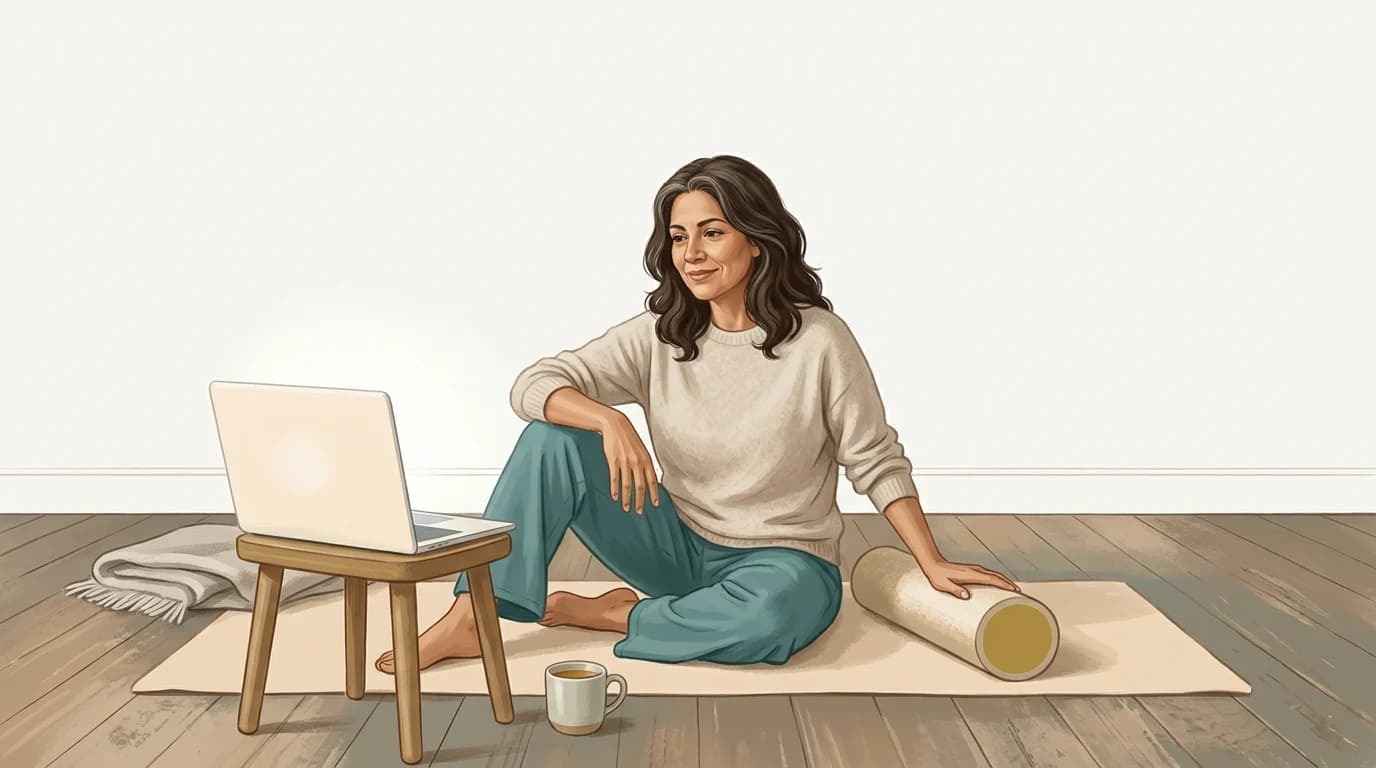
Fibromyalgia weighed less on daily life after six months of live online classes at home
68 adults were offered three live sessions a week and attended 63 of 72 on average. The daily burden eased steadily, though sleep stayed in the poor range.
The advice for fibromyalgia has said the same thing for years: move. Treatment guidelines put exercise at the centre of care. Anyone who lives with the condition knows the catch, and it isn't the exercise itself. It's the day after.
A trial published on 13 October in the Journal of Rehabilitation Medicine tested something a little more specific than "exercise more" (Marantidou and colleagues, 2026). A team at Aristotle University of Thessaloniki in Greece recruited 68 adults with fibromyalgia through online support groups; 66 were women, most were between 41 and 60, and all had been inactive. Thirty five were offered three live classes a week over Zoom for six months. The other 33 carried on with their usual routines, and both groups kept their usual medication.
Each class ran 50 to 60 minutes. It opened with slow breathing and easy mobility, moved on to self massage of the back and hips with a foam roller or a tennis ball, spent around half an hour on mat work based on Pilates with light resistance, and closed with a few minutes of stretching and relaxation. The instructor asked about pain and fatigue after almost every exercise, and when someone was struggling, repetitions were cut, rest was added or the movement was dropped; the programme moved forward only when symptoms allowed, not when the calendar said so.
Here is what it showed, and what it didn't.
1. The weight of the whole day eased
The main measure was a 100 point questionnaire on how much fibromyalgia gets in the way of daily function, pain and everything around it. In the online group, the typical score fell from about 59 to about 51 over six months. In the comparison group it stayed near 62. By the end, the gap between the groups averaged close to 12 points.
That's a real difference, and it widened steadily instead of fading after an early burst. It's also less tidy than it sounds. The plausible range for the true gap ran from about 4 points to about 20, and the benchmark the authors used to call it meaningful was borrowed from an older version of the questionnaire, a point they flag themselves.
2. Sleep moved, but not into good sleep
The summary lists sleep among the improvements, and across the six months the online group's sleep scores did improve more than the comparison group's. Look at the checkpoints, though. At three and at six months the difference between the groups was less than one point on a 21 point scale, small enough to be chance, and both groups still scored in the range researchers use to define poor sleep. The authors put it plainly: the programme eased sleep problems rather than resolving them.
3. The mood results have a gap in them
Depression scores fell in the online group and held steady in the other; stress leaned the same way, more weakly. Anxiety didn't separate between the groups. But by month six, 13 of the 35 people in the online group hadn't returned their mood questionnaire, while everyone in the comparison group had. If the people who stopped answering were the ones feeling worse, the mood result would look better than it is. We don't know why those 13 didn't answer. Add that the trial was registered only after it had finished, that no one could be blinded to which group they were in, and that every result was self reported, and the mood findings are not the part of this study I'd put much weight on.
4. People kept showing up
This is the part I'd underline. On average, people attended 63 of the 72 classes (a count that includes make up sessions watched as recordings and reported by the participants themselves). No adverse events were reported in either group. For a condition where exercise programmes so often lose people to the next bad week, that may be the most useful finding in the paper.
The trial can't say which ingredient did it. Was it the Pilates? The foam roller? The live instructor? Or the permission to do less on a hard day? A Montreal trial on chronic back pain recently found that a live class or a recording made little difference, so I wouldn't credit the screen alone; how the classes were run may matter more than whether they were live.
Doing less
One line in the methods matters more than it looks: the instructor reduced the work whenever someone reported pain or fatigue. In fibromyalgia the nervous system is already turned up, sensitivity spreads, and a movement that hurt last week can register as a threat this week. Pushing through tends to confirm the threat. Doing less, and staying where movement feels easy, pleasant, and comfortable, gives the nervous system something different to learn from: movement, again and again, that doesn't end in a flare. In the Feldenkrais Method® we reduce effort on purpose, because smaller, slower movement is where you can actually feel what you're doing. People with fibromyalgia often tell me the session was never the hard part. The day after was.
What to take from it
If you have fibromyalgia and have been told to exercise, this trial points less to one method and more to a way of practising. Regular. Gentle enough to repeat three times a week for half a year. Adjusted to the day you're actually having. That might be a class like this one, a programme from your physiotherapist, or a quieter practice at home; whatever you choose sits alongside the care you already have, not in place of it. If you're weighing up home options, I've set out how some of the best exercise therapy programs for chronic pain compare. And if restless, tense nights are your hardest symptom, this trial suggests sleep may need attention of its own.
Sixty three sessions out of seventy two. Somewhere inside that number are a great many mornings when someone logged on tired, did less than the plan said, and came back two days later anyway.
Let Feldy guide you, eyes closed
A calm voice walks you through gentle moves so your attention stays in your body, not on the screen.
Try Feldy Free for 7 daysNo credit card needed.
Sources
- Six-month supervised telerehabilitation combining Pilates-based therapeutic exercise and self-myofascial release in adults with fibromyalgia: a randomized controlled trial— Journal of Rehabilitation Medicine, 2026
- Full text (PMC13673445)— PubMed Central
- PubMed record (PMID 42867081)— PubMed
Movement Pulse is informational, not medical advice. See our editorial policy.
Move better with Feldy
See the programMovement Pulse Weekly
The week's best research, in your inbox Tuesday.
Movement science, gentle-practice ideas, and a practitioner's read on what's new. Free.
More from Movement Pulse
A live class or a recording? For chronic back pain, the format barely changed the outcome
A Montreal trial gave the same twelve week program over Zoom with an instructor, or as videos done alone. Pain eased about equally. It is the fourth study since June where the detail people argue about most turned out to matter least.
Oct 1, 2026
Massage or a foam roller for fibromyalgia? A six week trial saw pain ease with both
Forty women with fibromyalgia improved on every measure, and a physiotherapist's massage moved daily function further, though no untreated group was there to compare.
Oct 8, 2026Ready to start moving better?
Gentle, guided lessons for your body. Try your first one free, no credit card required.