
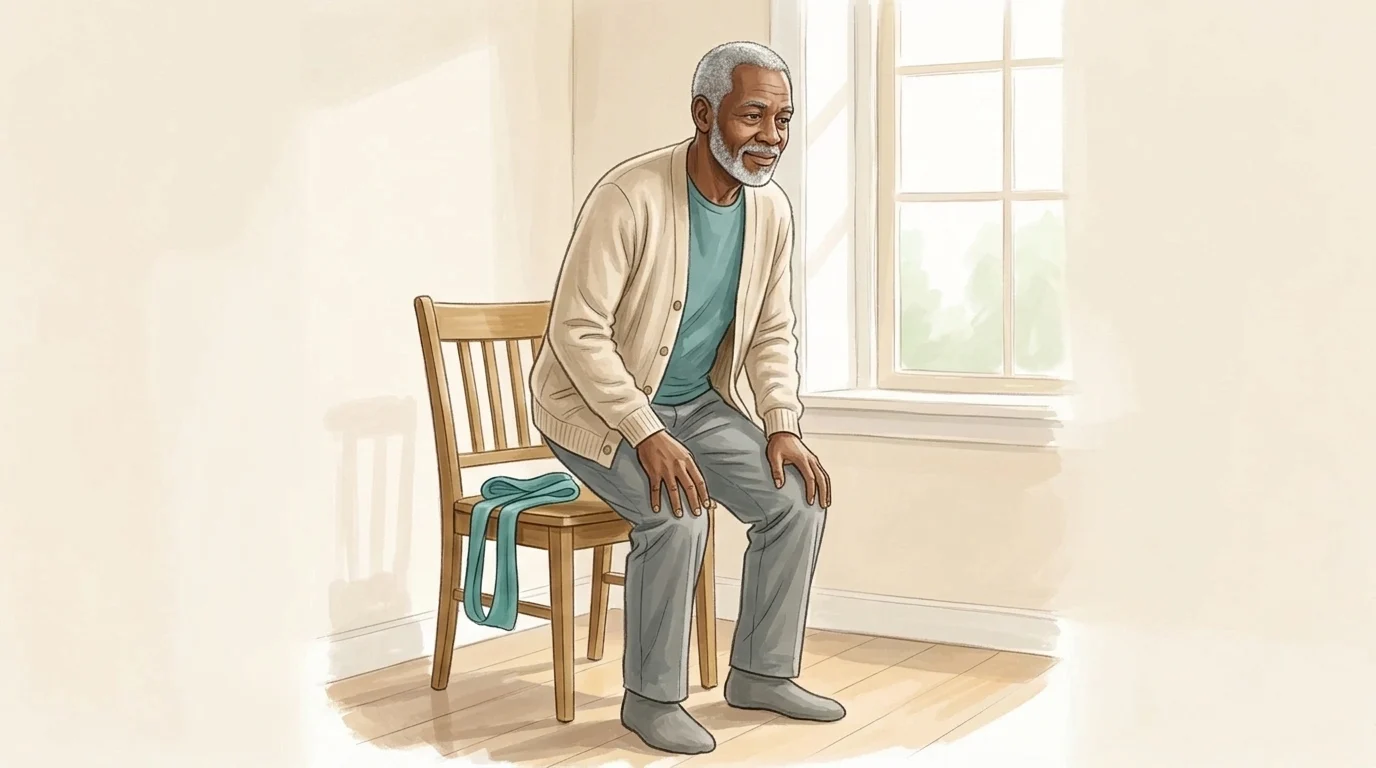
Knee arthritis pain held steady, yet rising from a chair got easier
Pain is not the only sign that knee exercise is working. In 80 adults, home band training made standing and walking easier.
You've done the knee exercises for weeks, and the knee still aches on the stairs. Are they doing anything? A trial published on 8 November suggests they may be, just not in the place you've been checking.
When the ache is your only gauge, it's easy to decide the effort was wasted, or that your knee is past helping, and plenty of people quietly stop there. If the usual first steps have already let you down once, that conclusion can start to feel like proof.
It isn't. You can start from what your knee lets you do today.
The trial, from a team in Taiwan, followed 80 adults with knee arthritis for whom the usual first steps had not been enough (Lin and colleagues, Research in Sports Medicine, 2026). Everyone had one injection into the knee. Then half spent twelve weeks doing strengthening exercises with elastic bands at home, supervised remotely, while the other half got standard education and no supervised exercise.
Standing up got easier
By the end, the exercise group could stand up from a chair and sit back down nearly four more times in thirty seconds than the education group. They also got through a short timed walk, up from a chair, a few steps, a turn and back, almost two seconds faster, and they rated everyday tasks as easier.
Those are the movements a day is made of. Getting out of the car. Rising from the sofa without the little rocking run up. Turning in the kitchen with a pan in your hand.
So if your practice hasn't touched the ache yet, that doesn't mean it is doing nothing. Watch what you can do, not only how much it hurts.
The pain score stayed put
When people marked how much their knee hurt, the two groups ended about level after twelve weeks. On a broader arthritis questionnaire that covers pain, stiffness and daily function together, the exercise group came out only a little ahead overall, a margin that just cleared the bar researchers use for "unlikely to be chance". The clearer gain sat in daily function.
The authors put it plainly in their title: function over pain. The extra exercise did not bring extra pain relief in this trial. It brought more ease in moving.
The better question
"How much does it hurt today?" is the question most of us ask a sore knee every morning. In the Feldenkrais Method® I'd swap it for a different one: how do you get up? Where does the effort start, does the breath stop, does the other leg quietly do all the work? An aching, arthritic joint often changes in how it is used before it changes in how it feels. What I see again and again in my classes is people saying a movement feels lighter weeks before they'd say the knee hurts less, and you only ever go where it feels easy, pleasant and comfortable.
What the headline will miss
This is one small trial of 80 people in one country, over twelve weeks, and we don't know what happened after that. Everyone had an injection, so it can't tell us how the exercise works without one, and it wasn't designed to judge the injection itself. The comparison group got education rather than another activity, so some of the gain may come from the contact and attention of being supervised. And it didn't test the Feldenkrais Method or any gentle awareness practice; strengthening with bands is a different way of working.
Questions for your next appointment
If you live with knee arthritis, these are worth raising with your doctor or physiotherapist:
- "Besides my pain, can we track what I can do?" For example, how many times you can stand up from a chair in thirty seconds, or how long a short walk and turn takes. In this trial, those were the measures that moved.
- "Is there a supervised option I could do from home?" The authors note that supervised exercise is often hard to get after an injection; theirs was supervised remotely. Your physiotherapist can tell you what is available and what suits your knee.
- "What movement should sit alongside the care I'm already having?" Whatever your treatment plan, it's fair to ask what you should be doing in your own body between appointments, and how to build it up.
If your knee becomes suddenly hot, very swollen or gives way, or you can't put weight on it, don't wait for a routine visit; get it checked promptly.
Until then, one thing to notice. The next time you get up from your chair, leave the ache aside for a moment and watch how you rise: whether you rock, where you push, whether you hold your breath. Then notice it again in a month. Judge your practice by what gets easier, not only by what still hurts.
Let Feldy guide you, eyes closed
A calm voice walks you through gentle moves so your attention stays in your body, not on the screen.
Try Feldy Free for 7 daysNo credit card needed.
Sources
Movement Pulse is informational, not medical advice. See our editorial policy.
Move better with Feldy
See the programMovement Pulse Weekly
The week's best research, in your inbox Tuesday.
Movement science, gentle-practice ideas, and a practitioner's read on what's new. Free.
More from Movement Pulse
Tai chi and yoga eased knee arthritis pain more than strength work
Slow practice also ranked first for stiffness in 51 trials. Strength work still built the most muscle, so a gentle start counts.
Nov 16, 2026
What 29 trials say a physiotherapist's hands add to exercise for knee arthritis pain
Manual therapy on top of exercise eased knee pain a little more for weeks to a few months, then the gap closed, in evidence the authors rate mostly very low certainty.
Oct 20, 2026
The stiffness you feel is not the stiffness we can measure
A 2025 knee osteoarthritis study measured muscle stiffness with shear wave elastography and found it did not correlate with the tightness patients reported feeling.
Jul 17, 2026Ready to start moving better?
Gentle, guided lessons for your body. Try your first one free, no credit card required.