
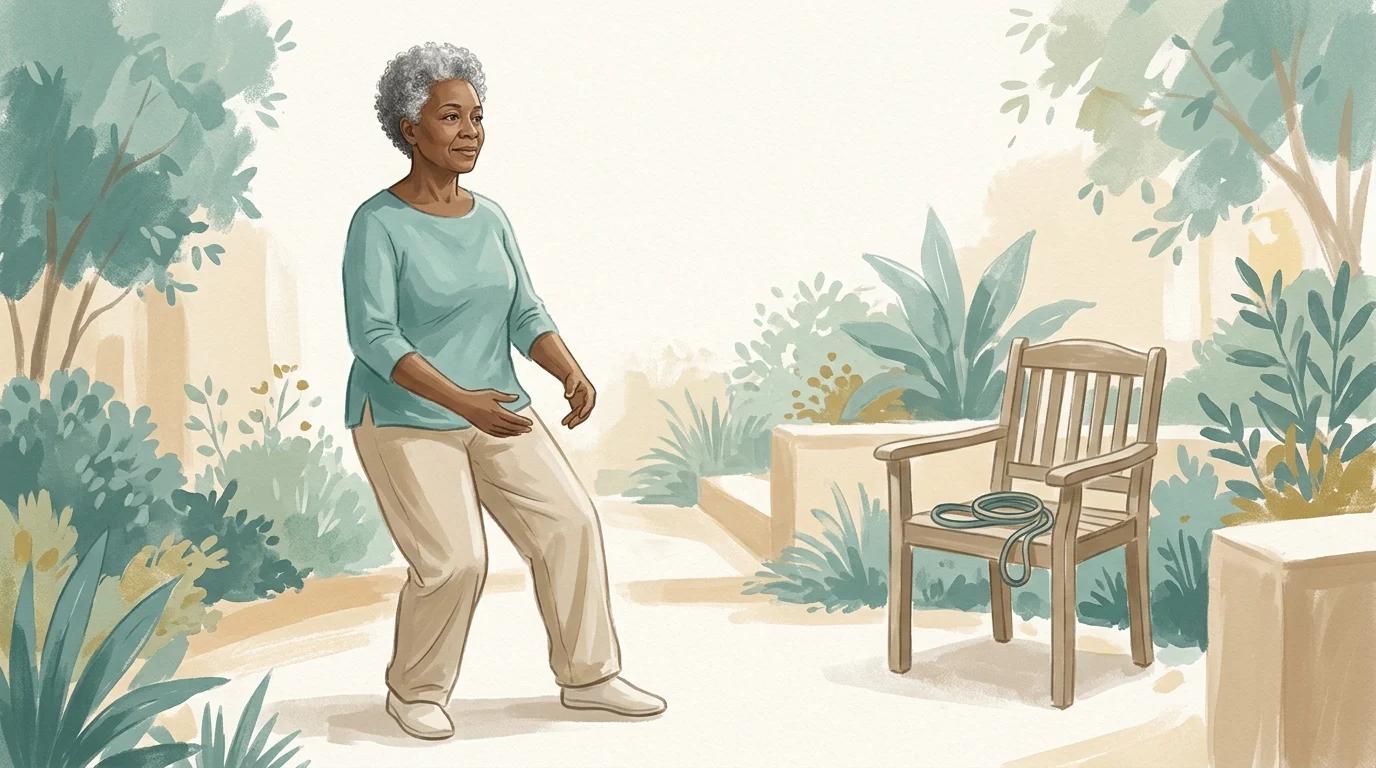
Tai chi and yoga eased knee arthritis pain more than strength work
Slow practice also ranked first for stiffness in 51 trials. Strength work still built the most muscle, so a gentle start counts.
Ask most people with knee arthritis which exercise they were given, and the answer is usually strengthening: leg lifts, slow sits to a chair, an exercise band around the ankle. So which kind of exercise actually eases the ache and the stiffness? A review that lined up 51 trials, just published in PeerJ, found that the slow mind and body practices, tai chi, yoga and Pilates, eased pain the most and ranked first for stiffness too.
This doesn't mean strength exercises are no longer useful. They built the most muscle, and nothing else came close. What the review does suggest is that a gentle start is a real start, not a lesser one, and that matters most if knee pain has made you give up exercise before.
Every kind of exercise helped
The review compared five kinds of exercise with doing none, in about 3,000 people: slow mind and body practices, strength training, aerobic work such as walking or cycling, and two other kinds of program. Every one of them eased knee pain compared with no exercise.
This is encouraging if pain has stopped you from being active, because pain is often the reason people stop. Any movement you can manage comfortably counts.
Slow practice eased pain most
If your knee aches more than it feels weak, this is the part for you. The slow practices ranked first for pain. When the review compared them with strength training, they eased pain more, and the gap was unlikely to be chance alone.
Stiffness ranked the same way, though the review was much less sure of it. Only two kinds of exercise eased it noticeably more than doing nothing: the slow practices and strength training. The slow practices ranked first; strength work came further down the list.
Strength work built the muscle
For thigh and leg strength, the results were different. Strength training did the most, aerobic work helped too, and the slow practices didn't change strength in a way the trials could measure. For everyday function, such as stairs and getting up from a chair, mixed programs ranked first and the slow practices second, though these were among the results the researchers were least sure of.
So strong thighs still matter. You don't have to start there. If a physiotherapist gave you strengthening exercises, these findings do not mean you should stop them; the review sits alongside that plan, and it's a good reason to ask whether a slower practice could share the week.
Doing less
Tai chi, yoga and Pilates are different methods, each with its own strengths, and the review can't say which part of them helped. What they share is pace. When a movement slows down there is time to feel where the knee takes the weight, and where the hip and the ankle could share it. In a Feldenkrais Method® lesson we lean on exactly that (smaller movements, less effort, attention to how the movement travels through the whole leg). What I see again and again in my classes is people with sore knees who tense the leg before every step; when they learn to move with less effort, that tension often eases. That is my reading of the result, not something these trials measured.
What the headline will miss
The researchers rated their confidence in the pain results as moderate to low, and in the stiffness and everyday function results as low to very low. Programs ran anywhere from 4 to 48 weeks at very different intensities, and few trials checked on people after the program ended. Pain and stiffness were reported by the participants themselves, so how much people enjoyed their classes may have coloured the results. The rankings also rest partly on indirect comparisons: each practice was often measured against doing nothing in separate trials, rather than tested directly against the others. So ranking first is a useful sign, not a final answer. To my eye, some of the effects look larger than exercise trials usually show, which can happen when many of the trials are small. Most participants were women, which fits many readers here but leaves the picture less certain for men.
Where to start this week
If strengthening has been hard on your knee, try one slow session this week: tai chi, a gentle yoga class or a short guided lesson. Our page on knee stiffness after 60 has more on why slow movement suits a stiff knee, and an earlier look at the largest review of tai chi and qigong includes a five minute weight shift to try. If the knee is hot, swollen or suddenly worse, talk to your doctor or physiotherapist before starting anything new.
Choose movements that feel easy, pleasant and comfortable. The next morning, notice how your knee feels on the first three stairs.
Let Feldy guide you, eyes closed
A calm voice walks you through gentle moves so your attention stays in your body, not on the screen.
Try Feldy Free for 7 daysNo credit card needed.
Sources
Movement Pulse is informational, not medical advice. See our editorial policy.
Move better with Feldy
See the programMovement Pulse Weekly
The week's best research, in your inbox Tuesday.
Movement science, gentle-practice ideas, and a practitioner's read on what's new. Free.
More from Movement Pulse
Knee arthritis pain held steady, yet rising from a chair got easier
Pain is not the only sign that knee exercise is working. In 80 adults, home band training made standing and walking easier.
Nov 11, 2026
What 29 trials say a physiotherapist's hands add to exercise for knee arthritis pain
Manual therapy on top of exercise eased knee pain a little more for weeks to a few months, then the gap closed, in evidence the authors rate mostly very low certainty.
Oct 20, 2026
Stiff most mornings? What the largest review of tai chi and qigong actually found
A new BJSM umbrella review grades the evidence for tai chi, qigong and related practices across 1,744 trials. Plus a five minute weight shift experiment.
Aug 20, 2026Ready to start moving better?
Gentle, guided lessons for your body. Try your first one free, no credit card required.