
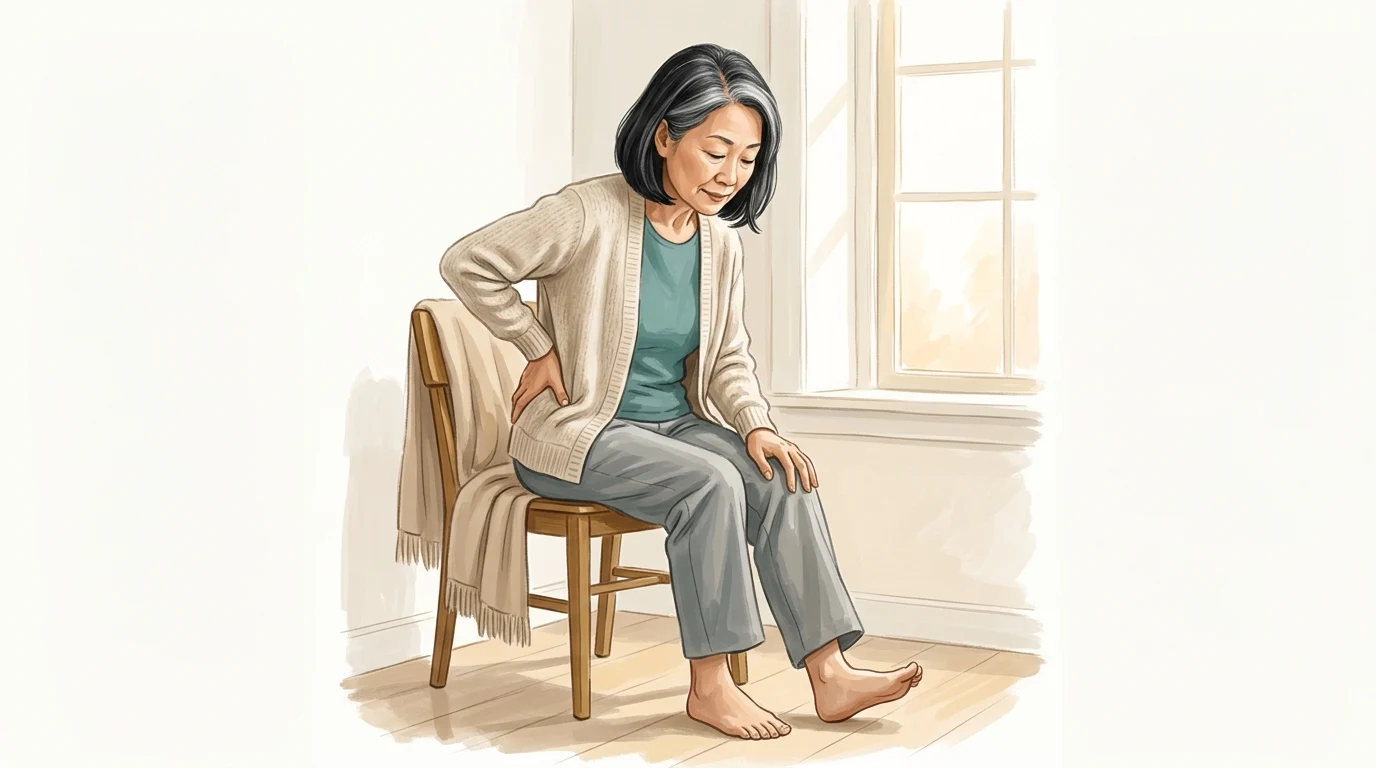
What 51 trials found mindfulness eases for people with chronic pain
Worry about the pain eased and people made more room for it. Talking therapy did not clearly do better, and most trials were weak.
When you've lived with pain for years, it gets hard to stop watching it, and a twinge on the stairs can turn into a forecast for the whole week.
If you've ever mentioned that worry to a doctor and heard some version of "it's in your head", you may wonder whether anything aimed at the mind is just a politer way of brushing you off.
A new review of 51 trials points the other way: people with long lasting muscle and joint pain who learned mindfulness worried less about their pain and made more room for it in their lives. On average, the pain itself eased somewhat too (Barnet-Hepples and colleagues, Pain Research & Management, 2026).
The pain is real. So is the worry that grows around it, and it isn't a character flaw; it's a common response when a body has been on guard for a long time. (If that idea is new to you, here is a plain explainer on body regulation.) You can start from exactly there.
Less spiralling, more room
Researchers have a clumsy name for that worry, pain catastrophizing. Most people who live with pain know it well without the label: going over the pain again and again, expecting the worst from it, and feeling there's nothing you can do. It isn't something you choose. Mindfulness courses practise something close to the opposite habit. You learn to notice what is happening in your body and mind, moment to moment, without arguing with it or running from it.
People who took a course worried about their pain noticeably less than people who had no program, one of the biggest changes in the review, and they found more acceptance, which here doesn't mean giving up; it means carrying on with what matters to you while the pain is present. Anxiety and low mood eased too. Pain itself eased somewhat less, and getting through daily tasks improved least of all.
So here's what's in it for you. The worry around pain is not fixed. In these trials it shifted during a mindfulness course, and on average the pain eased too, though less than the worry did.
Little clear difference from talking therapy
Some of the trials compared mindfulness with cognitive behavioural therapy, the talking therapy most often offered for long lasting pain. Across these measures the review found few clear differences between the two. That is useful to know if you've tried one and it didn't suit you, or if a mindfulness course is simply easier to find where you live. Each works in its own way, and neither takes the place of seeing your doctor or physiotherapist about the pain itself.
From the inside
In a Feldenkrais® lesson, attention does most of the work. You make a movement small enough to feel it clearly, then notice what happens around it: the breath you hold, the shoulder that tightens before anything has hurt. What I see again and again in my classes is that, for a moment, attention leaves the sore place and finds somewhere that is simply moving. That isn't ignoring the pain. I think it gives the nervous system something else to listen to, so the pain is no longer the only voice in the room. None of these trials tested the Feldenkrais Method®; this is how I read the finding from my teaching, not something the review showed.
Here's a short practice in that spirit. You only go where it feels easy, pleasant and comfortable.
Back to the foot
About 5 minutes. Move slowly, do less than you can, and stay well below any pain. Rest whenever you need to.
- 1
Sit on a firm chair, feet flat and resting, or lie down with your knees bent and feet standing.
- 2
Which parts of you are heavy on your support, and which hardly touch it? Notice your hands too.
- 3
Find one place that feels easy or neutral today, perhaps your right foot. Rest your attention there.
- 4
Slowly roll that foot a little onto its outer edge, then its inner edge. Keep it small, or only imagine it.
- 5
If your attention jumps to the pain or to a worry, notice where it went. Then come back to the foot.
- 6
Stop and rest. Take a breath and let it out slowly. Does that foot feel different from the other one?
- 7
Notice your whole body and its support again. What has changed since the start, if anything?
Let Feldy guide you, eyes closed
A calm voice walks you through gentle moves so your attention stays in your body, not on the screen.
Try Feldy Free for 7 daysNo credit card needed.
What the headline will miss
Most of the trials were set up in ways that can make a result look better than it is, and the authors aren't very sure of most of these findings, so the real effects could be smaller than these averages suggest. The main comparisons were with no program at all, not with another treatment. How regularly people practised varied from trial to trial, and it isn't yet clear how much practice it takes. The trials didn't report clearly enough whether anyone felt worse during mindfulness, so the review couldn't judge its safety. If turning your attention inward stirs up distress, stop, and raise it with whoever supports your care.
A mindfulness course, like the Feldenkrais practice above, sits alongside medical care and physiotherapy, not in place of them. If your pain changes suddenly, or comes with new symptoms such as numbness, weakness or fever, seek medical advice first.
Two things, not one
Next time a twinge starts a forecast in your head, try noticing two things instead of one: the sensation itself, and the story that arrives with it. You don't have to change either, or tell yourself not to worry. Seeing that there are two can be where a little room begins.
Sources
- The Effects of Mindfulness-Based Programs on Pain-Related Cognitions in Individuals With Chronic Musculoskeletal Pain: A Systematic Review and Meta-Analysis— Pain Research & Management, 2026
- The Effects of Mindfulness-Based Programs on Pain-Related Cognitions in Individuals With Chronic Musculoskeletal Pain (PubMed record)— PubMed
Movement Pulse is informational, not medical advice. See our editorial policy.
Move better with Feldy
See the programMovement Pulse Weekly
The week's best research, in your inbox Tuesday.
Movement science, gentle-practice ideas, and a practitioner's read on what's new. Free.
More from Movement Pulse
The APA pain guideline backs exercise, then declines to say which kind is better
A summary of the APA's chronic musculoskeletal pain guideline has just appeared in American Psychologist. Its first line list is short and firm. Almost every comparison between one movement approach and another came back as insufficient evidence.
Aug 23, 2026
The back pain trial where a pill known to be a placebo did about as well as a painkiller
130 adults with chronic low back pain took a painkiller or a pill they knew was empty for three weeks. Paired with one encouraging video, the empty pill kept pace.
Oct 7, 2026
Chronic back pain slowed how quickly people sensed their back, while their hands kept pace
Nineteen people with long standing low back pain and nineteen matched controls judged left from right on pictures of twisting bodies and rotated hands. Only the trunk task separated the groups. The answers stayed accurate, and the delay did not track how much it hurt.
Sep 26, 2026Ready to start moving better?
Gentle, guided lessons for your body. Try your first one free, no credit card required.