
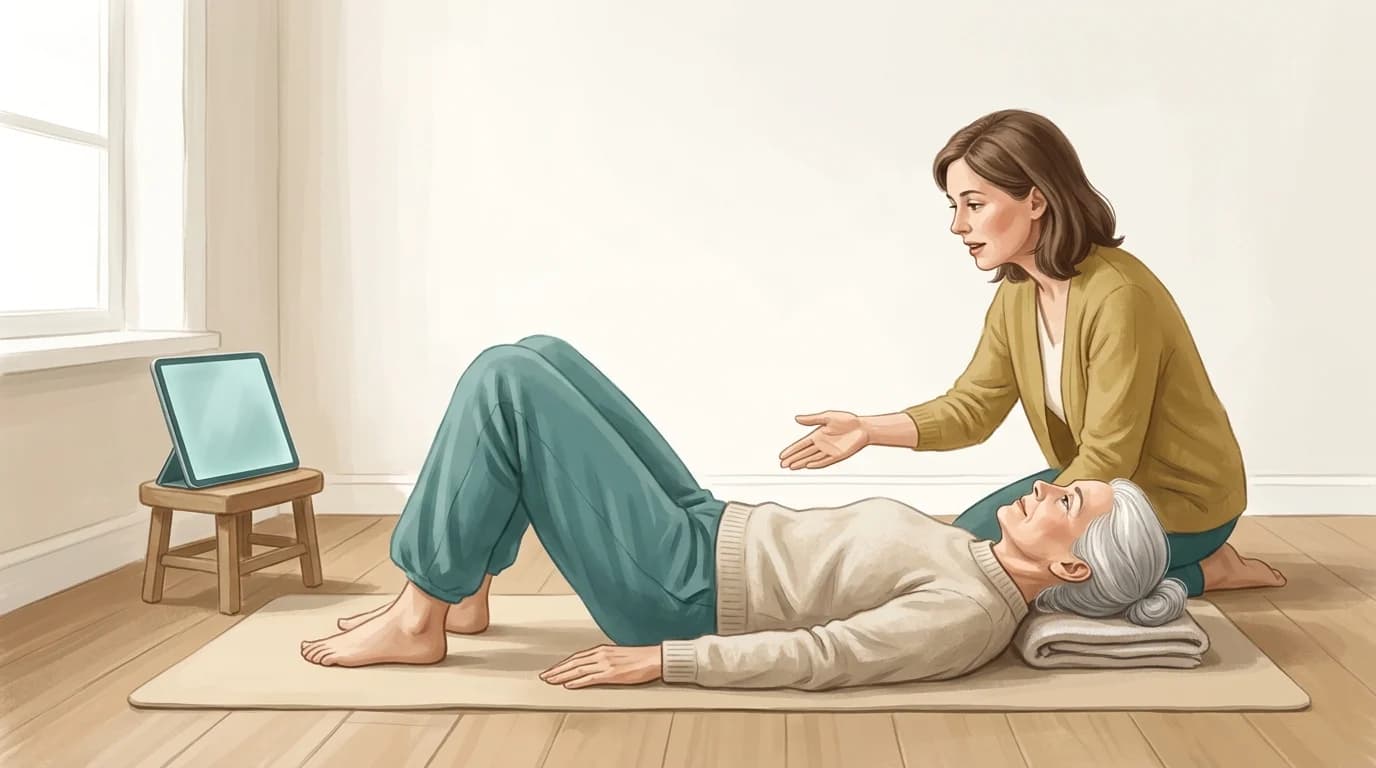
Online back programs that eased pain noticeably all included a person
On a screen alone, back care rarely made a felt change. The mixes that did had a physio, or exercise or teaching in person.
If you've followed a back program on your phone, or exercised along with a video on the laptop, you may have wondered whether the screen can carry the whole thing. The fairest answer so far: compared with doing nothing, almost every online program that reached a change people would feel also had a real person somewhere in the care. That comes from a review of 46 trials, most of them in people whose back pain had lasted for months.
That support took different forms. Sometimes it meant exercising with someone in person or seeing a physiotherapist; sometimes education about how back pain works, given face to face, while the exercises came from an app (Kaczorowski and colleagues, npj Digital Medicine, 2026).
Several parts, not one
The review pulled together trials of apps, websites, video calls and phone coaching for long lasting low back pain. Instead of judging each program as a whole, the authors pulled the programs apart into their ingredients: exercise, education about pain, and psychological support, such as learning how to manage the worry that often comes with pain. On its own, no single ingredient brought a change big enough for people to feel in daily life. Mixed, several did.
So if a screen is how you practise, that doesn't mean it's wasted effort. It may simply do more as one part of your care than as all of it.
A person somewhere in it
In the main analysis, every combination that reached a change people would feel included something in person: exercise with someone in person, a physiotherapist, or education given face to face. When the authors looked only at trials that tested a program done entirely on a screen, none of those programs reached it.
In person care on its own did about as well as the digital and mixed versions, so the review can't say how much of the gain comes from the person. The authors suggest, without proving it, that part of it may be the relationship itself; they also note that patients often say they want a human somewhere in the loop. What I think the screen adds is reach: practice at your own pace, at home, on the days nobody is there.
If you're comparing the best digital physical therapy apps for back pain, it's worth asking of each one where a person comes in.
The Feldenkrais angle
In a Feldenkrais Method® lesson the teacher isn't there to fix how you move. The work is to point your attention somewhere you hadn't looked. Perhaps your ribs move less freely since your back started hurting. Or you hold your breath just before you stand. Someone who can see what you can't yet feel from the inside can point to that, and that is part of what a person in the room offers. It's hard to get from a video playing at full speed while you try to keep up. You can borrow a little of it at home: go slower than the screen asks, and after each movement ask what you just noticed. None of these trials tested Feldenkrais; this is how I read the finding, not something the review showed.
Here's a short practice in that spirit. You only go where it feels easy, pleasant and comfortable.
Slower than the screen
About 5 minutes. Move slowly, do less than you can, and stay well below any pain. Rest whenever you need to.
- 1
Find a spot on the floor or a firm bed. Lie on your back and stand both feet, knees pointing up.
- 2
Notice your lower back. Where does it rest on the floor, and where does it lift away?
- 3
Press lightly through your feet so your pelvis rolls a little toward your head. Let it roll back.
- 4
Do it a few more times, smaller and slower each time. What does your lower back do?
- 5
Keep the movement going and notice your breath. Do you hold it? Then rest with your legs long.
- 6
Bend your knees again and roll your pelvis once or twice. Is it lighter now?
- 7
Rest. Notice your back on the floor again. What has changed since the start?
Let Feldy guide you, eyes closed
A calm voice walks you through gentle moves so your attention stays in your body, not on the screen.
Try Feldy Free for 7 daysNo credit card needed.
What the headline will miss
Every program here was compared with doing nothing at all, not with usual care, so it can only hint, not show, whether a mix does better than seeing a physiotherapist alone. Only results taken right at the end of each program could be analysed. There wasn't enough longer follow up to say whether the gains lasted. Nearly two thirds of the trials were at high risk of bias, which here mostly means people knew which program they were in and rated their own pain. The average participant was 48, so people in their sixties and seventies were probably few. And one extra analysis, limited to long lasting pain, did find a fully online mix (exercise, education and psychological support together) that reached a change people would feel in everyday tasks.
I teach an online movement program, so I have a personal interest in these findings. What I take from them is modest. The Feldy online movement program is built to sit alongside the care you already have, not in place of it, and this is the kind of evidence that keeps me saying so.
Bring it into the room
If you already see someone for your back, take your home practice to the next appointment, the app, the video or the lesson above, and ask one question: what would you want me to notice when I do this on my own?
Sources
Movement Pulse is informational, not medical advice. See our editorial policy.
Move better with Feldy
See the programMovement Pulse Weekly
The week's best research, in your inbox Tuesday.
Movement science, gentle-practice ideas, and a practitioner's read on what's new. Free.
More from Movement Pulse
Yoga, Pilates, tai chi or qigong for chronic back pain? 25 trials found no clear winner
All four eased pain by a similar margin. Tai chi topped the ranking, yet every tai chi trial was measured against people doing nothing at all.
Oct 26, 2026
Chronic back pain and the turn toward the nervous system
A new JAMA Internal Medicine trial joins a decade of research showing chronic low back pain often responds to attention, not just mechanics.
Jul 3, 2026Ready to start moving better?
Gentle, guided lessons for your body. Try your first one free, no credit card required.