
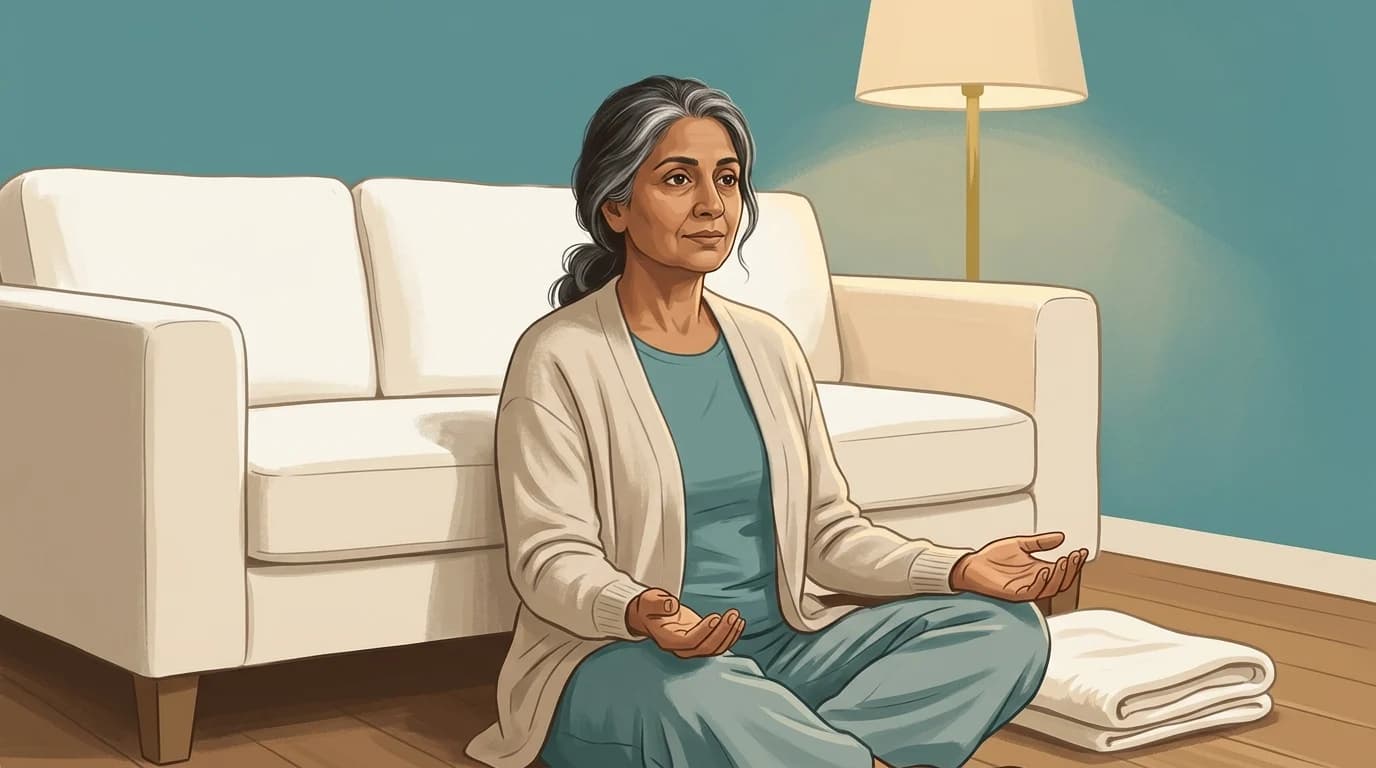
Why clenching a muscle helps you let it go, and what a new sleep review could not settle
A pooled analysis of fourteen randomized trials found that tensing and releasing muscles improved how adults rated their sleep. Doing more did not do more.
The instruction sounds backwards the first time anyone hears it. To relax a muscle, squeeze it hard first.
That is the engine of progressive muscle relaxation, a routine the American physician Edmund Jacobson published in 1929 and which has been taught in sleep clinics, oncology wards and stress courses ever since. You work upward through the body in groups. Squeeze the calves for a few seconds, let go, wait, notice what changed. Then the thighs, the belly, the hands, the shoulders, the face. A review published on 6 August in Frontiers in Public Health gathered fourteen randomized trials of that routine and asked whether it helps adults sleep.
What the review found
Kehan Li and colleagues, working across three Malaysian universities, searched five databases through May 2026 and pooled 957 participants. The result was a benefit of 1.24 in Hedges g, a standard way of expressing effect size, with a 95 percent confidence interval spanning 0.77 to 1.71 points of improvement and no part of it crossing over into harm (Frontiers in Public Health, 2026). In the paper those three figures are printed as minus 1.24, minus 1.71 and minus 0.77, because the sleep questionnaires used in these trials score lower when sleep gets better. Every one of them points the same way.
By convention an effect of that size is large. It also came with a heterogeneity figure of 85.5 percent, which is the review's own way of saying the fourteen trials disagreed with each other a great deal, and that the pooled number is an average across studies that were not measuring quite the same thing in quite the same people. Both halves of the population studied improved, those with cancer and those without, with the larger effect in the group without.
The two numbers I keep looking at
The first is a dose test. The authors ran a meta regression asking whether people who did more sessions slept better than people who did fewer, and the answer came back at p equals 0.2106. No relationship. More was not better. For a method whose usual failure mode is a person quietly deciding they must not be doing enough of it, that is worth sitting with.
The second is the age split, and it is where a headline could go wrong. Among adults under 55 the benefit reached 1.40 and was clearly significant. Among adults aged 55 and over the benefit was 1.17, and it did not reach significance. Read fast, that looks like a technique that stops working. Read properly, it is not. The two point estimates are close neighbours; what differs is precision, because the older group's interval was so wide that it stretched from a large benefit all the way across zero and out the other side. That is the signature of too few trials, not of an absent effect. Absence of evidence, as the phrase goes, and the authors are careful about it in their own conclusion.
Why the squeeze is there at all
Here is the part that interests me as a practitioner rather than a reader of statistics. Jacobson's clench is not the medicine. It's a contrast device. Most of us cannot feel a moderate amount of muscular effort at all, because it has been running so long that it has become the background, the way you stop hearing a fridge; what we can feel is a large change, so the method manufactures one, deliberately, in order to make the release loud enough to register. The jaw is the place I see this most often, a clench so familiar it has become part of the background, and Feldenkrais® work for the jaw approaches it through the neck, eyes, and breath rather than the jaw itself.
Two or three times a year someone arrives in my lessons saying they have done tense and release nightly for years and it has gone quiet on them. The routine still runs. Nothing much happens. What that usually tells me is that the contrast has been learned, and the person now needs the other approach to the same problem: instead of raising the effort until the difference is unmistakable, you lower everything until the room goes quiet and small differences become audible on their own. That's the direction the Feldenkrais Method® works in, and it is a genuinely different mechanism from Jacobson's, not a better one. Each has its strengths. People who find one of them dull often find the other one immediately interesting, which is information about them rather than about the methods.
Here is a short version of the second approach. It asks for six minutes, no equipment, and no squeezing whatsoever.
An evening effort scan to try
About 6 minutes. Move slowly, do less than you can, and stay well below any pain. Rest whenever you need to.
- 1
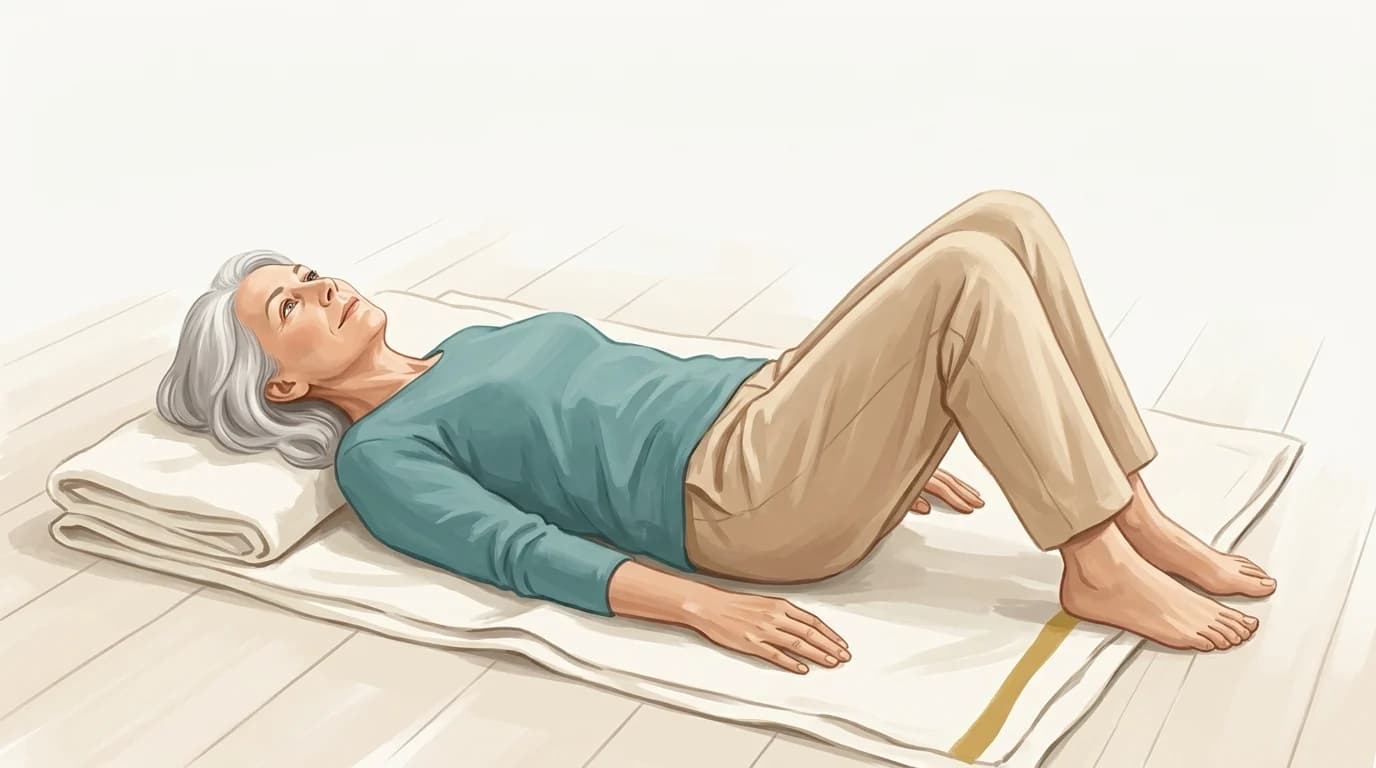
Lie on your back somewhere firm enough to feel yourself against it. Let your legs lie however they want.
- 2
Begin at your left foot and ask: is this doing anything right now? Then the calf, the thigh, the hip. Take your time.
- 3
Visit the right side the same way, foot upward. Is one side clearer to sense than the other?
- 4
Tighten your left hand into a fist, half as hard as you could, for one slow breath. Then release it fully.
- 5
Notice the left hand compared with the right. Then do the same with the right hand, and let it go. Rest.
- 6
Lie still for a minute and let whatever settled, settle. If any of this felt effortful, make it smaller next time.
- 7
Notice where your shoulders lie now, and your hands, compared with when you began. What has changed?
Let Feldy guide you, eyes closed
A calm voice walks you through gentle moves so your attention stays in your body, not on the screen.
Try Feldy Free for 7 daysNo credit card needed.
What to do with this
If tensing and releasing gets you to sleep, keep doing it. Nothing in this review says otherwise, and fourteen trials pointing the same way is not a small thing. If counting suits you better than squeezing, the 4 7 8 breathing method is another bedtime pattern, built on a long, slow exhale. If it used to work and no longer does, the meta regression offers a clue about which lever not to pull: adding sessions was not what separated the people who improved from the people who did not.
And if what keeps you awake is the sense of a body that will not put itself down, that pattern has its own long history in the research on chronic stress and muscle tension, and it responds to attention more reliably than it responds to force. The link between sleep disruption and physical tension runs in both directions, which is part of why a method aimed squarely at muscles ends up being scored on a sleep questionnaire at all. Persistent sleep trouble, snoring that worries the person next to you, daytime exhaustion that rest does not touch: those belong in a conversation with your physician, and gentle evening practice sits alongside that conversation rather than in place of it. In the Feldy online movement program, the bedtime ritual is built on exactly the logic above, done lying down, in the dark, at low effort.
Fourteen trials, 957 people, and the one group the review could not resolve is the group most likely to be lying awake at half past two reading about it. Somebody should run those trials.
Sources
Movement Pulse is informational, not medical advice. See our editorial policy.
Move better with Feldy
See the programMovement Pulse Weekly
The week's best research, in your inbox Tuesday.
Movement science, gentle-practice ideas, and a practitioner's read on what's new. Free.
More from Movement Pulse
Lying down is not the same as resting, and researchers have now measured the difference
A panel of 27 people and 162 adults living with fatigue helped build a scale for rest. One of its six parts is called lack of skill.
Sep 13, 2026
Slow movement and stress: what trials keep finding
A new controlled trial joins years of research linking slow, attentive movement with a calmer nervous system, and showing where doing more stops helping.
Jul 13, 2026
What a slower exhale does to a stressed nervous system
A small June 2026 study found that lengthening the exhale eased tension and quieted a marker of brain arousal in 40 minutes. A practitioner's read on why.
Jun 30, 2026Ready to start moving better?
Gentle, guided lessons for your body. Try your first one free, no credit card required.