
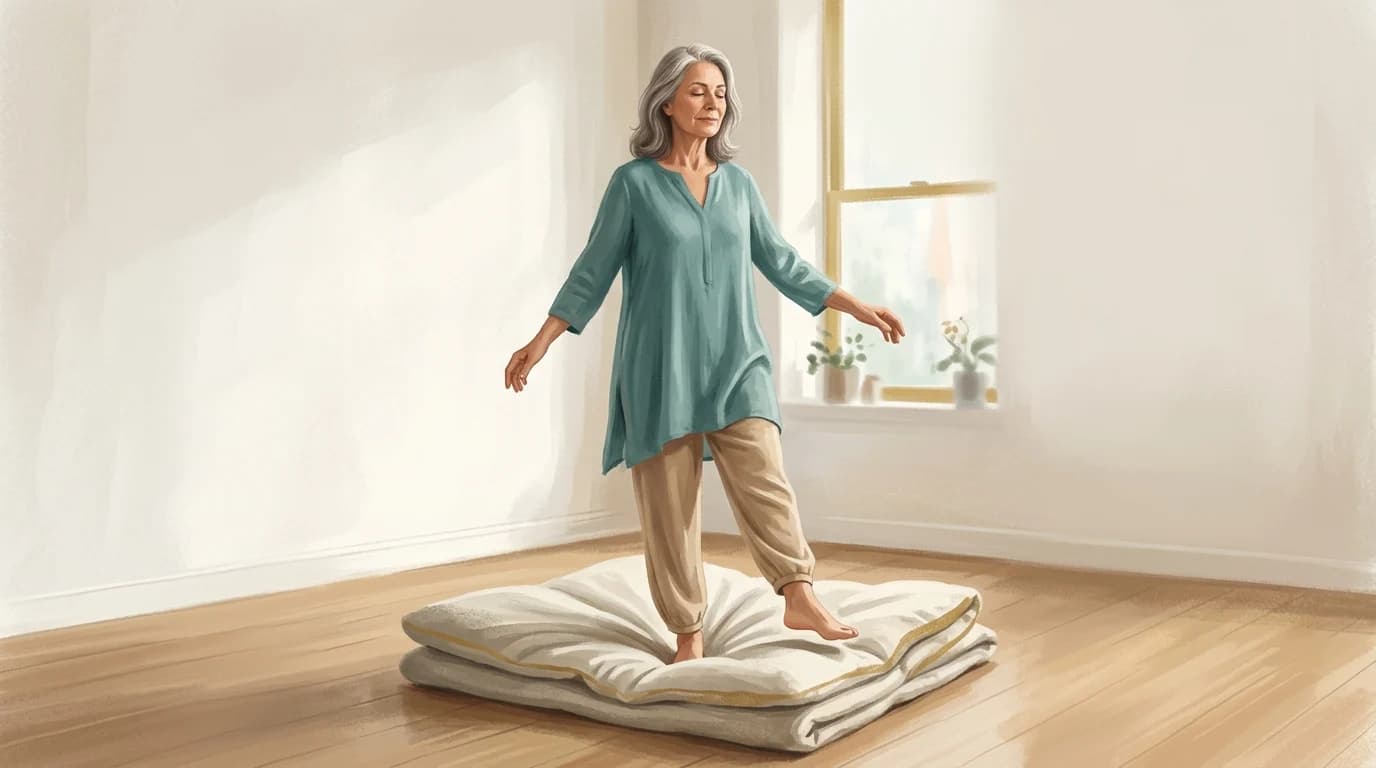
Unstable training's edge was confidence, not strength
A July 2026 meta-analysis compared resistance training on unstable surfaces with the same work on solid ground in older adults. Strength matched. Confidence did not.
A meta-analysis published online this month asked a tidy question about strength training for older adults: if you do the same resistance work standing on something wobbly instead of on solid ground, do you get more out of it? The easy headline says yes. The data says something narrower, and to my eye something far more interesting.
The review, by Doan and Chang in the American Journal of Physical Medicine & Rehabilitation, pooled seven randomized controlled trials reported across eight articles, six of which contributed to the meta-analyses (American Journal of Physical Medicine & Rehabilitation, 2026). Every trial compared unstable resistance training, meaning the same squats or leg work performed on a foam pad, wobble cushion, or balance board, against stable resistance training on the floor. The outcomes were grouped into three families: lower limb strength, measured by maximal isometric leg extension and the Five Times Sit to Stand test; mobility, measured by the Timed Up and Go test and gait speed; and fear of falling, measured by the Falls Efficacy Scale International. Results were pooled separately for short programs of 10 to 12 weeks and long programs of 24 weeks.
Here is what came out. After the short programs, unstable training showed no significant advantage over stable training on any strength or mobility outcome. On the sit to stand test, the stable group actually showed a nonsignificant trend toward better performance. The one measure that separated the two groups in the short term was fear of falling, which unstable training significantly reduced. Then, only in the trials that ran to 24 weeks, the Timed Up and Go improved as well.
What the headline misses
Read quickly, this becomes "wobble boards work, add instability." Read carefully, it says something else. The unstable surface did not build a measurably stronger leg than the stable one did. It changed what people believed their leg could do. And the functional measure, the time it takes to stand up, walk three meters, turn, and sit back down, followed later.
That order is worth sitting with, because it runs opposite to how fall prevention is usually explained. The standard story is that you build strength, and confidence arrives as a byproduct. In these pooled trials the confidence measure moved first and the functional measure moved second.
There is a plausible reason, and it has little to do with muscle. Standing on an unstable surface is not primarily a strength stimulus. It is a sensory and attentional one. A foam pad degrades the information coming up through the sole of the foot, so the nervous system has to work harder at sampling everything else: the ankle, the hip, the weight of the head, the small continuous corrections that keep a body over its base. What repeats, week after week, is not load. It is the experience of being slightly off balance and finding that nothing bad happens.
This is where the finding lands for me as a Feldenkrais® practitioner. Fear of falling is not a soft outcome sitting alongside the hard ones. It is a driver of the thing it fears. Roughly half of older adults report it, with a pooled global prevalence of 49.6 percent across 153 studies and more than 200,000 participants (BMC Geriatrics, 2024). And the well documented consequence of fear of falling is that people narrow what they attempt. Fewer stairs, fewer uneven paths, fewer turns of the head while walking. The narrowing then produces the deconditioning that makes a fall more likely. You have not lost the movement. You have lost trust that the movement will hold you.
The honest limits
Seven trials is a thin evidence base, and the review says so. Nobody can blind a participant to whether they are standing on foam. Fear of falling is self reported, so some of the improvement may reflect having spent 12 weeks proving something to yourself rather than a change in physical risk. And unstable training was not superior across the board. On one strength measure the trend, though not significant, favored the stable version. None of this is a case for replacing floor based strength work, which remains the best supported intervention for the changes in movement that come with age.
What it suggests in practice
If confidence is a variable in its own right, it can be practiced in its own right, and it does not require a piece of equipment. Awareness Through Movement®, the guided lessons of the Feldenkrais Method®, works in that same territory: small, slow, comfortable movements where you only go where it feels easy, pleasant, and comfortable, repeated until the nervous system stops treating an unfamiliar position as a threat. Rolling the weight slowly from one foot to the other. Turning the head while standing and noticing what the ankles do. Nothing dramatic, and nothing that needs a wobble cushion under it.
Whatever a person chooses to do about the strength side, and that is a conversation for them and their physiotherapist, this work sits alongside clinical care rather than in place of it. Among the movement practices people take up on their own, tai chi, yoga, Pilates, and the Feldenkrais work I teach are different mechanisms, each with its own strengths, not a ranking.
The Feldy online movement program is one way to keep that kind of attentive, unhurried practice going on ordinary days. It is not a fall prevention treatment. It is a way of giving the nervous system regular, quiet evidence that being slightly off balance is survivable, which appears to be a large part of what these trials were measuring all along.
Let Feldy guide you, eyes closed
A calm voice walks you through gentle moves so your attention stays in your body, not on the screen.
Try Feldy Free for 7 daysNo credit card needed.
Sources
- Comparative Effectiveness of Unstable Versus Stable Resistance Training on Lower Limb Strength, Mobility, and Fear of Falling in Older Adults: A Systematic Review and Meta-analysis of Randomized Controlled Trials— American Journal of Physical Medicine & Rehabilitation (PubMed)
- The global prevalence of and risk factors for fear of falling among older adults: a systematic review and meta-analysis— BMC Geriatrics
Movement Pulse is informational, not medical advice. See our editorial policy.
Move better with Feldy
See the programMovement Pulse Weekly
The week's best research, in your inbox Tuesday.
Movement science, gentle-practice ideas, and a practitioner's read on what's new. Free.
More from Movement Pulse
Even strong athletes wobble when the eyes close
A July 2026 study found even competitive weightlifters lost steadiness once the surface softened and the eyes closed. Balance is sensing, not strength.
Jul 6, 2026
Your balance may be listening to your nose, and pleasant scents steadied some older adults
Ten small studies of smell and standing suggest that balance draws on more than eyes, ears and feet, and that how a moment feels may change how steadily you stand in it.
Oct 15, 2026
The best time to start gentle balance practice may be before you feel you need it
Ten trials of Tai Chi, Baduanjin and yoga in older adults who were frail or edging toward it. Balance improved in both groups, and most clearly in people who had not yet crossed the line.
Sep 28, 2026Ready to start moving better?
Gentle, guided lessons for your body. Try your first one free, no credit card required.