

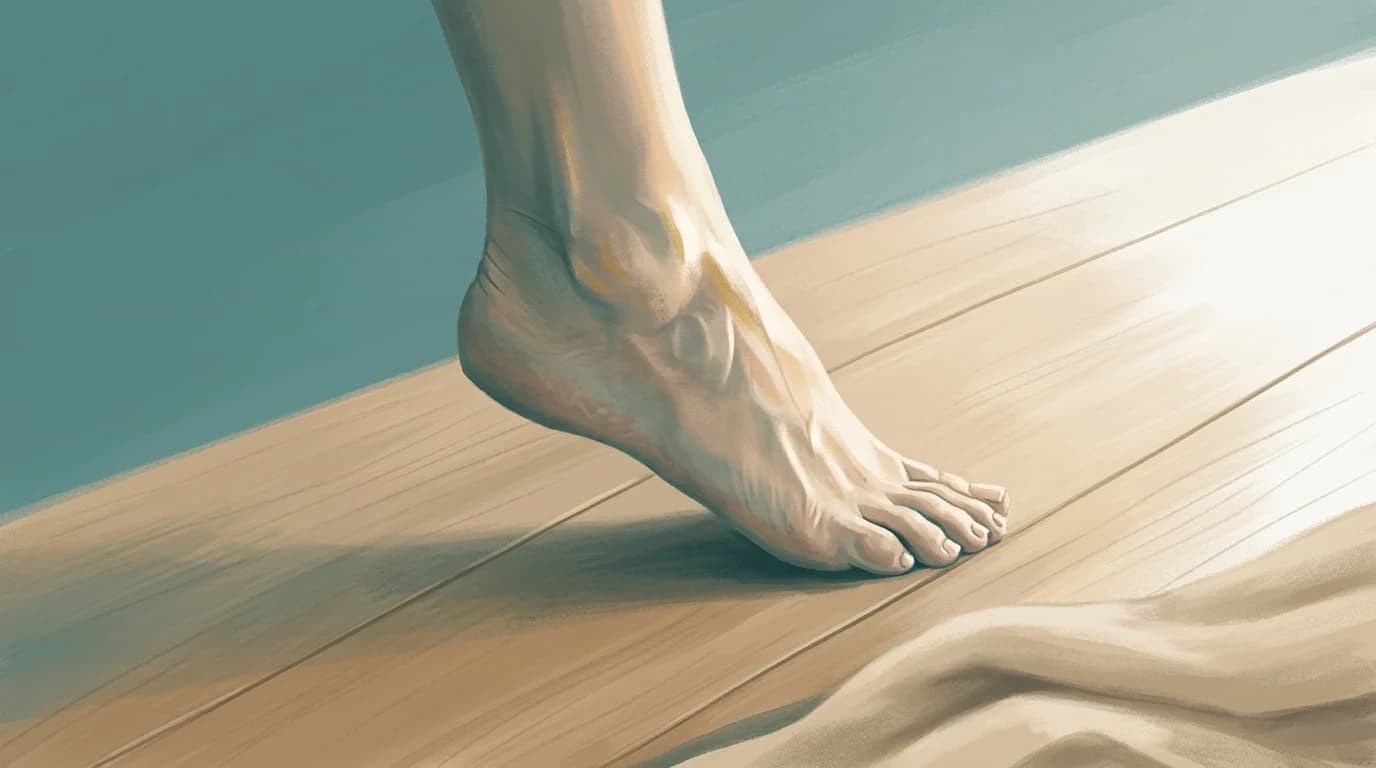
What predicted falls in older women was not the strength in the leg but how well they sensed the foot
A new study in women over sixty five found that foot and ankle position sense, more than raw muscle strength, was the strongest predictor of who fell. Here is a short way to practice the sensing itself.
For years the advice on preventing falls has pointed in one direction: get stronger. Build the legs, train the glutes, load the muscles that hold you upright. It is good advice, and it is not wrong. But a study published this year quietly complicates the story, and the complication is worth understanding, because it changes what you might practice.
Researchers assessed ninety two women aged sixty five and over and compared several things that could plausibly explain who fell and who did not (Journal of Back and Musculoskeletal Rehabilitation, 2026). They measured muscle strength, reaction time, the sense of vibration in the foot, and something called joint position sense, which is how accurately a person can feel where their ankle is in space without looking. When they lined everything up, the strongest single predictor of falls was not strength. It was that sense of position. The women whose ankles gave them the least accurate information about where they were fell the most.
This is a cross sectional study, a snapshot rather than a film, so it shows a strong association rather than proving cause. But it fits a picture that anyone who works with movement recognizes. Staying upright is not mainly a feat of strength. It is a feat of sensing and responding, fast and below the level of thought, to the small errors that happen with every step. A strong leg that cannot feel the ground clearly is like a powerful engine attached to a foggy windscreen. The power is there. The information is missing.
The encouraging part is that sensing, unlike raw strength, responds quickly to attention. You cannot think your way to a stronger muscle, but you can absolutely sharpen how vividly you feel your own feet, and you can do it in a few minutes without equipment. This is the heart of a gentle Feldenkrais® approach to balance. Rather than drilling harder, you slow down enough that the nervous system starts collecting clearer information about where you are, which over time can quiet the wariness that so often shadows unsteadiness. Here is a short version you can try standing at your kitchen counter.
A short standing practice for the sense in your feet
About 5 minutes. Move slowly, do less than you can, and stay well below any pain. Rest whenever you need to.
- 1
Take the first reading. Stand near a wall or a sturdy chair you can touch at any moment, feet about hip width apart, and let your attention drop all the way down to the soles of your feet. Without changing anything, ask where the weight actually falls. More toward the heels or the toes. More to the outer edges or the inner arches. Evenly between the two feet or quietly favoring one. You are not correcting the answer, only reading it.
- 2
Explore the edges of your own balance. Very slowly, let yourself sway a small amount forward and back, then side to side, so small that a person watching would barely notice. Feel how the pressure travels under each foot as you move, and feel the ankles making dozens of tiny adjustments you never normally sense. Go only where it feels easy, pleasant, and comfortable, and keep the wall or chair within reach the whole time.
- 3
Wake up one ankle. Bring your attention to just one foot. Slowly lift the toes without lifting the heel, set them down, then let the whole foot spread. Do it a few times, unhurried, and notice how much clearer the position of that ankle becomes the moment you pay attention to it. Then stand still and compare the two feet. Most people find the foot they attended to feels more present, more in contact, easier to sense.
- 4
Take the second reading. Stop everything and stand quietly for half a minute. Then read the soles of your feet again, in the same order as the first time. You are not looking for a better result. You are comparing two readings taken five minutes apart, and either answer teaches you something about how well you can feel where you are.
Let Feldy guide you, eyes closed
A calm voice walks you through gentle moves so your attention stays in your body, not on the screen.
Try Feldy Free for 7 daysNo credit card needed.
None of this replaces strength work, and none of it replaces the balance assessment a physiotherapist or doctor can offer if falls are a real concern for you. Strength and sensing are partners, not rivals, and a good plan grows both. What the study adds is a reminder that the quieter half of balance, the feeling of where you are, is trainable, is often neglected, and may matter more than we have given it credit for. It is also, conveniently, the half you can practice barefoot, at home, in the time it takes the kettle to boil.
Sources
- Proprioception: the strongest predictor to falls in older females, a cross sectional study— Journal of Back and Musculoskeletal Rehabilitation
Movement Pulse is informational, not medical advice. See our editorial policy.
Move better with Feldy
See the programMovement Pulse Weekly
The week's best research, in your inbox Tuesday.
Movement science, gentle-practice ideas, and a practitioner's read on what's new. Free.
More from Movement Pulse
The strongest predictor of falls is not strength
A new 2026 study put proprioception, vibration sense, and muscle strength head to head against fall frequency in older women. The sensing variable won.
Jun 20, 2026
Why the balance exercise that works in a class may not be the one that works at home
A new analysis pooled 423 trials and nearly 34,000 older adults to compare 19 ways of training balance. The ranking changed depending on which kind of balance was being measured.
Aug 16, 2026
Even strong athletes wobble when the eyes close
A July 2026 study found even competitive weightlifters lost steadiness once the surface softened and the eyes closed. Balance is sensing, not strength.
Jul 6, 2026Ready to start moving better?
Gentle, guided lessons for your body. Try your first one free, no credit card required.