
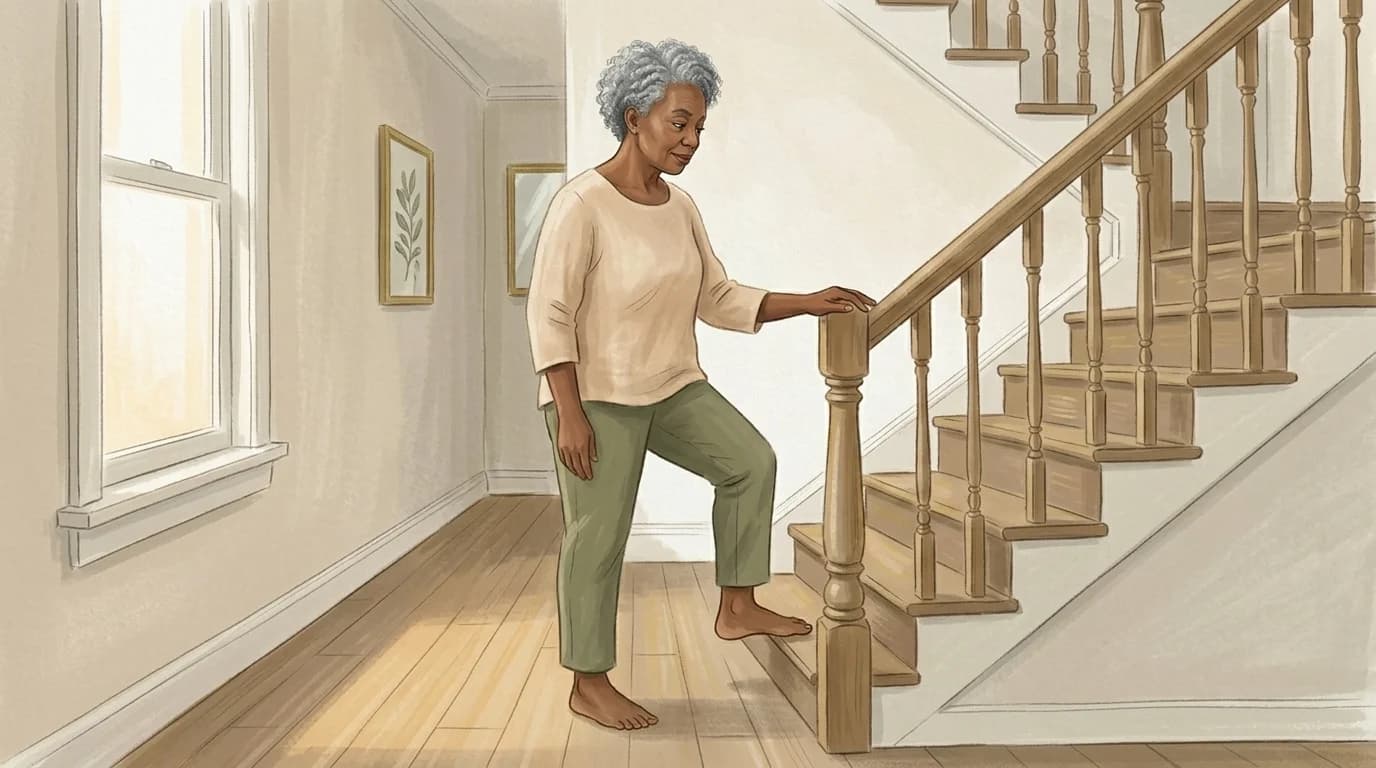
Why the balance exercise that works in a class may not be the one that works at home
A new analysis pooled 423 trials and nearly 34,000 older adults to compare 19 ways of training balance. The ranking changed depending on which kind of balance was being measured.
If you have gone looking for the best exercise for balance in older adults, you have probably found a list. A large new analysis suggests the list is missing the question that comes before it, which is what kind of balance you are trying to train.
Published in Ageing Research Reviews in mid August, the review pooled 423 randomized controlled trials covering 33,901 adults aged 60 and over, none of them recruited for a specific disease, and compared 19 exercise approaches against each other rather than testing them one at a time (Wang et al., Ageing Research Reviews, 2026). It is the largest comparison of its kind I have come across.
Eighteen of the nineteen approaches were associated with better overall balance than control conditions. The one that showed no clear benefit was stretching. The largest overall estimates went to perturbation training, where a therapist or a machine deliberately unbalances you so you practice the recovery, at 0.66 on a standardized scale, followed by sensory training at 0.55, dance at 0.54, and agility stepping at 0.53. Those are small to moderate effects, not transformations.
Then the ranking moved. When the authors separated balance into its component jobs, a different approach came to the front for each one. Tai Chi had the largest estimate for global balance. Perturbation training led for static balance. Pilates led for dynamic balance. Agility stepping and aquatic exercise led for proactive balance. Balance specific training, aquatic exercise, and conventional resistance training showed tentative signals for reactive balance. The authors are careful here, and so am I. They state plainly that these estimates do not establish superiority.
Balance is at least four jobs, not one
Static balance is staying steady when you are not going anywhere. Standing at the kitchen counter. Waiting in line.
Dynamic balance is staying steady while you move through space. Walking across a room, then turning to leave it.
Proactive balance is the adjustment you make before a challenge you can see coming. Stepping over the dog, reaching up to a high shelf, going down a curb.
Reactive balance is the catch. The trip you did not plan for, the moment your weight goes somewhere you did not send it.
Once those are separate, a pattern I run into constantly with clients starts to make sense. Someone has been practicing balance diligently for a year. They can stand on one leg for a minute. And they are still uneasy on the stairs, still hesitant stepping off a curb in the rain. They did not fail at it. They trained one job well and then met a different one.
Different mechanisms, not a leaderboard
This is where the ranking question loses its grip. Tai Chi, Pilates, dance, yoga, the Alexander Technique, and the Awareness Through Movement® lessons I teach as a Feldenkrais Method® practitioner are all things you practice on your own, and each works by a genuinely different mechanism. Tai Chi rehearses continuous weight transfer. Pilates organizes the trunk while the limbs move. Dance adds rhythm, direction change, and the useful fact that you forget you are exercising. Sensory work, the category my own field sits closest to, is aimed at how clearly you sense your position, your contact with the floor, and where your weight actually is, rather than at how strong or how fast you are.
These are not competing versions of the same thing. On this evidence they are good at different jobs, which is a more useful result than a winner would have been. It is the same shape of answer I give when someone asks me to settle yoga or Pilates for flexibility. The two are built differently, so they are good at different things, and the ranking never quite arrives.
The two findings I keep putting side by side
Two of the study's context results sit next to each other in a way worth noticing. Perturbation training, the approach with the largest overall estimate, produced its bigger effects in supervised settings and among people already at increased fall risk. Sensory training produced the largest home based estimate.
That is not a claim that sensory work is better. It is a claim about where each one is practicable. Being deliberately destabilized by a trained person is a genuinely effective thing that almost nobody can arrange in their living room on a Wednesday. Work on how you sense yourself is something you can do lying on the floor with no equipment, which is roughly why it survives contact with an ordinary week. Proprioception changes with age quietly enough that most people notice the consequence long before they notice the cause.
What to take from it
Ask which balance your current practice is training. Most home routines are static heavy, because standing on one leg is easy to explain and easy to check. If the situations that worry you are stairs, curbs, turning quickly, or carrying something across a room, those are dynamic and proactive problems, and they are worth practicing as such.
Note also what stretching did not do here. It has its own uses. On this evidence, being a balance program is not one of them.
And if you have already had a fall, or a clinician has told you that you are at increased fall risk, this is not a solo project. The supervised approaches did better in exactly that group, and what you practice at home sits alongside physiotherapy and clinical care rather than in place of it. Fear of falling belongs in the picture too, and it tends to respond to different things than leg strength does.
The shift this analysis invites is small and fairly freeing. Stop asking which method is best for balance. Start asking which balance you are training, and whether the thing you have chosen is something you will still be doing once the novelty has worn off. Nineteen approaches worked. The one that goes on working is the one you can do on an ordinary Tuesday, gently enough that you go only where it feels easy, pleasant, and comfortable, in a body that is meanwhile learning to feel where it is.
Let Feldy guide you, eyes closed
A calm voice walks you through gentle moves so your attention stays in your body, not on the screen.
Try Feldy Free for 7 daysNo credit card needed.
Sources
Movement Pulse is informational, not medical advice. See our editorial policy.
Move better with Feldy
See the programMovement Pulse Weekly
The week's best research, in your inbox Tuesday.
Movement science, gentle-practice ideas, and a practitioner's read on what's new. Free.
More from Movement Pulse
The strongest predictor of falls is not strength
A new 2026 study put proprioception, vibration sense, and muscle strength head to head against fall frequency in older women. The sensing variable won.
Jun 20, 2026
Tai chi walking is the balance trend of the summer. What the research actually shows
Tai chi walking is everywhere this summer. The evidence on balance and falls is encouraging, and it comes from classical tai chi, not the viral version.
Jul 29, 2026Ready to start moving better?
Gentle, guided lessons for your body. Try your first one free, no credit card required.