
Stiff most mornings? What the largest review of tai chi and qigong actually found
A new BJSM umbrella review grades the evidence for tai chi, qigong and related practices across 1,744 trials. Plus a five minute weight shift experiment.
Tai chi has carried the same reputation in the West for decades: pleasant, gentle, probably good for you in some vague way, but surely too slow to count as real exercise. A large new review suggests the evidence has stopped agreeing with that picture, and if stiffness is part of your daily life, the details are worth a careful read.
What the review actually found
On August 17, researchers from China Medical University published an umbrella review in the British Journal of Sports Medicine that gathered what the trial literature currently says about traditional Chinese exercises for musculoskeletal conditions. Traditional Chinese exercises is the collective term for tai chi, qigong, baduanjin, yijinjing and several related practices, all of them slow, deliberate, and built around attention to the body while it moves. The review drew on 92 pooled analyses covering 1,744 randomized controlled trials (British Journal of Sports Medicine, 2026), which makes it the widest look at this question I have come across.
What makes the paper unusual is not its size but its honesty. The team graded every finding with the GRADE framework, a standard system for rating how much confidence a body of evidence actually deserves. Most findings landed in the lower tiers, which is true of nearly every exercise literature ever assembled, and the authors say so plainly. But a core set earned the top grade. High certainty evidence showed that these practices improved physical function in knee osteoarthritis, supported mental health in people with knee osteoarthritis and neck pain, and improved sleep quality in fibromyalgia. Tai chi specifically alleviated chronic musculoskeletal pain and stiffness. For a family of practices that many people still file under relaxation, that is a serious list.
The subgroup analyses added a practical note: programs that ran longer, met more often, and reached a moderate to high weekly volume were associated with greater gains in knee osteoarthritis and osteoporosis. Regular, sustained practice tracked with better results than occasional visits.
One more finding deserves mention, and it deserves careful labeling. The review separately reports, at lower certainty than the findings above, that tai chi was associated with increased bone mineral density in participants with osteopenia or osteoporosis. That is an encouraging signal, and it fits a broader pattern in the bone health literature, but the evidence behind it is not yet as solid as the function, pain, and stiffness results. If bone density is your main concern, treat this as a promising thread to raise with your physician rather than a settled conclusion.
The part that interests me most
Notice what every practice on that list has in common. None of them is fast. None of them is strenuous in the gym sense. What they share is slowness, repetition, and a demand that you pay attention to what you are doing while you do it. What I see in clients is that stiffness rarely lives in a position; it lives in the transitions, in the getting up, the turning, the first steps across a cold kitchen floor. Practices built from slow transitions give a person thousands of chances to meet exactly those moments.
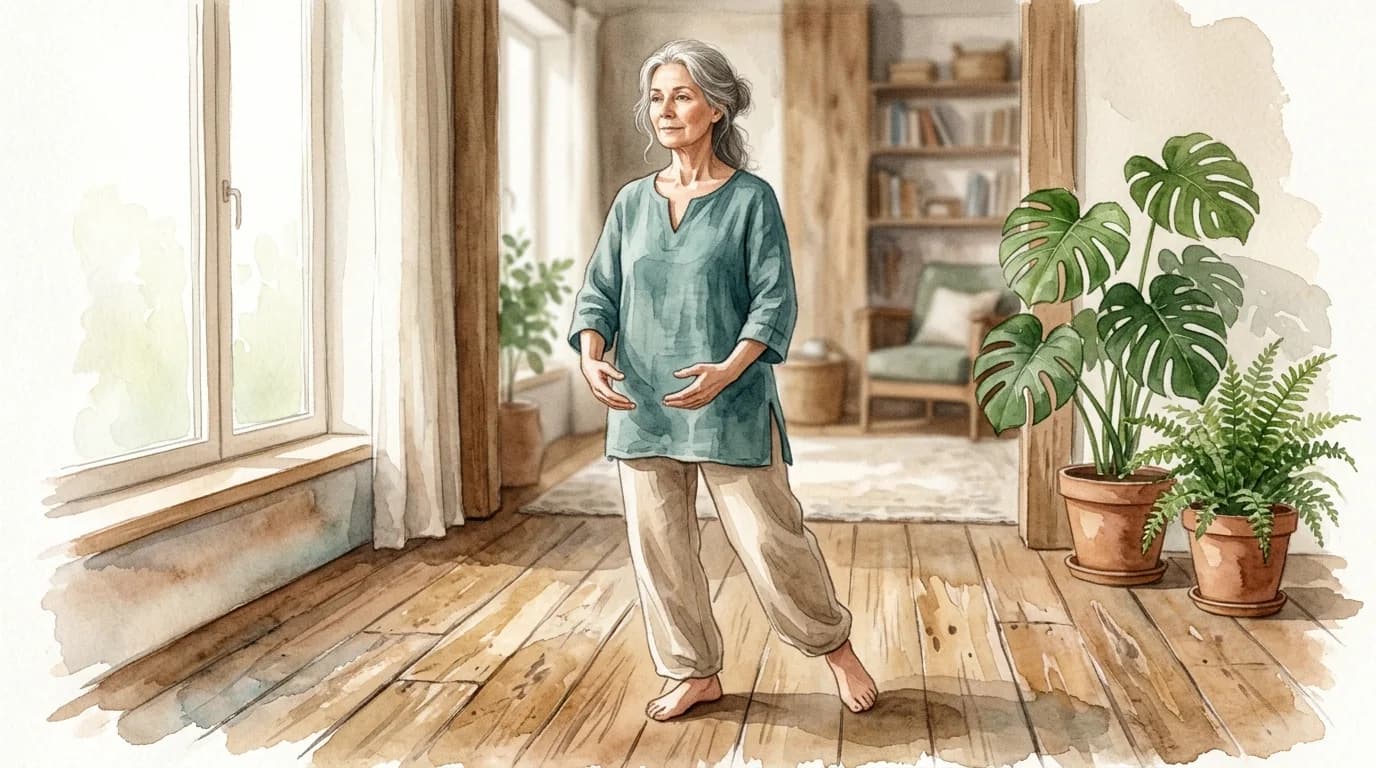
Here is a small experiment in that direction, borrowed from the logic these practices share. It asks for five minutes, no equipment, and no flexibility whatsoever. Throughout, you only go where it feels easy, pleasant, and comfortable.
A slow weight shift to try
About 5 minutes. Move slowly, do less than you can, and stay well below any pain. Rest whenever you need to.
- 1
Stand with your feet a comfortable width apart, near a counter or the back of a chair if you like having something to rest a hand on. You can also do this sitting. Before anything moves, notice how your weight is arranged between your two feet. Is it even? Is one foot carrying more than the other?
- 2
Begin to shift your weight toward your right foot, and make the shift far slower than feels natural, as if it were spread across a whole breath in and a whole breath out. There is nowhere to arrive. You only go where it feels easy, pleasant, and comfortable.
- 3
Drift back through the middle and over toward the left foot, just as slowly. As the weight travels, notice what else joins in. Do the ribs move? Does the head drift a little? Does the breath change somewhere along the way?
- 4
Now slow it down even more, and see if you can catch the exact moment when one foot begins to carry more than the other. Most of us have never once felt that moment, even though we pass through it thousands of times a day.
- 5
Let the shifting become smaller and smaller until you are simply standing. Rest there for a few breaths. How is your weight arranged now, and does standing feel like the same activity it was five minutes ago?
Let Feldy guide you, eyes closed
A calm voice walks you through gentle moves so your attention stays in your body, not on the screen.
Try Feldy Free for 7 daysNo credit card needed.
What to make of it
If you tried the experiment, you spent five minutes inside the raw material of tai chi: a weight shift, done slowly enough to be felt. Whether anything seemed different afterward, the more interesting question is what you noticed on the way. People who feel stiff in the knees in the morning often discover in this kind of experiment that the stiffness has a geography, that it announces itself at one point in the shift and not at another. That information is useful in a way no general label ever is.
To be clear about where all of this sits. For arthritis, osteoporosis, or persistent pain, a practice like tai chi sits alongside the care of your physician and physiotherapist, never in place of it. Among the movement methods themselves, tai chi, qigong, yoga, and the Feldenkrais Method® each work through a different mechanism, and each has its own strengths; nothing in this review ranks one above another, and neither would I. In the Feldenkrais® lessons I teach, the slowness and the attention are the whole point too, applied to an even wider range of everyday movements, usually lying down where gravity asks less of you. A person drawn to what this review describes might feel at home in either room, or in both.
The quiet headline here is bigger than any single modality. The most rigorous summary we have of this literature now says that slow, attentive, low effort movement, practiced regularly, earns some of its strongest evidence exactly where stiffness lives: function, pain, and the felt quality of moving through a day. If you already have a slow practice, this is a good week to keep going. If you do not, five minutes of shifting your weight is a very honest place to begin.
Sources
- Efficacy and evidence certainty of traditional Chinese exercises for musculoskeletal disorders: an umbrella review of meta-analyses— British Journal of Sports Medicine
Movement Pulse is informational, not medical advice. See our editorial policy.
Move better with Feldy
See the programMovement Pulse Weekly
The week's best research, in your inbox Tuesday.
Movement science, gentle-practice ideas, and a practitioner's read on what's new. Free.
More from Movement Pulse
Half an hour of stretching a day gave tight hamstrings no clear edge over a few minutes
A six week trial in Thailand set 210 minutes of stretching a week against nine. A practitioner's read on why the range changed while the muscle did not, and a short practice that asks for less.
Oct 4, 2026
The same muscle, the same knee angle, a stiffness reading that changed when the hip moved
A randomized crossover study in Scientific Reports measured quadriceps stiffness in four body positions. Keeping the knee at the same angle, changing the hip position changed the measured stiffness of a muscle that does not cross the hip.
Sep 19, 2026
The stiffness you feel is not the stiffness we can measure
A 2025 knee osteoarthritis study measured muscle stiffness with shear wave elastography and found it did not correlate with the tightness patients reported feeling.
Jul 17, 2026Ready to start moving better?
Gentle, guided lessons for your body. Try your first one free, no credit card required.