
Body Awareness Exercises: A 5 Minute Feldenkrais® Lesson
A short lying or seated lesson that uses small movements to sense where you meet the floor or chair, one side compared with the other.
Before you begin. This is a gentle attention practice, not a treatment. Skip or shorten it after a recent injury or surgery, and sit instead of lying down if lying down makes you dizzy. If paying attention to your body ever feels overwhelming, keep your eyes open, stop at any time, and consider talking with a trained professional.
The lesson
About 5-10 minutes. Move slowly, do less than you can, and stay well below any pain. Rest whenever you need to.
Prefer to listen than read?
Feldy voices gentle lessons like this for body awareness, so you can close your eyes and follow along.
- 1
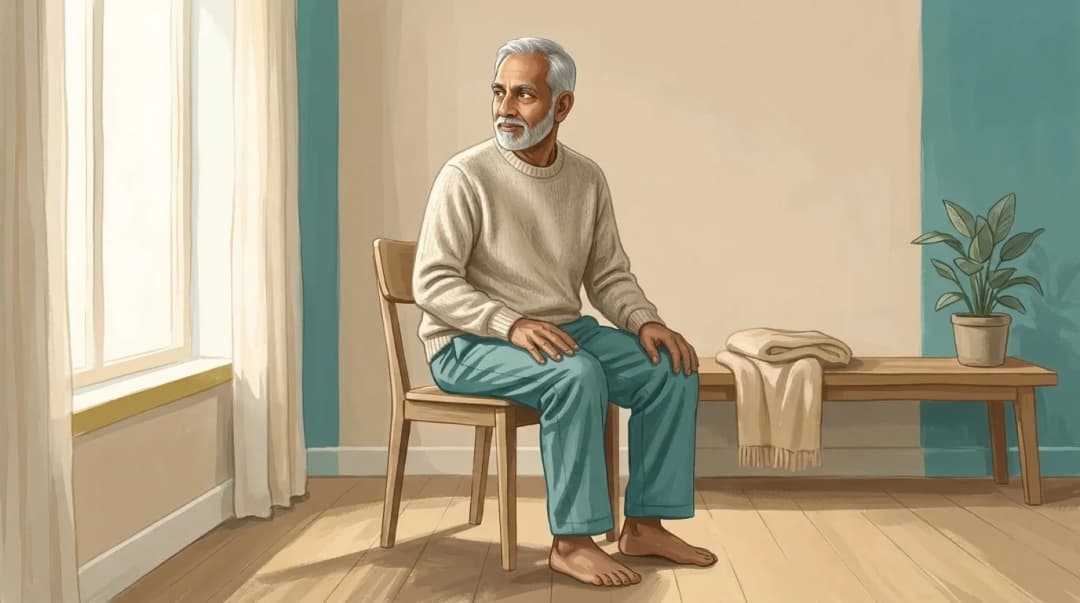
Settling in. Settle on the floor, face up, knees bent and feet standing. A chair works too. Eyes open or closed, as you prefer.
- 2
Where you touch. Notice where your body meets the floor or chair. Which parts press more, and which barely touch?
- 3
Two sides. Compare your two sides. Does one shoulder, one hip or one heel seem to make more contact than the other?
- 4
A small heel slide. Slide one heel a little way along the floor and back, slowly. Make it smaller, or only imagine it, if it feels like effort.
- 5
Rest and compare. Stop and rest. Compare the leg you moved with the other one. What is different in how each one touches?
- 6
A small shoulder lift. Raise one shoulder slightly, then lower it, slowly. Stop and rest. Where else did you sense that small movement?
- 7
The closing scan. Notice your contact with the floor or chair again, side to side. What has changed, if anything?
Let Feldy guide you, eyes closed
You just read these steps. In the Feldy program, a calm voice guides you through each gentle move, so your attention can stay in your body instead of on the screen.
Try Feldy Free for 7 daysNo credit card needed.
Body awareness exercises are short practices that ask you to notice your own body while you move, so you can feel where you are, how much effort something takes and how you touch the floor. Below is one you can do right now, lying on the floor or sitting in a chair. It takes about five minutes, and the steps are written so you can read one, do it, and come back for the next.
The lesson is drawn from the Feldenkrais Method®. It uses small movements, because a movement gives your attention something to follow, and then rests, because rest is where you compare. Nothing here is a goal. The only task is to be curious about what you feel.
Body awareness exercises: a lesson to try now
Choose a surface that supports you: a rug, a bed, or a chair with your feet on the floor. Read each step, do it slowly, and take a pause before moving on. If a movement feels like effort, make it smaller or only imagine it.
What body awareness means in plain words
Body awareness is simply noticing three things: where your parts are (position), how hard they are working (effort), and where you touch the world around you (contact). Most of the day this sensing runs in the background while your mind is elsewhere. You do not need it to be loud. These exercises let it come forward for a few minutes, without any judgment about what you find.
The second step of the lesson is a good example. When you ask which parts press into the floor and which barely touch, you are asking about contact. Many people are surprised by how uneven the answer is, and by how little they had noticed before.
Why small and slow helps you notice
Big, quick movements are easy to do while thinking about something else. A very small movement is different: there is less going on, so what is left is easier to sense. Slowness gives you time to notice the start of a movement, the middle of it and the way it stops.
Rest matters just as much. After a small heel slide, the moment you stop is when the two sides can be compared. That comparison is what makes this feel different from a body scan. In a scan, your attention travels around a still body. Here the movement leaves a trail, so attention has something to follow. If you like the scan idea, our body scan for sleep shows how tiny movements can be woven into it.
The wider evidence for this way of working is still developing. One systematic review of 20 randomized trials described promising results for functions such as balance, but the studies had a high risk of bias, so it is better read as a hopeful sign than as proof (Hillier and Worley, 2015). You can read more about the approach in the Feldypedia entry on the Feldenkrais Method.
When to try them, and how long to take
A few minutes is enough, and any time of day works. Some people like to do it before getting out of bed, when the body is still warm and nothing has begun. Others use it as a pause in the middle of a working day, in a chair. You can do the lesson once, or return to a single step that interested you. There is no required order for the days you do it.
If you would like to explore a sense that sits close to this one, our page on proprioception exercises works with guessing where your arm is before you look. For the sense of what is going on inside you, such as breath and heartbeat, the explainer on interoception is a good start. And if you want a guided path with a voice, you can try Feldy free for 7 days and listen to a lesson instead of reading one.
Who should change or skip this practice
Gentle does not mean suitable for everyone on every day. A few situations call for a change.
- A recent injury or surgery. If a shoulder, hip, knee or back is recovering, skip the movement for that area, or only imagine it. Ask the clinician looking after you what is fine to try.
- Dizziness on lying down. Do the lesson sitting in a chair instead. If dizziness continues in any position, speak with a doctor.
- Attention to the body feels overwhelming. For some people, especially with a history of trauma, turning attention inward can feel like too much. Keep your eyes open, rest your attention on the chair or the room around you, and stop whenever you like. It can also help to talk this through with a trained professional.
None of this replaces medical care. If something hurts, or a symptom is new or worrying, that deserves a conversation with your doctor first.
One thing to notice when you stand up
The next time you stand up from a chair, pause for a moment once you are up, with a hand on something steady if you like. Notice what your feet are doing against the ground, and which side seems to take more of your weight. You do not need to change it. Just notice, and see whether it is the same as you sit back down.
Common Questions about body awareness exercises (FAQ)
What are body awareness exercises?
They are simple practices that turn your attention to how you sit, stand and move: where you touch the ground, how much effort a movement takes, and where your limbs are. Many are small and slow, so there is time to notice. They are about curiosity, not performance, and nothing in them is meant to be done well or badly.
Are body awareness exercises safe for everyone?
Most people find small, slow movements gentle. Skip or shorten them after a recent injury or surgery, and sit instead of lying down if lying down makes you dizzy. If attention to your body ever feels overwhelming, as it can with a trauma history, keep your eyes open, stop at any time, and consider working with a trained professional.
How often should I do body awareness exercises?
A few minutes once a day is plenty, at whatever time suits you. Some people like the morning before getting up, others like the evening. Short and regular usually feels better than long and occasional, and a skipped day needs no making up.
How soon might body awareness exercises make a difference?
Many people sense a small shift in the very first session, for example one side of the body feeling different after a little movement. Whether that carries into daily life varies from person to person. Judge it by what you notice, not by a deadline, and bring any lasting concern to a clinician.
How is this different from a body scan?
A body scan moves your attention through the body while you stay still. Here, small movements give your attention something to follow, and rests let you compare before and after. Neither is better. They are two ways in, and some days one suits you more than the other.
What are the best body awareness exercises for adults?
The best ones are those you will actually do and that never ask for strain. Start with a lying or seated lesson like the one on this page, using movements small enough to feel easy. Once that feels familiar, you can explore a seated lesson on sensing position or a longer guided audio lesson.
Learn to listen to your body
See the programRelated resources
Yoga vs Pilates: Differences, Benefits and How to Choose
Yoga vs Pilates in plain words: what each one trains, who each suits, and a gentler third option if your body is stiff or cautious.
FND Programs: Feldy as a Gentle Complement to Your Care
Specialist FND care is where treatment happens. Here is how hospital programs, neuro physio, CBT, free education and Feldy compare, and where Feldy fits.
Shoulders turned further after a slow, varied lesson than after repeating one twist
Ready to start moving better?
Gentle, guided lessons for your body. Try your first one free, no credit card required.