
Proprioception Exercises: Train Your Sense of Where You Are
A seated eyes closed lesson that trains your sense of position by guessing where your arm is before checking, with gentle paths onward for every joint.
Before you begin. This is gentle self care, not medical advice. The whole lesson is done sitting down, so the eyes may close without worry; if closing them ever brings dizziness, simply keep them open. If an arm or shoulder is painful or recovering from injury or surgery, make the movements smaller, or only imagine them, and let a clinician look at the pain itself.
The lesson
About 5-10 minutes. Move slowly, do less than you can, and stay well below any pain. Rest whenever you need to.
Prefer to listen than read?
Feldy voices gentle lessons like this for body awareness, so you can close your eyes and follow along.
- 1
Settling into the chair. Please sit comfortably toward the front of a chair and let your hands rest on your thighs. Without looking down, take a moment to feel exactly where each hand lies.
- 2
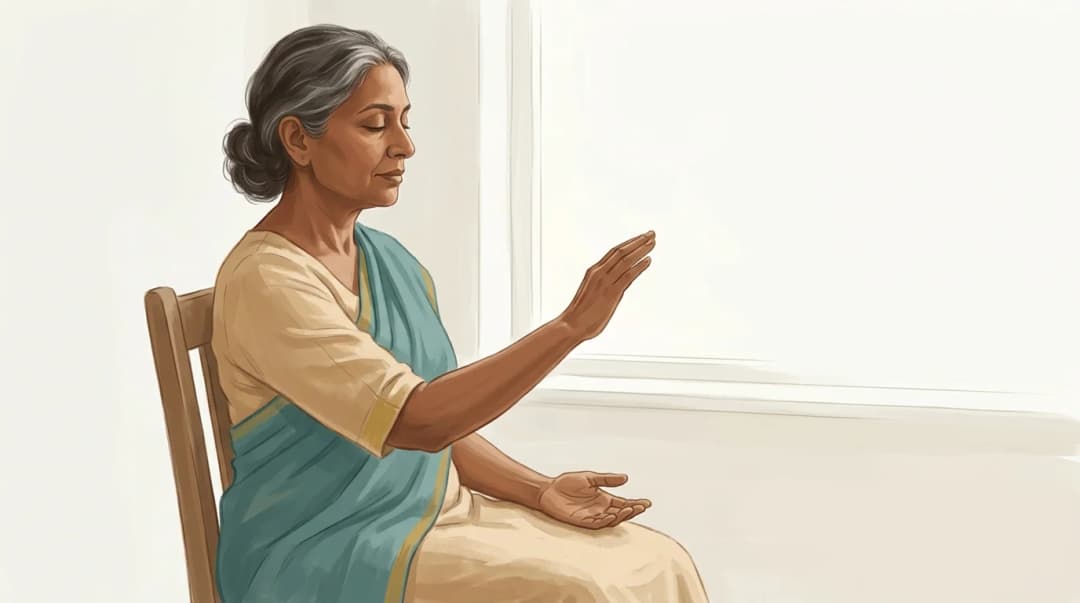
Guessing before checking. Let your eyes close and slowly float one arm forward and upward, stopping wherever it happens to stop. Before you peek, make a guess: is the hand above or below your shoulder? Then open your eyes and compare.
- 3
Resting and comparing. Lower the arm slowly and let both hands rest again. Does the arm that traveled lie on your thigh differently from the other one?
- 4
A circle that shrinks. With your eyes closed again, let the same hand draw a slow circle in the air, then the same circle at half the size, then smaller still. At what size does your feeling of the circle begin to blur?
- 5
Two hands finding each other. Eyes still closed, float both arms up and see whether the two hands can arrive at matching heights. Look whenever curiosity wins, then let the arms come down and rest.
- 6
A quiet pause with breath. Sit with your hands resting and follow a few breaths as they come and go. Nothing to do here; the pause belongs to the lesson.
- 7
How you sense yourself now. Once more, feel where your hands lie without looking at them. What, if anything, is clearer or different from when you began?
Let Feldy guide you, eyes closed
You just read these steps. In the Feldy program, a calm voice guides you through each gentle move, so your attention can stay in your body instead of on the screen.
Try Feldy Free for 7 daysNo credit card needed.
Proprioception exercises train the sense that tells you where your body is when your eyes are not watching, and the seated lesson above puts that sense sweetly on the spot: you float an arm with your eyes closed, guess where it stopped, then look. This way of learning comes from the Feldenkrais Method®, whose classes are called Awareness Through Movement®. The space between the guess and what you see is not a score; it is the lesson, and attending to it is how the sense sharpens.
What proprioception exercises actually train
Proprioception is your sense of position and movement. It rises from receptors woven through your muscles, tendons, joints, and skin, which report the length, load, and angle of each part from moment to moment. Your nervous system blends those reports with the inner ear's reading of gravity and with whatever the eyes contribute, and the blend gives you something you use constantly without naming it: taking stairs in the dark, or reaching a cup while your eyes stay on the page.
Because the blending is automatic, the sense only shows itself when you interrupt it, which is exactly what the guessing game above does: vision steps aside, and the felt report has to stand on its own.
Why the sense of position grows faint
Position sense is not settled for life. It grows vague with the years, as receptors thin out and the signals arrive with less detail; our Feldypedia entry on how proprioception declines with age tells that story more fully. It also dims after injury, surgery, or weeks of immobilisation, and it fades quietly when movement narrows to a few familiar patterns on flat floors.
The kinder half of the story is that the sense remains trainable at any age, and what it responds to is not strain but attention: slow movement, felt closely, with the checking built in.
How attention turns guessing into proprioception exercises
Nothing in the lesson above asks for effort, and that is deliberate. Effort is loud, and loud movement drowns the very signals you are trying to hear. Moving slowly, well within comfort, lets small differences surface, and each guess followed by a check gives your nervous system a comparison to learn from.
The research here is younger than the practice. When Hillier and Worley pooled twenty randomized controlled trials of the method, their reading was cautiously warm: promising for everyday functions such as balance, with two frank notes, that risk of bias ran high and that none of the trials recorded an adverse event (Hillier and Worley, 2015). An early signal worth taking seriously, not a settled verdict, and not a promise about falls. Feldy builds daily lessons around this attentive way of moving, and a 7 day free trial lets you feel a guided version from the inside.
One sense, joint by joint
The sense lives locally, and some part of you probably reports more faintly than the rest. For knees that feel unsure on stairs, our knee proprioception exercises work with slow weight shifts and small controlled bends. If the ground feels far away underfoot, try the proprioception exercises for the ankle. For steadiness as a whole, especially past sixty, there are balance proprioception exercises, and for an arm that hesitates overhead, shoulder proprioception exercises bring the same quiet approach.
Find where to start
The seated lesson above suits everyone and makes a fine daily habit. If you would rather begin where your own sensing is thinnest, let a quick question point you there.
Unsure which method is yours? Take the Movement Match quiz, four quick questions in about two minutes, to find your best movement method.
Common Questions about proprioception exercises (FAQ)
What are the best proprioception exercises?
The ones that make you guess. Any movement done slowly enough to feel, with the eyes closed and a moment of checking afterward, asks your position sense to do real work: floating an arm and estimating its height, or shrinking a circle until you can barely feel it. Equipment adds little; the comparing is what matters.
How often should I do proprioception exercises?
Think in minutes, not sessions. Five unhurried minutes on most days serves position sense better than one long weekly effort, and a seated, silent lesson slips easily into the edges of a day. Stop while it still feels interesting, and it will be easy to come back.
How long until I notice a difference?
Often within a single sitting, in a small way: the practiced arm may feel more vivid, or your guesses may land closer by the last round. Changes you would notice out in the world tend to gather quietly over weeks of easy repetition. Noticing more detail is itself the result.
How is this different from balance training?
Balance training challenges your whole steadiness, usually in standing, and lets you wobble and recover. Proprioception work goes one layer deeper and trains the information steadiness draws on: the felt position of each part. Here everything is slow, seated, and supported, so you can attend to the sensing itself.
Is it safe to close my eyes, and who should be careful?
This lesson stays seated throughout, and in a stable chair closing the eyes is generally safe. Keep them open if closing them brings dizziness or unease; a soft downward gaze works just as well for guessing. Anyone with vertigo, recent falls, or a healing arm or shoulder should stay well within comfort and ask a clinician before adding standing versions.
What should I avoid when practicing?
Leave out speed, effort, and end of range stretching, because all three drown the quiet signals you are listening for. Skip standing with the eyes closed unless a clinician has agreed and a sturdy support is at hand. And avoid treating the guessing as a test to pass; a guess that misses is information, not a score.
When should I see a professional?
A doctor or physiotherapist is the right first stop when numbness, tingling, or weakness accompanies the vagueness, when position sense changed suddenly, when dizziness or falls are part of the picture, or when you are recovering from injury, surgery, or a neurological condition. A clinician can also tell you how lessons like this one might accompany their care.
Learn to listen to your body
See the programRelated resources
Awareness of Body Position: The Sense That Knows Where You Are
The quiet sense that finds the last stair in the dark: where your feeling of position comes from, why it can grow vague, and how noticing wakes it up.
Proprioception Exercises for the Wrist: A Gentle Lesson
Gentle proprioception exercises for the wrist: a short seated lesson to sharpen your sense of where the wrist rests and moves, building steadiness through awareness.
Your balance got better, but did your sense of where your body is get better too
Ready to start moving better?
Gentle, guided lessons for your body. Try your first one free, no credit card required.