

Elbow Exercises for Pain: A Gentle Whole Arm Lesson
A slow lesson for an aching elbow: small movements of the forearm, wrist and shoulder together, so the whole arm learns to share the work it does all day.
Before you begin. This lesson is gentle self care and movement education, not medical treatment, and it sits alongside any care you receive rather than replacing it. See a professional promptly if your elbow pain began with a fall, if the elbow will not straighten or if it locks, if it is swollen, if numbness or pins and needles travel into the hand, or if pain wakes you at night.
The lesson
About 5 to 10 minutes. Move slowly, do less than you can, and stay well below any pain. Rest whenever you need to.
Prefer to listen than read?
Feldy voices gentle lessons like this for body awareness, so you can close your eyes and follow along.
- 1
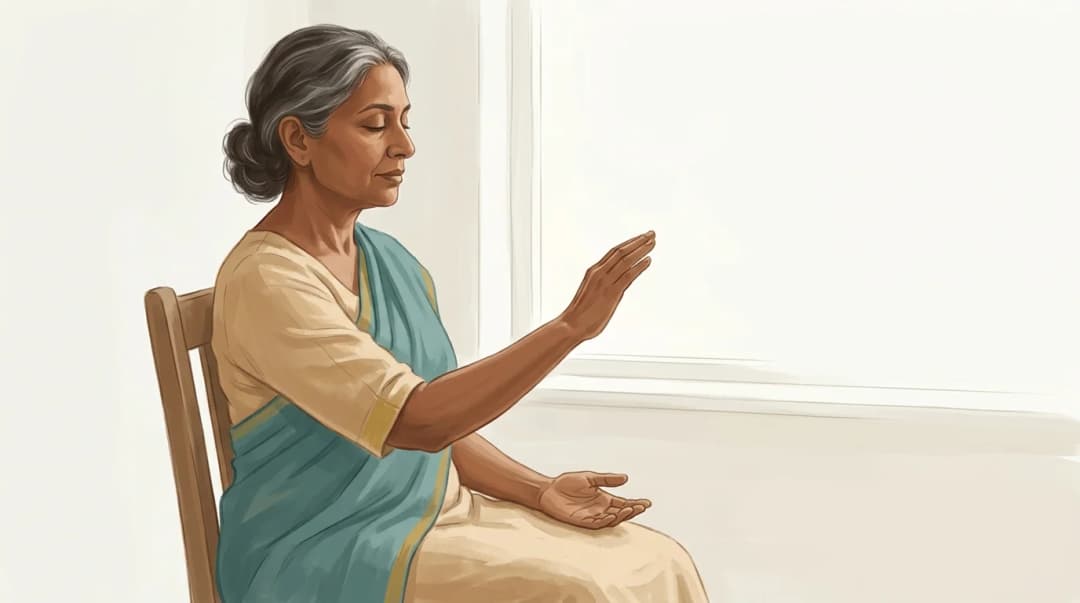
Settle with the arm supported. Lie on your back on a bed or carpet, or sit in a chair with armrests, and let the sore arm rest along your side with a folded towel under the forearm if that feels kinder. Take a little while to feel the weight of the whole arm sinking into whatever holds it.
- 2
Two arms, side by side. Before anything moves, notice how this arm lies compared with the other one. Does one feel heavier, longer, or closer to the surface beneath you?
- 3
The palm turns, unhurried. Let the forearm roll gently until the palm faces the ceiling a little more, then let it roll back the other way, staying far inside what feels easy. Pause after every few turns, and if anything is unpleasant, make it smaller, or simply imagine it.
- 4
A small bend, a small return. Slide the hand a few centimeters toward your shoulder so the elbow bends slightly, then let it travel back, keeping to the easy middle of the movement and nowhere near fully straight. Rest, and notice whether it becomes smoother when it becomes slower.
- 5
The shoulder moves, the elbow rests. Leaving the elbow completely quiet, let the shoulder drift a little toward your ear and back down, then a little forward and back. Can the elbow stay soft while its neighbor does the traveling?
- 6
A breath passes through. Rest, and follow a few slow breaths, noticing whether the arm rises and settles as the chest moves. Let the exhale take its time.
- 7
How the arm rests now. Let everything be still, and compare this arm with the other one once more, and with how it lay when you began. What, if anything, feels different about the way it meets the support?
Let Feldy guide you, eyes closed
You just read these steps. In the Feldy program, a calm voice guides you through each gentle move, so your attention can stay in your body instead of on the screen.
Try Feldy Free for 7 daysNo credit card needed.
Most elbow exercises for pain concentrate on the elbow itself, and this page begins from a different observation: an aching elbow is usually an overworked elbow, and the elbow rarely works alone. It sits halfway between the shoulder and the hand, passing along everything you carry, grip and turn, so how the rest of the arm behaves matters more than any single drill. The short lesson above comes from the Feldenkrais Method®, a form of movement education, and it invites the forearm, wrist and shoulder to move slowly and together, well below pain, so the whole arm rediscovers more ways of doing the same job.
Why these elbow exercises for pain involve the whole arm
Think about what an elbow actually does in a day. It bends to bring a cup toward you, straightens to set down a bag, and holds a middle position for hours while you type or drive, all while the forearm rotates the hand into position thousands of times. When the muscles that cross the elbow are asked to hold and repeat more than their share, they tire and begin to ache, at the joint itself or along the forearm.
One familiar version of this story is tennis elbow, which has an annual incidence of about 1% to 3%, is more common over the age of 40, and tennis players make up only about 10% of the people who get it (StatPearls, 2024). If your ache lives at that bony point on the outside of the elbow and flares when you grip, our lesson of tennis elbow exercises speaks to that specific pattern. This page stays deliberately broader, for the elbow that simply aches after long days of computer work, gardening, carrying, or lifting grandchildren. If a keyboard is part of your picture, our Feldypedia entry on repetitive strain from keyboard use maps how those hours add up.
The lesson reflects this whole arm view. The palm turns slowly, the elbow bends only through its easy middle, and then the shoulder moves while the elbow rests, so you can feel how much of the arm's work could be distributed differently. Nothing is gripped, nothing is stretched, and nothing goes anywhere near the pain.
When to try these elbow exercises for pain, and when to wait
A quiet moment suits this lesson best: lying on a bed, or sitting somewhere the forearm can be fully supported. Because the movements stay small and far below discomfort, most people with ordinary elbow aching can explore them on most days, including days when the elbow feels grumpy, as long as grumpy never becomes sharp.
Frankness matters here. If your pain is tendon related and has settled in for the long haul, the approach with the strongest evidence is graded loading, a progressive strengthening program usually set up by a physiotherapist, and nothing on this page replaces that. Clinical care sits at the center, and this gentle work keeps company with it, tending to the habits of gripping and carrying that keep asking the sore spot for more. Other movement approaches, like stretching routines or resistance work, act through different mechanisms, lengthening tissue or building capacity, where this lesson works only through attention.
Wait, and seek assessment first, if the pain began with a fall, if the elbow will not straighten or locks, if it is swollen, if numbness or pins and needles travel into the hand, or if pain wakes you at night. Those signs deserve a professional's eyes before any self guided movement.
Letting the lesson travel into your day
The few minutes of practice are only half of it. The other half happens at the kettle, the steering wheel and the shopping bag, when you remember what the lesson showed you and ask a small question: is my hand squeezing harder than this object needs, and could my shoulder carry a little more of this load? An elbow that no longer has to do everything by itself tends to complain less over time, though each arm has its own pace and no page can promise yours.
If you would like to continue this kind of study, the neighboring lesson of proprioception exercises for the wrist carries the same quiet curiosity one joint further along the arm, and the body awareness program extends it to the whole of you with short guided audio lessons in the Awareness Through Movement® tradition. Feldy's free trial is an easy way to hear what this sounds like with a warm voice guiding you, rather than words on a page.
Find where to start
An aching elbow is one doorway into this work, and there are many others: a stiff neck, a tired back, a shoulder that has forgotten how to rest. If you are unsure which doorway is yours, there is a short quiz that can point the way.
Curious what would fit you? Answer the Movement Match quiz, four quick questions in about two minutes, and see your movement method.
Common Questions about elbow exercises for pain (FAQ)
What is the best exercise for elbow pain?
There is no single best one, because elbow pain has more than one cause. For tendon related pain, the strongest evidence supports a graded loading program set up by a physiotherapist. For the everyday aching that comes from an overworked arm, slow supported movement like this lesson helps you notice how you grip, carry and turn, which is where the extra effort usually hides. The answer is the exercise that matches the reason your elbow aches, and a professional can help you find that reason.
What exercises should I avoid with elbow pain?
While the elbow is irritable, it is wise to leave out anything that reproduces the pain: heavy gripping, wringing movements, pulling the wrist into a strong stretch, and loading the arm at the very end of its reach. None of that is off the table forever, it is simply asking a sore tendon for more than it can give today. In this lesson, anything sharp or unpleasant is a signal to make the movement smaller, or to imagine it instead.
Is this lesson safe, and who should skip it?
The lesson stays supported, slow and far below pain, so it suits most ordinary elbow aching. Skip it and see a professional first if the pain began with a fall, if the elbow will not straighten or if it locks, if it is swollen or hot, if numbness or pins and needles travel into the hand, or if pain wakes you at night.
How often should I practice these elbow exercises for pain?
A few unhurried minutes on most days works well. Nothing here loads the tissue, so there is no need to schedule rest days between sessions. The real value builds through repetition of attention: each time you sense how the shoulder can share the arm's work, that option becomes a little more familiar during ordinary tasks.
How long until elbow pain improves?
The awareness side of this work can shift within one sitting, often felt as a lighter forearm or a softer grip afterward. Irritated tissue follows its own slower timeline, commonly weeks to months, and pain that lingers past a few weeks of sensible care deserves a proper assessment rather than more patience alone.
How is this different from the loaded strengthening a physiotherapist prescribes?
A loading program works the forearm muscles against gradually increasing resistance so the tendon adapts, and for tendon pain that approach has the stronger evidence base. If a physiotherapist has given you one, it belongs at the center of your care. This lesson loads nothing and asks a different question: how is the work of carrying, gripping and turning shared across the hand, elbow and shoulder? The two sit comfortably alongside each other.
When should I see a professional about elbow pain?
See a doctor or physiotherapist promptly if the pain followed a fall, if the elbow will not straighten fully or catches and locks, if there is swelling, if numbness or pins and needles run into the hand, or if the pain wakes you at night. Beyond those signs, pain that has lasted more than a few weeks, or that keeps returning with the same activities, is also worth an assessment.
Learn to listen to your body
See the programRelated resources
Tennis Elbow Exercises: A Gentle Lesson for the Forearm
Gentle tennis elbow exercises with a difference: a seated lesson in noticing grip, slow easy forearm turns, and how the whole arm can share the work.
Proprioception Exercises for the Wrist: A Gentle Lesson
Gentle proprioception exercises for the wrist: a short seated lesson to sharpen your sense of where the wrist rests and moves, building steadiness through awareness.
Your balance got better, but did your sense of where your body is get better too
Ready to start moving better?
Gentle, guided lessons for your body. Try your first one free, no credit card required.