


Tennis Elbow Exercises: A Gentle Lesson for the Forearm
Gentle tennis elbow exercises with a difference: a seated lesson in noticing grip, slow easy forearm turns, and how the whole arm can share the work.
Before you begin. This is gentle awareness work, not medical advice and not a loading program for the tendon. Persistent elbow pain deserves a proper assessment. Stop and seek advice if you notice numbness or tingling into the hand, night pain, swelling, or pain that began with a fall or injury.
The lesson
About 5 to 10 minutes. Move slowly, do less than you can, and stay well below any pain. Rest whenever you need to.
Prefer to listen than read?
Feldy voices gentle lessons like this for body awareness, so you can close your eyes and follow along.
- 1
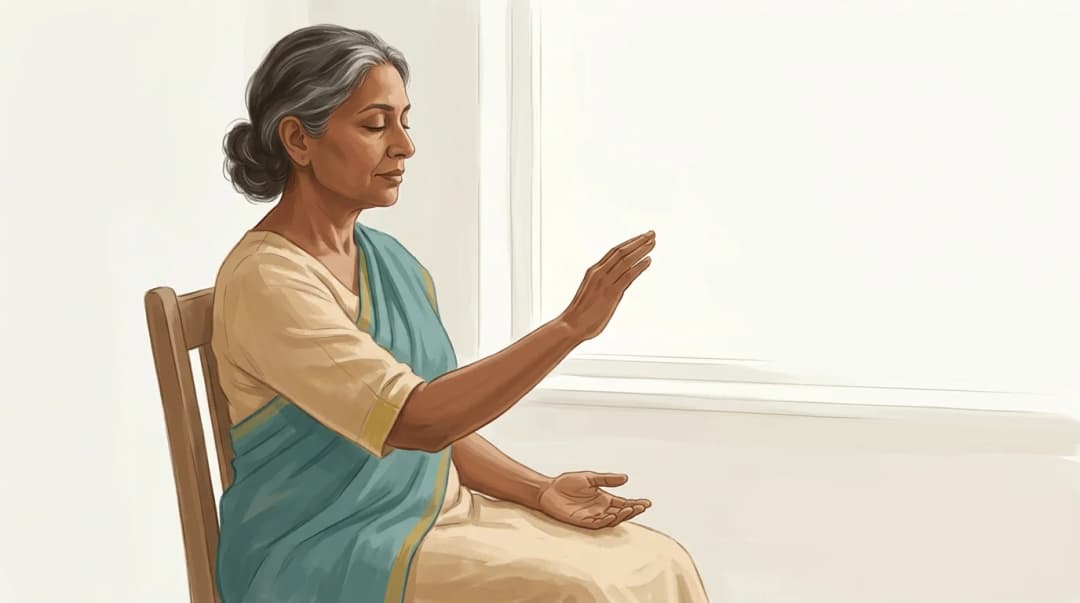
An arm with nothing to do. Sit comfortably and rest your forearm on a table or on your thigh, palm down, holding nothing. Notice how the hand lies there, and whether the fingers are truly resting or still quietly working.
- 2
Small turns of the forearm. Slowly roll the forearm so the palm turns a little toward the ceiling, then a little back toward the floor, staying far below any pain. Let each turn be small enough that it feels like almost nothing.
- 3
A pause. Let the arm lie still and take a few unhurried breaths. Nothing needs to happen here.
- 4
The wrist drifting. Allow the wrist to drift softly, a tiny amount in any direction it likes, without gripping and without aiming anywhere. If the fingers begin to tighten, make the movement smaller still.
- 5
An echo in the shoulder. Return to the slow turns of the palm and let them grow only enough to sense the rest of the arm joining in. Can you feel a small echo of the movement in your shoulder, or in the shoulder blade behind it?
- 6
A quiet comparison. Rest the forearm as you did at the beginning and let everything settle. Compared with when you started, what, if anything, feels different about the way this hand and arm are resting?
Let Feldy guide you, eyes closed
You just read these steps. In the Feldy program, a calm voice guides you through each gentle move, so your attention can stay in your body instead of on the screen.
Try Feldy Free for 7 daysNo credit card needed.
The tennis elbow exercises most people search for are strengthening drills, and this page offers something different. The short lesson above asks you to hold nothing, load nothing, and stretch nothing. Instead it invites you to sit with the forearm supported and study a question that rarely gets asked: how much work is your hand doing when it has nothing to do? The lesson comes from the Feldenkrais Method®, which teaches through unhurried, attentive movement rather than effort.
What tennis elbow actually is
Tennis elbow, or lateral epicondylitis, is soreness at the bony point on the outside of the elbow where the muscles that lift the wrist and fingers anchor through a shared tendon. Despite the older name, it behaves less like a sudden injury and more like a tendinopathy: the common extensor tendon has been asked to repeat the same effort too many times and has become irritable. It is an overuse story rather than a single accident, which is why it visits people who type, grip tools, and carry bags, and why most who develop it have never played a set of tennis.
The natural course is genuinely encouraging. StatPearls reports that 80 to 90 percent of people recover spontaneously within one to two years (StatPearls, 2024). That is a long while to wait passively, though, which is why what you do with the arm meanwhile matters.
Why these tennis elbow exercises look so quiet
The mainstay of care for tennis elbow is graded loading: progressive, often eccentric strengthening of the wrist extensors, usually set up by a physiotherapist or hand therapist, together with adjusting whatever activity keeps aggravating the tendon. Nothing in the lesson above substitutes for that, and this page will not pretend otherwise.
What the lesson adds is a different kind of information. A tendon gets overworked for a reason, and the reason usually lives upstream: a grip that squeezes a mouse or a kettle far harder than the object requires, a wrist held cocked for hours, a forearm doing work the shoulder and trunk could share. Slow, small turns of the palm, made with real attention, let you feel those habits directly. Clinical care, a doctor's assessment with physiotherapy, hand therapy, and a proper loading program, belongs at the center of treating a stubborn tennis elbow, and this lesson keeps quiet company with it. Other movement approaches, such as strengthening programs and stretching routines, work through a different mechanism, building capacity or length where this lesson builds only awareness.
If your elbow traces back to a keyboard, our Feldypedia entry on repetitive strain from keyboard use maps that territory, and musicians will find their version in musicians and repetitive strain.
Grip, and the work the shoulder could share
The step where the turning of the forearm is allowed to travel up into the shoulder blade is the heart of this page. The muscles that anchor at the outer elbow are small, and when they carry jobs that larger structures could help with, they tire early and complain first. Sensing the shoulder blade join a movement of the palm introduces another option: an arm that spreads its work more widely. The point is never to judge how your arm has been working, only to give the nervous system a clear, unhurried taste of the alternative.
Inside Feldy, the same curiosity guides each short audio lesson, whether the theme is a hand, a hip, or the breath. If the soreness reaches beyond the elbow, our guide on how to relieve shoulder and elbow pain looks at the arm as one connected chain, while our proprioception exercises for the wrist carry the same quiet study one joint further along.
How to practice these tennis elbow exercises
A few minutes on most days is plenty. The one rule that matters is comfort: every turn stays far below pain, and smaller is always available, down to simply imagining the movement. Between sittings, let the lesson leak into ordinary life: notice your grip on the steering wheel, the toothbrush, the phone, and ask whether half the effort would do. If this way of paying attention suits you, the Feldy program for body awareness continues it with guided audio lessons that give the whole body the same interest your forearm just received.
Common Questions about tennis elbow exercises (FAQ)
Are these tennis elbow exercises safe, and who should skip them?
The lesson stays seated, supported, and far below pain, and it suits most everyday outer elbow soreness. Have the arm assessed first if the pain followed a fall or a sudden wrench, if the elbow is swollen or hot, if numbness or tingling runs into the hand, or if pain wakes you at night. Within the lesson, anything sharp means make the movement smaller or leave it out.
How often should I do this lesson?
A few unhurried minutes on most days suits it well. Nothing here loads the tendon, so there is no need to plan recovery days. What repays the repetition is familiarity: the more often you notice how much your hand is holding, the more often you catch that extra effort during the rest of your day.
How long until tennis elbow pain improves?
The awareness side can shift within a single sitting, often as a softer grip or a lighter forearm. The tendon recovers on a slower schedule, usually over months, and a graded loading program guided by a professional is the most reliable way to help it along. This lesson eases the daily habits that keep bothering it in the meantime.
How is this different from an eccentric loading or strengthening program?
A loading program works the wrist extensor muscles against resistance, progressively, so the tendon adapts and builds capacity. That approach is the mainstay of care, and if your elbow has been sore for a while it is the one to prioritize, ideally with a physiotherapist or hand therapist. This lesson loads nothing. It works through attention, examining how hard you grip and how the whole arm shares effort, which is a question no dumbbell asks. The two combine easily.
Does stretching help tennis elbow?
Mild stretching of the wrist and forearm often appears in care plans and can feel pleasant, though research suggests stretching alone does less for the tendon than progressive loading. Keep it brief and comfortable, never pulling into pain at the outer elbow. Stretching works through a different mechanism than this lesson, lengthening tissue rather than studying habits, so one does not replace the other.
When should I see a professional about tennis elbow?
Get it looked at when the pain has lasted more than a few weeks despite sensible care, when it began with a fall or a sudden pull, when numbness or tingling travels into the hand, when the elbow swells or aches at night, or when gripping becomes unreliable. A doctor, physiotherapist, or hand therapist can confirm what is going on and build a loading plan suited to you.
Learn to listen to your body
See the programRelated resources
Elbow Exercises for Pain: A Gentle Whole Arm Lesson
A slow lesson for an aching elbow: small movements of the forearm, wrist and shoulder together, so the whole arm learns to share the work it does all day.
How to Relax Your Jaw: A Gentler Feldenkrais® Approach
The jaw rarely lets go because you told it to. Here is a slower way in, built on small movements and attention rather than stretching or force.
Your balance got better, but did your sense of where your body is get better too
Ready to start moving better?
Gentle, guided lessons for your body. Try your first one free, no credit card required.