

Foot Exercises for Ballet: Sensing the Foot Off the Barre
Foot exercises for ballet dancers that sharpen how clearly you sense the sole, toes, and ankle: slow, shoeless, one foot at a time, away from the barre.
Before you begin. Dancers often train through pain, and this page will not encourage that. A foot that hurts sharply, is swollen, or hurts when you put weight on it needs a doctor, physiotherapist, or podiatrist before any movement lesson. Stress fractures in dancers' feet are common enough to take seriously, so when in doubt, have it checked first.
The lesson
About 5-10 minutes. Move slowly, do less than you can, and stay well below any pain. Rest whenever you need to.
Prefer to listen than read?
Feldy voices gentle lessons like this for body awareness, so you can close your eyes and follow along.
- 1
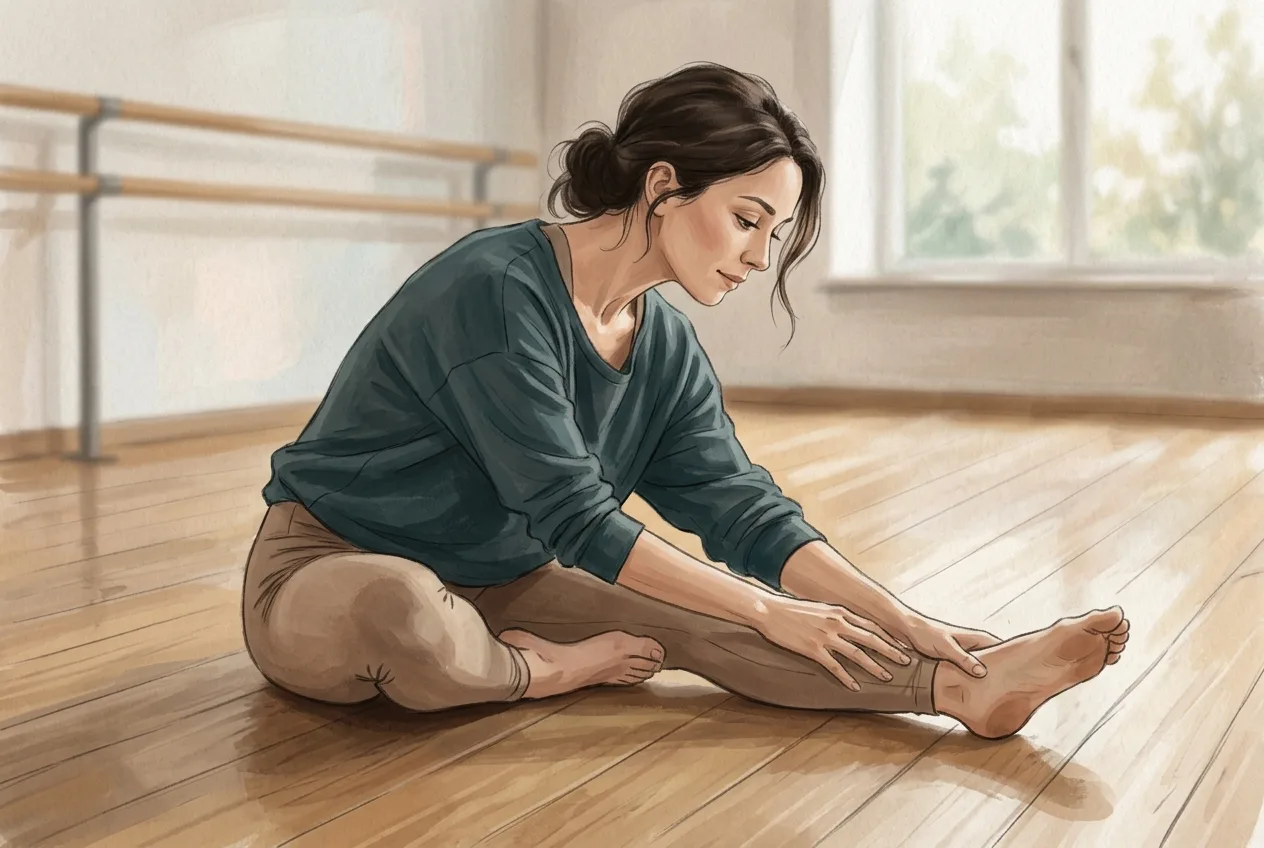
Settling in, without shoes. Please sit on the floor or a firm bed with one leg long, or lie on your back with your knees bent, whichever lets you rest. Take off your shoes and socks if you can, so the foot has nothing between it and the air.
- 2
Noticing how the foot rests. Let your attention travel slowly over the sole of one foot. Which parts can you feel clearly, and which parts are vague, almost missing from the picture?
- 3
Toes drifting apart and together. Very slowly, let the toes of that foot move a little away from each other, then a little toward each other, much less than they could. Where does the movement seem to begin, in the toes themselves or somewhere higher up?
- 4
A pause to rest. Let the foot rest completely for a few breaths. Does it feel any different from before, warmer, wider, more present?
- 5
Drawing a small circle. Imagine the ball of that foot resting against a wall, and let it trace a small, slow circle there, as if drawing. Keep the circle tiny and smooth, and rest whenever you like.
- 6
Following the circle upward. As the circle continues, notice how the movement travels through your ankle and along your shin. Can you make the circle so easy that the whole leg quietly agrees to it?
- 7
Comparing the two feet. Let everything stop and rest. Feel both feet now, side by side in your attention. What, if anything, is different between them?
Let Feldy guide you, eyes closed
You just read these steps. In the Feldy program, a calm voice guides you through each gentle move, so your attention can stay in your body instead of on the screen.
Try Feldy Free for 7 daysNo credit card needed.
Most foot exercises for ballet promise a stronger pointe, a higher arch, or faster progress, and this page will be candid with you from the first line: the lesson above promises none of those things. It is not technique training, and it will not change what your teacher sees at the barre next week. What it offers is something quieter and, for many dancers, surprisingly useful: a clearer, more detailed sense of one foot at a time, felt slowly, without shoes, away from the demands of class. The Feldenkrais Method® works this way on purpose. Instead of asking the foot for more strength or more range, it invites you to notice how the foot actually moves when nothing is at stake, because a foot you can sense in detail is easier to use with intention. The short lesson above stays inside that spirit from beginning to end.
Why foot exercises for ballet can be about sensing, not strengthening
A dancer's foot works hard and is asked for extraordinary precision, yet most of that work happens under load, at speed, and inside a shoe. Under those conditions the brain runs on habit, and habits are exactly what slip out of awareness. Slow, small, shoeless movement gives the nervous system a different kind of information: which toes actually move independently, where the sole is vivid and where it is vague, how a movement of the ball of the foot travels through the ankle and up the shin. None of this changes your anatomy. Feldenkrais lessons do not lengthen an arch or add degrees of turnout, and any page that claims they do is overselling.
What the research suggests is more modest and more interesting. A systematic review pooling 20 randomised controlled trials described promising evidence that Feldenkrais lessons can help functions like balance, and it was equally clear that risk of bias in those trials was high (Hillier and Worley, 2015). For a dancer, balance is not an abstraction: it is the everyday business of standing on one leg with a calm face. Clearer sensing of the foot is one plausible ingredient in that, and it is the ingredient this lesson works with.
What the slow toe movements and small circles are doing
Each step of the lesson invites feeling, never achieving. The opening scan builds a baseline: before anything moves, you find out which parts of the sole you can actually feel today. The slow travel of the toes away from and toward each other is deliberately far below what your feet do in class, because at that size and speed there is nothing to perform and nowhere to push, only detail to notice. The small circle drawn with the ball of the foot, as if against a wall, then lets you follow how a movement of the foot is never only a movement of the foot: the ankle joins, the shin joins, and sometimes the whole leg softens around it.
The rests are not gaps in the lesson. They are where the comparing happens, and comparing is the point. When you finish and feel both feet side by side, the difference between the worked foot and the resting foot is your own nervous system showing you what changed. If any movement is uncomfortable, make it smaller, go slower, or just picture it happening in your mind, which still gives the foot something real to sense.
Keeping foot exercises for ballet realistic and safe
Two boundaries keep this practice useful. The first is about claims: this lesson complements class, it does not compete with it, and it makes no promise of injury prevention. Whatever your teacher and your physiotherapist advise about technique, conditioning, and rehabilitation comes first, and this work sits alongside their guidance, never in place of it. The second boundary is about pain. Ballet culture quietly rewards training through discomfort, and feet pay for that habit more than most body parts. A foot that hurts sharply, is swollen, or hurts when you put weight on it needs a doctor, physiotherapist, or podiatrist, not a movement lesson, and stress fractures in dancers' feet are common enough that a deepening ache deserves respect rather than another class. For a wider look at how Feldenkrais work fits into a dancer's life, our Feldypedia note on dancers and injury prevention looks at that balance in more depth.
More gentle movement in the same spirit
Dancers who enjoy this way of working often want more of it, and the same unhurried quality travels well to neighbouring territory. Our intrinsic foot exercises explore the small muscles of the sole with the same sensing approach, and these proprioception exercises for the ankle continue the journey upward from the foot. Feldy's guided lessons follow the same idea every day: small, slow, comfortable, and led by your own attention.
Find where to start
Dancers arrive at this kind of work from very different places, from a serious student in daily class to an adult returner finding the barre again after years away. If you would like help choosing a first lesson, our short quiz can point the way.
Not sure which approach fits? The Movement Match quiz asks four quick questions in about two minutes, then names your movement method.
Barre or bedroom floor, a foot you can feel clearly is a good place to begin.
Common Questions about foot exercises for ballet (FAQ)
What are the best foot exercises for ballet dancers?
It depends on what you are after. Strength, articulation, and pointe readiness belong to your teacher's and physiotherapist's programme, and nothing here replaces that work. The lesson on this page does a different job: it sharpens how clearly you sense the sole, toes, and ankle, which is useful information to bring back to class.
What foot exercises should ballet dancers avoid?
Anything done through sharp pain, and anything that forces the foot toward a shape it does not have, including cranking the arch with devices or another person's weight. A movement that leaves the foot aching afterward is telling you something. If a movement in this lesson is unpleasant, make it smaller, slow it down, or simply imagine it.
Will this give me a better pointe, a higher arch, or more turnout?
No, and it would be misleading to suggest otherwise. Feldenkrais work changes how clearly you sense the foot, not the shape of your bones, so your arch and your turnout remain what your structure allows. What many dancers do report is a more detailed, more trustworthy feel for the foot they already have.
How often should I practise this foot lesson?
A few quiet minutes most days is plenty, and many dancers enjoy it in the evening, well away from class. It is not a warm up and it is not conditioning, so there is no dose to hit. Stop while it still feels pleasant and interesting.
How is this different from theraband work and intrinsic foot strengthening?
Theraband and intrinsic foot work build tissue capacity through load, and that has real value for dancers. This lesson works through a different mechanism: slow, small movement with full attention, which gives your nervous system clearer information about the foot. Both kinds of work can live comfortably in the same week.
When should a dancer see a professional about foot pain?
Promptly, and sooner than most dancers do. Sharp pain, swelling, pain when you put weight on the foot, or an ache that deepens over days of training all deserve a doctor, physiotherapist, or podiatrist, because stress fractures in dancers' feet are common enough to take seriously. A movement lesson is for a foot that is comfortable, not a substitute for a diagnosis.
Learn to listen to your body
See the programRelated resources
Awareness of Body Position: The Sense That Knows Where You Are
The quiet sense that finds the last stair in the dark: where your feeling of position comes from, why it can grow vague, and how noticing wakes it up.
What Is Somatic Sensory Information? Your Body's Own Feed
The constant stream of touch, pressure, position, and effort your body sends your brain, why it fades with disuse, and why movement quality depends on it.
Your balance got better, but did your sense of where your body is get better too
Ready to start moving better?
Gentle, guided lessons for your body. Try your first one free, no credit card required.