
How to Stretch Upper Traps Without Straining the Neck
The upper traps are usually holding rather than short. Here is how to stretch upper traps by letting the shoulders stop carrying themselves, not by pulling the head sideways.
Before you begin. This is gentle self care, not medical advice. Never pull your head with your hand in this lesson, and stop if you feel pain, dizziness, or any tingling into the arm or hand. See a doctor for neck pain that followed an injury, that comes with weakness or numbness, or that is not settling.
The lesson
About 5-10 minutes. Move slowly, do less than you can, and stay well below any pain. Rest whenever you need to.
Prefer to listen than read?
Feldy voices gentle lessons like this for body awareness, so you can close your eyes and follow along.
- 1
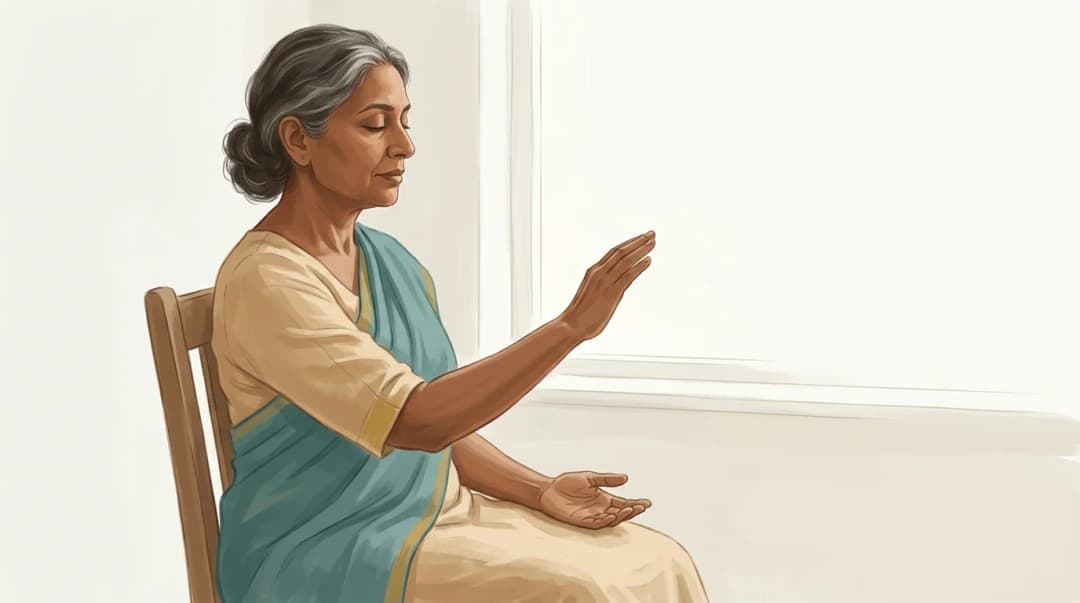
Sitting down to begin. Sit toward the front of a chair with your hands resting on your thighs, or lie on your back if that is kinder today. Everything in this lesson stays small and well before any pull, and imagining a movement counts fully.
- 2
How the shoulders are carried. Without changing anything, notice your shoulders. Are they resting on your ribs, or are they quietly holding themselves up?
- 3
A small lift and a letting go. Raise both shoulders a tiny amount toward your ears, then let them fall on their own, without placing them anywhere. Wait a moment before the next one.
- 4
The head leaning a little. Let your head tilt a small way toward one shoulder, only within the range that feels completely easy, and come back. Then the other side, staying well short of any pulling feeling.
- 5
Arms with their full weight. Let your hands lie heavy on your thighs, or your arms heavy beside you, as if they belonged to the chair or the floor for a while. Do the shoulders need to do anything to keep them there?
- 6
An easier out breath. Follow a few breaths and let each one leave a little more slowly than it arrived. Can you feel your shoulders ride along with the breathing?
- 7
A last visit. Sit or lie quietly and travel once more through your shoulders, your neck, and your arms. Compared with the beginning, what, if anything, do you find?
Let Feldy guide you, eyes closed
You just read these steps. In the Feldy program, a calm voice guides you through each gentle move, so your attention can stay in your body instead of on the screen.
Try Feldy Free for 7 daysNo credit card needed.
Most advice on how to stretch upper traps starts the same way: tilt your head to one side, place a hand on it, and pull. That is precisely the part worth reconsidering. The upper trapezius, the band running from the base of the skull out to the tip of the shoulder, is rarely tight because it is short. It is tight because it is working, holding your shoulders up hour after hour, and a muscle that is busy holding does not respond well to being hauled toward its limit. The Feldenkrais Method® takes a different route: let the shoulders stop carrying themselves, and the band eases on its own.
This kind of tension is nearly universal. In some populations, more than 70% of people report episodic tension type headache, and headache disorders of every kind affect roughly 40% (WHO, 2025). Held shoulders are a familiar companion to both.
Why the upper traps hold rather than shorten
The upper trapezius has a job most people never think about, which is helping suspend the shoulder girdle. Your arms hang from your torso by way of the collarbone and shoulder blade, and something has to take that weight. When you are relaxed, the load is shared and nothing complains. When you are at a keyboard, gripping a steering wheel, carrying a shoulder bag, cold, tired, or braced against a difficult week, that muscle picks up a larger share and quietly keeps it.
The result is a muscle that never fully switches off. It becomes tender, it feels tight, and it aches by mid afternoon. It has not shortened. It is fatigued, in the way any muscle is after a long shift, and stretching a fatigued muscle offers a few minutes of relief before it goes straight back to work.
That is why the tightness returns so reliably an hour after a good stretch, and why the more durable route is to change what is being asked of it. Feldypedia on neck and shoulder tension covers this pattern in depth.
How to stretch upper traps by letting go instead of pulling
The lesson above is built on three ideas. The first is lifting and dropping, since letting a shoulder fall of its own accord is a completely different experience from placing it down, and the difference is where the learning sits. The second is weight: letting your arms be genuinely heavy removes the reason the muscle was holding in the first place. The third is small head tilts kept well short of any pull, which give the region movement without provoking the guarding.
Notice what is absent. There is no hand on the head, and no held position. A hand pulling the head sideways can push the neck close to its end range while the surrounding muscles are already protective, and for a proportion of people that produces more tension, not less. If you have any tingling into the arm, that approach is one to avoid entirely and to raise with a doctor.
Our guide to tight shoulders and neck covers the wider pattern, and our neck stretches for forward head posture deal with the head position that often accompanies it.
Making it stick through the day
The lesson matters less than what happens in the hours after it. Shoulders creep up during concentration, during cold, and during anything mildly stressful, and most people have no idea it is happening. A few times a day, notice where your shoulders are, and let them be heavy for a breath. No adjustment, no verdict, just weight. Repeated over a couple of weeks, that does more than any single stretch.
Physical therapy and medical care sit alongside this, and are the right first step if there is pain with weakness, numbness, or a clear injury behind it. Other movement approaches such as yoga and Pilates reach the shoulders through different mechanisms and help many people. Feldy works through attention, and the program for body awareness carries this further. You can hear the audio guided version with a free 7 day trial.
Common Questions about how to stretch upper traps (FAQ)
How do you stretch upper traps safely?
Keep the movement small and never use your hand to pull your head over. The classic side bend with a hand on the head puts the neck near its end range while a muscle is already guarding, and for many people that raises the tension rather than easing it. Slow shoulder movements, small head tilts inside an easy range, and letting the arms hang heavy tend to be both safer and more effective.
Why do my upper traps feel tight all the time?
Usually because they are working, not because they are short. The upper trapezius helps hold the shoulder girdle up, and it takes that job on whenever you are at a desk, carrying a bag, cold, tired, or braced against stress. A muscle that never fully switches off feels tight and tender, and stretching a muscle that is busy holding rarely changes much for long.
How often should I do this?
Briefly and often works better than long sessions. A minute or two several times a day, especially during desk work, tends to interrupt the holding before it settles in. Because nothing here is strenuous, there is no need to leave recovery time between.
How long until my shoulders feel different?
Many people feel some ease during the first session, though it often does not last at first. Lasting change usually takes a few weeks, because what is changing is a habit of holding rather than the length of a muscle. Noticing when your shoulders creep up during the day is what makes it stick.
How is this different from a normal trap stretch?
A normal trap stretch takes the head toward the opposite shoulder and holds, working on the tissue directly. This lesson works on the holding instead, by giving the shoulders repeated chances to stop supporting themselves. Both are used by plenty of people, but if your traps feel tight again within an hour of stretching, the holding is the more likely culprit.
When should I see a professional?
See a doctor for neck or shoulder pain that followed an injury, that comes with weakness, numbness, or tingling into the arm or hand, that includes dizziness or headaches that are new for you, or that is simply not settling over a few weeks. A physical therapist can also assess whether something other than habit is driving the tension.
Learn to listen to your body
See the programRelated resources
Stretching Routine for Beginners: Start Slow, Start Small
A stretching routine for beginners that asks for attention rather than effort. Seven short steps you can do on the floor or on your bed, with nothing to reach for.
How Long to Fix Posture: A Realistic Timeline
Weeks for how you feel, months for how you stand, and it depends far more on frequency than on effort. What actually changes, and in what order.
Your balance got better, but did your sense of where your body is get better too
Ready to start moving better?
Gentle, guided lessons for your body. Try your first one free, no credit card required.