
Mind Body Exercises: A Gentle Lesson to Start With
Try a short mind body exercise lying down, then learn what makes movement mind body, how the main approaches differ, and who should adapt.
The lesson
About 5-10 minutes. Move slowly, do less than you can, and stay well below any pain. Rest whenever you need to.
Prefer to listen than read?
Feldy voices gentle lessons like this for body awareness, so you can close your eyes and follow along.
- 1
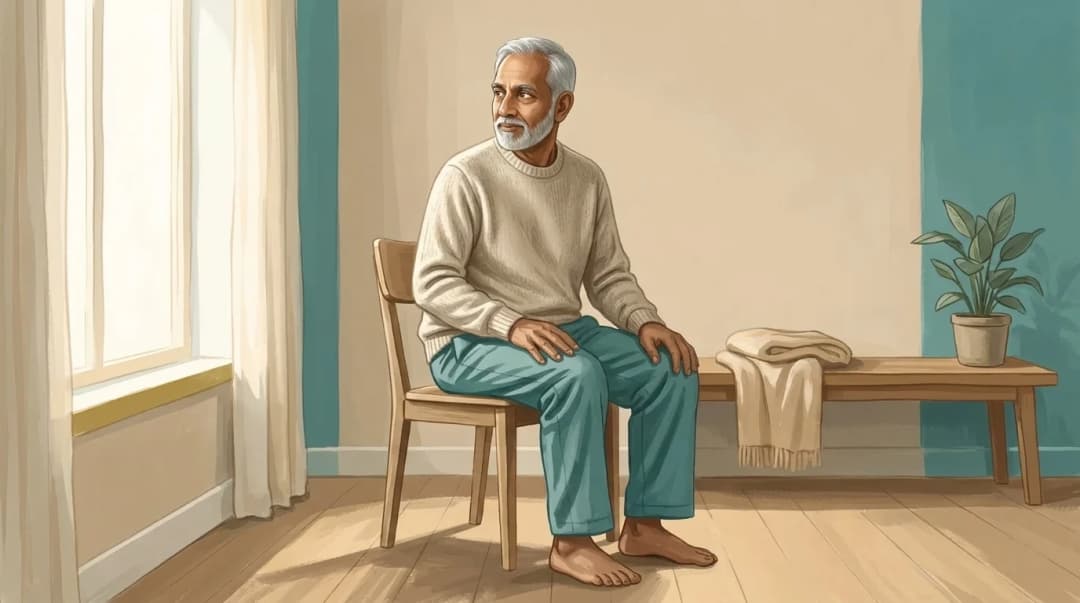
Settle in. Lie on your back with your knees bent and feet standing. If that is uncomfortable, sit in a chair instead.
- 2
Notice the breath. Let your breath come and go as it does. Where do you feel it most, your belly, your ribs, or your chest?
- 3
A small pelvis roll. Slowly roll your pelvis a little toward your feet, then a little toward your head. Keep it tiny. Then rest.
- 4
Listen to the ribs. Roll again, even slower. What do your ribs do, and does your breath change on its own?
- 5
One side, then the other. Let one knee drift out and back, then the other. Which side feels easier? Make it smaller if you need to.
- 6
Rest. Slide your legs long and stop for a few breaths. How does your back meet the floor now?
- 7
What has changed?. Bend your knees again and roll your pelvis once more, very small. What do you notice now, compared with the start?
Let Feldy guide you, eyes closed
You just read these steps. In the Feldy program, a calm voice guides you through each gentle move, so your attention can stay in your body instead of on the screen.
Try Feldy Free for 7 daysNo credit card needed.
Mind body exercises are movements where your attention is part of the exercise itself. You do not only move; you notice how you move while you are moving. The short lesson above gives you a first taste. Try it before you read on.
What makes an exercise mind body
In a typical workout, the count matters: how many, how fast, how heavy. In mind body exercises, the quality of your attention matters more. You might follow your breath, sense your weight on the floor, or notice which parts of you move together.
This is why the same movement can be mind body or not. Rolling your shoulders while you think about your to do list is just rolling. Rolling them slowly, while you sense your ribs and your breath, is a mind body exercise.
Many people are curious about this kind of practice. A national survey found that the share of US adults who practiced yoga grew from 5.0 percent in 2002 to 15.8 percent in 2022 (NCCIH, 2022).
The main families of body and mind exercises
There are several traditions. Each has a different approach, and each can be a good fit for different people.
- Yoga uses postures, breath and focus. Styles range from vigorous to very slow. See our Feldypedia page on yoga.
- Tai chi and qigong link slow, flowing movement with breath and a calm mind. They are often practiced standing, in a group. The tai chi guide explains more.
- Pilates focuses on controlled movement and body control, often on a mat.
- Feldenkrais® Awareness Through Movement® uses small, slow, easy movements, mostly lying down, to explore how you organize yourself. The Feldypedia guide to the Feldenkrais Method tells the story of how it began.
None of these is the one right choice. They are different ways in. If you want a sense of how yoga with a slower pace feels, our page on mindful movement yoga offers a lying down twist.
How a Feldenkrais style lesson feels different
A Feldenkrais lesson has no pose to reach and no count to finish. The movements are small, slow and easy. Comfort is the guide, so you stop well before any strain. Curiosity replaces effort: instead of asking "Am I doing it?", you ask "What do I notice?"
Rests are part of the lesson. You pause after a movement and compare, one side with the other, now with the start. If you are new to this style, our page on somatic exercises for beginners has a first lesson built around a head turn. Our guide on the mind body connection in back pain shows how the same idea can be used for the back.
When to try mind body exercises
You might try them when you want a calm break from a busy day, or when fast workouts feel like too much. They also suit people who want to feel more at home in their body, or who like to move without pressure. A few quiet minutes in the morning or before bed work well.
If you would like a teacher's voice to follow, Feldy offers a free 7 day trial of short, voice guided audio lessons you can do at home.
Who should adapt
Any movement can be adapted. A few cases need extra care.
- During a pain flare: make everything smaller, or only imagine the movement. Rest is also a fine choice.
- If you feel dizzy when getting up: do the lesson sitting, and come up from the floor slowly, in stages.
- If you have a history of trauma: keep your eyes open, keep sessions short, and stop whenever you like. Looking around the room can help you feel grounded.
- If you have a new or unexplained symptom: speak with your doctor before you begin.
Clinical care and movement practice can sit side by side. A doctor assesses and treats; a gentle practice builds attention and ease. They do different jobs.
Common Questions about mind body exercises (FAQ)
What is the best mind body exercise for beginners?
The best one is the one you will actually do and enjoy. Many beginners like a slow lying down lesson, because there is no balance to manage and no shape to copy. Gentle yoga, tai chi and Feldenkrais lessons are all friendly starting points.
What should I avoid when starting mind body exercises?
Avoid rushing, forcing a movement past comfort, and judging yourself against others. Skip pushing through pain. If your attention drifts into trying hard, make the movement smaller and slower. Doing less often works better here.
Are mind body exercises safe for everyone?
They are usually gentle, but not every version suits every body. Speak with your doctor first if you have a recent injury, a new health condition, or ongoing dizziness. You can always make a movement smaller or only imagine it.
How often should I do mind body exercises?
A few minutes most days suits attention better than one long weekly session. Short, regular practice is easier to keep up. Ten minutes a day is a full session.
How long until I notice anything?
Some people notice something in the first session, such as one side feeling different from the other. Others need a few weeks of regular practice. There is no schedule to meet, and nothing is promised.
How are mind body exercises different from a regular workout or yoga?
A regular workout usually aims at reps, speed or strength. Yoga often works through shapes and holds. A Feldenkrais style lesson uses small, slow, easy movements and asks you to notice how you move. Comfort is the guide, and curiosity matters more than effort.
Learn to listen to your body
See the programRelated resources
Should Gentle Exercise Hurt? What Is Normal and What to Change
Mild effort and a soft stretch feeling are ordinary. Sharp, burning, or lingering pain is a message. How to tell them apart, and what to change when a movement hurts.
Is Feldenkrais® Safe? What to Know Before Your First Lesson
Why this slow, gentle method asks less of your body than almost any other practice, and the few situations where a doctor should weigh in first.
Shoulders turned further after a slow, varied lesson than after repeating one twist
Ready to start moving better?
Gentle, guided lessons for your body. Try your first one free, no credit card required.