
Nerve Gliding Exercises: A Gentle Lesson for Hands and Arms
Tiny, slow, oscillating glides for the hand and arm, taught in the unhurried spirit of Feldenkrais: nothing held, nothing pushed, never into tingling.
Before you begin. Nerve glides are gentle exploration, not a treatment for a compressed nerve, and this page is not medical advice. If numbness, weakness, or pins and needles spread, grow stronger, or linger after you stop moving, end the practice and get assessed by a clinician. Seek prompt care for sudden weakness in a hand or arm, or for numbness that follows an injury.
The lesson
About 5 to 10 minutes. Move slowly, do less than you can, and stay well below any pain. Rest whenever you need to.
Prefer to listen than read?
Feldy voices gentle lessons like this for body awareness, so you can close your eyes and follow along.
- 1
Arriving in a chair. Please sit toward the front of a firm chair, feet flat on the floor, and let both hands rest in your lap. Take a moment to notice how heavy each hand feels.
- 2
Sensing one arm before it moves. Choose one arm and visit it with your attention, from the shoulder all the way to the fingertips. Which fingers touch your leg, and where do you sense the arm most clearly?
- 3
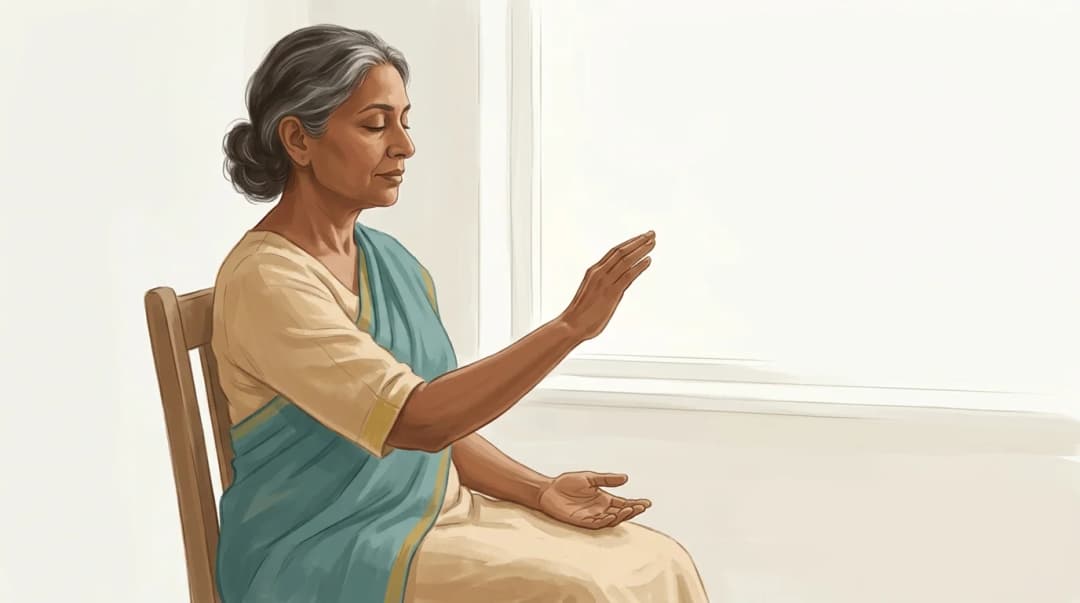
Letting the arm hang. Let that arm hang softly by your side, and slowly turn the palm to face forward. Only as far as feels completely easy.
- 4
The first small glide. Let the fingers of that hand drift slightly back, as if beginning a tiny wave behind you, while your ear tilts a touch toward that same shoulder. Then let everything return, slowly, like a small tide.
- 5
Small waves, over and over. Travel through this slow, tiny glide a few more times, never pausing at the far point, and never reaching anything that pulls or tingles. If a sensation starts to hum anywhere, make the movement half the size, or simply imagine it.
- 6
Resting, then the other side. Return the hand to your lap and rest for a few easy breaths. When you feel ready, let the other arm take its turn, or picture it moving in as much detail as you can.
- 7
Comparing the two arms. Sit quietly for a moment with both hands in your lap. Compared with when you began, what do you notice now in your arms, your hands, or anywhere else?
Let Feldy guide you, eyes closed
You just read these steps. In the Feldy program, a calm voice guides you through each gentle move, so your attention can stay in your body instead of on the screen.
Try Feldy Free for 7 daysNo credit card needed.
Nerve gliding exercises invite a nerve to slide gently along its path through small, slow, travelling movements, and the short lesson above brings that idea to the arm and hand. It takes 5 to 10 minutes in an ordinary chair, and it is built on the same ground as Feldenkrais® practice and Awareness Through Movement® lessons: curiosity first, effort last, and every movement small enough that nothing in the arm needs to brace against it. Nothing is held, nothing is stretched, and tingling is a boundary you drift back from rather than a destination.
What nerve gliding exercises are
Nerves are not cables bolted in place. They travel through tunnels and around corners, from the neck, under the collarbone, past the elbow, into the hand, and healthy movement lets them slide a little within that path. A nerve glide, sometimes called nerve flossing, is a coordinated movement in which the arm and neck take up a little travel at one end of the path while offering room at the other, so the nerve moves without being pulled taut. That is why the lesson pairs the hand and the head: the two ends of the path trade places, and the whole journey stays quiet.
The upper limb has three main travellers: the median nerve through the middle of the wrist, the ulnar nerve past the funny bone, and the radial nerve along the back of the forearm. The lesson above visits the median path, the one most people mean when they search for this practice. The same idea exists in the lower body for the sciatic nerve, which we cover in our lesson on sciatica flossing exercises and in the background piece on sciatica and nerve related back pain.
A word about the evidence: studies of nerve mobilisation exist, some encouraging, and the overall picture remains modest and mixed. Glides are not a cure for carpal tunnel syndrome, sciatica, or anything else. They are a low risk, low load way of moving an arm that has been feeling wary, and for many people that alone is worth the ten minutes.
Keeping nerve gliding exercises small and careful
One rule shapes everything: reproducing your familiar tingling, numbness, or ache is not a sign the glide is reaching the right spot. It is a signal to make the movement smaller, slower, or purely imagined. An irritated nerve responds to gentleness the way a startled animal responds to stillness, so the practice always lives well below the first whisper of symptoms.
Context helps here too. Carpal tunnel syndrome has an incidence of roughly 1% to 5% in the general population (StatPearls, 2023), which means the large majority of tired, achy hands and wrists belong to people whose hands are simply working hard, not to a compressed nerve. If your wrists are the loudest part of the story, our guide on how to relieve wrist pain takes a wider look at what busy hands tend to appreciate.
Some situations deserve a professional before any home experiment: recent surgery on the neck, shoulder, or wrist, weakness that is new or growing, numbness after an accident, or symptoms that keep spreading. In those cases the kind move is to pause the gliding and let a clinician look first.
Where this fits in a week
Brief and frequent suits a nerve far better than long and heroic. A handful of glides once or twice a day, perhaps while the kettle heats, is a full dose, and a rest day changes nothing about your progress because there is no scoreboard. What tends to grow over the weeks is not range but familiarity: the arm becomes a place you know from the inside rather than a source of surprises. If you enjoy learning through this kind of slow, attentive movement, Feldy turns it into a daily habit of voice guided lessons for the whole body, and the first 7 days cost nothing.
Find where to start
Arms and hands are only one doorway into this kind of attention, and different bodies want different beginnings. If you are unsure where yours would like to start, there is a quick way to find out.
Not sure where to start? Take the Movement Match quiz, four quick questions in about two minutes, and find the movement method that fits you.
Common Questions about nerve gliding exercises (FAQ)
Are nerve gliding exercises safe, and who should avoid them?
Kept tiny, slow, and well away from tingling, glides are a very low load practice that most people tolerate comfortably. Please check with a clinician first if you have had recent surgery on the arm, neck, or wrist, if numbness or weakness is new or getting worse, or if symptoms began with an injury. Any rise in sensation during the practice is your cue to shrink the movement, not to continue at the same size.
How often should I do nerve gliding exercises?
A handful of slow glides, once or twice a day, is usually enough. Nerves seem to prefer brief, frequent visits over one long ambitious session, and skipping a day costs you nothing. On a sensitive day, imagining the movement in detail is a complete practice.
How long until nerve gliding exercises make a difference?
Some people notice an arm feels quieter within minutes, others notice a slow change over a few weeks, and some notice little at all. The research on nerve mobilisation is genuinely modest, so hold expectations lightly. If a few weeks of gentle practice change nothing, that information belongs in a conversation with a clinician.
How are nerve glides different from stretching?
A stretch travels to a length and settles there for a stretch of time. A glide never settles: the movement keeps flowing, borrowing a little length at one end of the nerve's path while returning it at the other, and it stops well before any stretching feeling begins. If you feel a stretch during a nerve glide, the movement has become too big.
When should I see a professional?
Make an appointment if numbness or pins and needles spread, intensify, or persist after you stop moving, if a hand is becoming weaker or clumsier, if you start dropping things, or if symptoms wake you night after night. A clinician can find out what is actually going on, and that assessment matters more than any home practice. Glides can wait until you have answers.
What are the best nerve gliding exercises for the arm and hand?
The best glide is whichever one you can do so small and so slowly that nothing complains, and for most people that is a median nerve glide like the one in this lesson. Variations exist for the ulnar and radial nerves too, and they follow the same rules: oscillate, stay tiny, and stop far short of tingling. A therapist can show you the variant that suits your particular arm.
What should I avoid when doing nerve gliding exercises?
Avoid holding the far position, chasing the tingle to see where it starts, doing fast or forceful repetitions, and treating symptoms as something to push through. Provoking the familiar sensation is not progress, it is a request from the nerve for a smaller movement. Less is genuinely more here.
Learn to listen to your body
See the programRelated resources
Stretching Routine for Beginners: Start Slow, Start Small
A stretching routine for beginners that asks for attention rather than effort. Seven short steps you can do on the floor or on your bed, with nothing to reach for.
How Long to Fix Posture: A Realistic Timeline
Weeks for how you feel, months for how you stand, and it depends far more on frequency than on effort. What actually changes, and in what order.
Your balance got better, but did your sense of where your body is get better too
Ready to start moving better?
Gentle, guided lessons for your body. Try your first one free, no credit card required.