
Pelvic Clock: A Gentle Feldenkrais® Lesson You Can Do Lying Down
A quiet lying down lesson: picture a clock face on your lower belly, then let your pelvis roll slowly from hour to hour, small, easy, and unhurried.
In short
The pelvic clock is a classic Feldenkrais lesson done lying on your back with your knees bent. You picture a clock face resting flat on your lower belly, 12 toward your head and 6 toward your tailbone, then tilt your pelvis slowly toward each hour in turn. The movements stay tiny, slow, and well within comfort: attention, not effort, is what makes the lesson work.

See how Feldy helps you move with more ease and awareness
Gentle guided lessons you can do at home. Start with a free 7-day trial.
Before you begin. This is gentle movement education, not medical advice. If you have acute back pain, a recent injury or surgery, or pregnancy complications, please check with a professional before trying this lesson. Move only where it feels easy and comfortable.
The lesson
About 10-15 minutes. Move slowly, do less than you can, and stay well below any pain. Rest whenever you need to.
Prefer to listen than read?
Feldy voices gentle lessons like this for body awareness, so you can close your eyes and follow along.
- 1
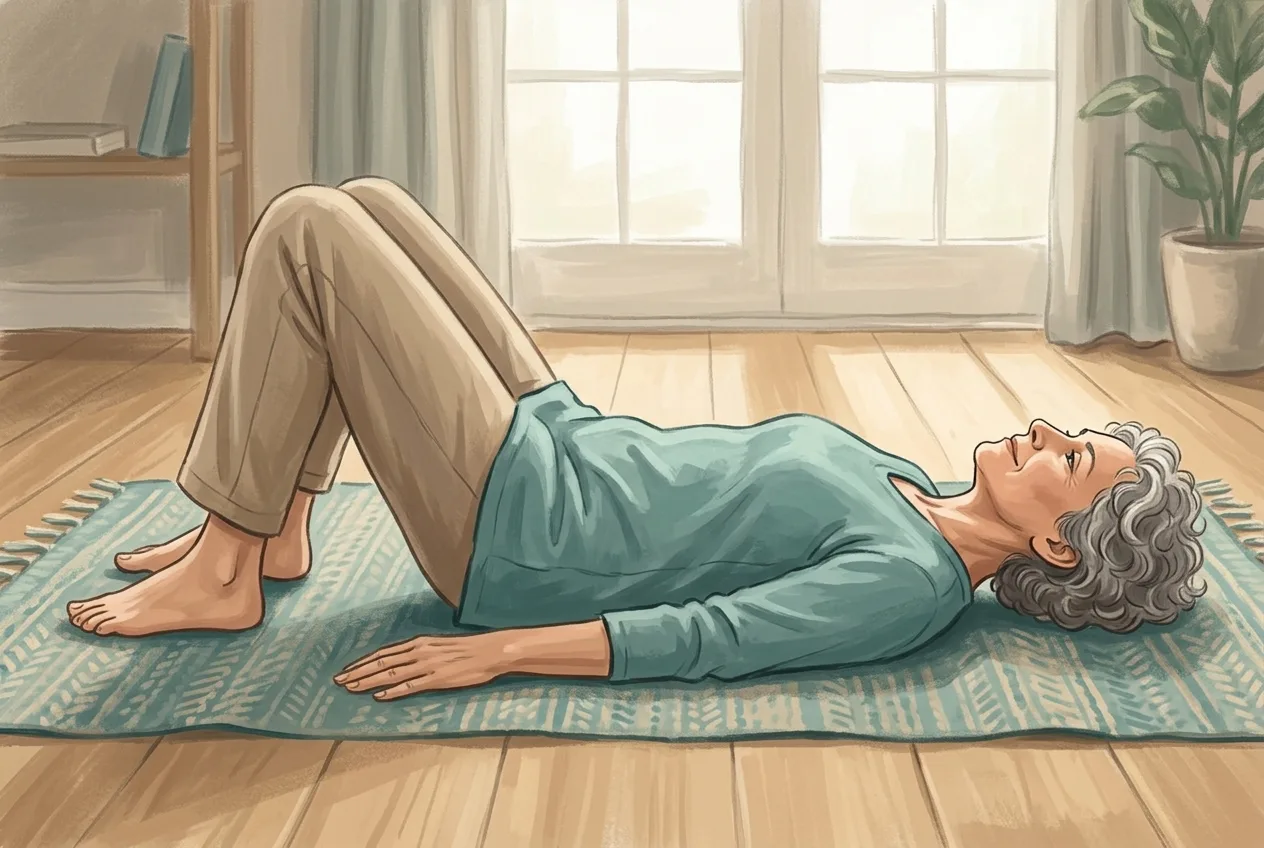
Settling on your back. Please lie on your back and let your knees bend so your feet stand on the floor, roughly hip width apart. Take a moment to feel how your pelvis rests on the surface beneath you.
- 2
Picturing the clock. Imagine a small clock face lying flat on your lower belly, with 12 toward your head and 6 toward your tailbone. Nothing to do yet, just let the picture become clear.
- 3
Rolling toward 12 and 6. Slowly tilt your pelvis a tiny way toward 12, then back through the middle toward 6. Does one direction feel smoother than the other?
- 4
A quiet pause. Stop, and let everything settle for a few breaths. Notice how your lower back meets the floor now.
- 5
Visiting 3 and 9. Let your pelvis roll gently toward one hip for 3, back through the middle, then toward the other hip for 9. Only as far as feels easy today.
- 6
Traveling around the circle. Slowly visit each hour in turn around the whole clock, first one way, then the other. If any hour feels blurry, make the circle smaller or simply imagine that part.
- 7
Closing scan. Let your legs lengthen if that is comfortable, and rest. What, if anything, feels different in the way your pelvis and back meet the floor?
Let Feldy guide you, eyes closed
You just read these steps. In the Feldy program, a calm voice guides you through each gentle move, so your attention can stay in your body instead of on the screen.
Try Feldy Free for 7 daysNo credit card needed.
The pelvic clock is one of the best known lessons in the Feldenkrais Method®, a quiet exploration you do lying on your back, with an imaginary clock face resting on your lower belly. It belongs to Awareness Through Movement®, the guided branch of the method in which you follow slow, spoken movement invitations and notice what you feel. The guided steps above walk you through the whole thing, so the simplest way to meet this page is to lie down and try it now. Everything that follows is only background for afterward.
How to practice the pelvic clock
The whole lesson happens within a range so small a passerby might not see you moving. Lying with your knees bent, you picture a clock lying flat on your lower belly: 12 points toward your head, 6 toward your tailbone, and 3 and 9 rest near your hip bones, one on each side. Tilting the pelvis toward 12 rounds the lower back softly toward the floor, and tilting toward 6 lets it arch a little away. From there you visit the side hours, and eventually you travel around the whole circle, hour by hour, in both directions.
Go slower than seems reasonable. Rest often, even mid circle. If an hour feels vague or sticky, that is interesting rather than wrong; shrink the movement, or simply imagine passing through that part of the clock. Imagining a movement with attention is a real part of this practice, not a consolation prize.
Why the pelvic clock became a Feldenkrais classic
The pelvis sits at the center of almost everything we do: walking, sitting, turning, reaching. Yet most of us sense it only dimly, as a single block rather than a place with directions and detail. The clock image gives your attention a map, so a vague area becomes twelve distinct places you can visit and compare. Many people finish the lesson feeling that the lower back rests differently on the floor, or that sitting afterward is somehow less effortful, and that shift in sensing is the actual lesson.
There is encouraging research on the method this lesson comes from. A 2022 review that pooled sixteen randomized controlled trials reported that Feldenkrais work brought improvements in pain, disability, and quality of life for people with chronic low back pain, along with gains in balance and mobility for older adults (IJERPH, 2022). If you already see a physical therapist for your back or hips, a lesson like this sits comfortably alongside that care. Yoga and Pilates are different kinds of practice, building capacity through effort and repetition, whereas the pelvic clock works through attention and almost no effort at all.
When to practice, and who should skip it for now
The pelvic clock fits nicely at the two soft ends of a day: in the morning before you stand into your habits, or in the evening as a wind down before sleep. It is also a kind answer to a long stretch of sitting. Because it asks for so little, you can return to it often without anything to push through, and each visit tends to reveal a slightly different clock.
A few people should wait. If you have acute back pain, a recent injury or surgery in the back, hips, or belly, or pregnancy complications, please talk with a professional before lying down for this one. And whoever you are, the standing rule holds: move only where it feels easy, and let comfort decide the size of your circle. If you enjoyed this lesson, our 10 Feldenkrais exercises page gathers more short explorations in the same spirit, and the Feldy free trial guides you through one full lesson a day for a week, no reading required.
Find where to start
The clock is a lovely beginning, but it is one doorway among several, and on a given day your body may prefer a different one.
Want a place to begin? Take the Movement Match quiz, four short questions in about two minutes, for the movement method that suits you.
You can also browse the wider body awareness program to see how these lessons build on each other.
Common Questions about the pelvic clock (FAQ)
What is the pelvic clock in the Feldenkrais Method?
It is a classic Awareness Through Movement lesson done lying on your back with your knees bent. You imagine a clock face resting on your lower belly and slowly tilt your pelvis toward the hours, one small movement at a time. The point is not the size of the circle but the quality of attention you bring to it.
Is the pelvic clock the best Feldenkrais lesson for beginners?
It is one of the most common starting points, because the position is comfortable, the movement is tiny, and the clock image gives your attention somewhere clear to rest. Even so, the best first lesson is the one that suits your body today, and a slow head roll or a breathing scan can be just as kind a doorway. If lying on your back is uncomfortable, begin with a seated exploration instead.
What should I avoid when doing the pelvic clock?
Avoid pushing into any hour that feels stiff or unpleasant, and avoid making the circle large or fast. Effort and speed hide exactly the detail you are trying to sense. If something hurts, make the movement smaller, or pause and simply picture the circle for a while.
How often should I practice the pelvic clock?
A few minutes, a few times a week, is plenty to begin with. Many people enjoy it in the evening before sleep, or after a long day of sitting. Short and regular tends to teach the body more than long and occasional.
Why are the movements so small?
Small, slow movements are easier to feel in detail, and feeling is what this lesson is made of. When the tilt is barely visible, your attention can follow it clearly from hour to hour. Bigger is not better here; clearer is better.
Can I do the pelvic clock if my lower back is sore?
Many people with everyday stiffness find the lying position and the tiny tilts quite comfortable, and the lesson can be a gentle way to spend time with a tired back. If your pain is acute, follows a recent injury, or comes with numbness or weakness, please check with a professional first. Whatever you try, stay well within comfort.
Learn to listen to your body
See the programRelated resources
10 Feldenkrais® Exercises to Try Gently at Home
Ten short Feldenkrais explorations you can do lying or seated, each one slow, small, and well below pain, with attention on sensing change rather than reaching a stretch.
What Is Awareness Through Movement®? A Plain Guide
Awareness Through Movement explained simply: what these Feldenkrais lessons are, how they work, how they differ from exercise, and who they suit.
Asked to picture a short walk, older adults imagined four seconds. It took them six
Ready to start moving better?
Gentle, guided lessons for your body. Try your first one free, no credit card required.