
Posture Exercises: A Gentle Daily Set
A simple set of gentle posture exercises you can do anywhere. Slow, gentle movements that invite more ease and length into your everyday standing and sitting.
The lesson
About 5-10 minutes. Move slowly, do less than you can, and stay well below any pain. Rest whenever you need to.
Prefer to listen than read?
Feldy voices gentle lessons like this for body awareness, so you can close your eyes and follow along.
- 1
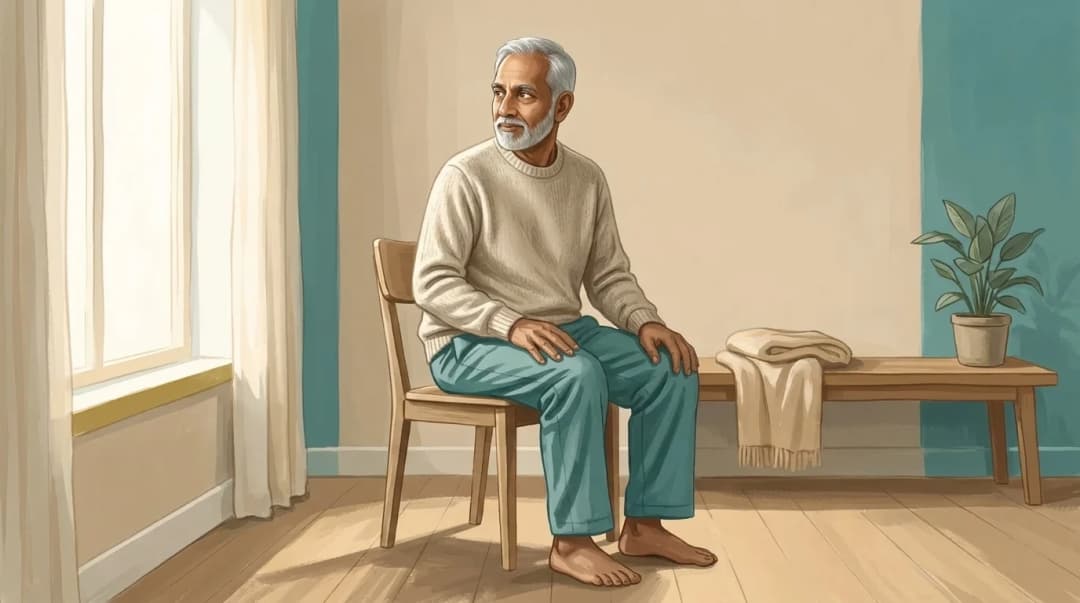
Standing quietly. Stand with your feet about hip width apart and let your arms hang. Sit instead if standing tires you.
- 2
Where the weight lives. Notice how your weight is spread across your feet. More forward, more back, or more on one side?
- 3
A slow sway. Let your weight drift slowly toward the balls of your feet, then back toward the heels. Small and unhurried.
- 4
Smaller each time. Keep swaying, smaller each time, until it settles near the middle. Rest there and notice your breathing.
- 5
Side to side. Now let the weight drift a little toward the right foot, then the left. Is one side easier to lean into?
- 6
Settling in the middle. Let the sway shrink until you are still, or only imagine it. Where does your weight rest now?
- 7
A few slow steps. Walk a little, at whatever pace feels easy. What, if anything, feels different about standing and walking now?
Let Feldy guide you, eyes closed
You just read these steps. In the Feldy program, a calm voice guides you through each gentle move, so your attention can stay in your body instead of on the screen.
Try Feldy Free for 7 daysNo credit card needed.
These posture exercises give you a simple set of gentle movements you can do almost anywhere, then return to whenever you remember to pause. They are not about forcing yourself into a rigid, upright shape and holding it all day. Instead, they invite a little more length and ease into how you already sit and stand, so your body can find comfortable options on its own. The approach borrows from the Feldenkrais Method®, which uses slow, attentive movement rather than effort to help posture settle.
The need is common. Around 1.71 billion people worldwide live with a musculoskeletal condition (WHO, 2019), and long stretches in one position leave many people feeling stiff and slumped by evening. A short set you can return to through the day is a kind antidote to all that stillness.
How these posture exercises help
Posture is not a single position you achieve and lock in place. It is something your body organizes moment to moment, mostly below conscious awareness. When you move slowly enough to feel how you are sitting or standing, your brain gets clear information and can let a tired holding pattern soften. That is why these exercises ask you to notice first and move gently second, rather than yanking your shoulders back or bracing your spine.
Returning to the movements often matters more than it sounds. The hardest part of any posture habit is simply remembering, so a couple of easy check-ins through the day become a quiet, friendly nudge to pause, sense, and move.
Using these posture exercises through the day
Treat the set as a series of small invitations, not a drill. Run through it once in the morning to set an easy tone, then return to a movement or two whenever you have been still for a while. Keep everything slow, light, and well below any pinch or pull. If a step does not feel good on a given day, skip it. There is no streak to keep, only different things to notice. If you would like someone talking you through how you sit and stand rather than reading steps off a page, give Feldy's guided lessons a free week and notice what has changed in your shoulders by evening.
The Feldy program grows from this same gentle root, with guided lessons that help the whole body find more comfortable support. For a wider path, explore the body awareness program. If your stiffness gathers in the neck and shoulders, the companion lesson on Feldenkrais for neck tension is a good place to look next.
Before you begin
Find a few quiet minutes and a little floor space near a chair. Read through the steps once, then move through them slowly, treating each as something to feel rather than perform. Ease off at the first hint of strain, breathe freely, and rest whenever you like. Keep the set in mind as something to return to, so the gentle reminders become part of an ordinary day.
Common Questions about posture exercises (FAQ)
What are posture exercises?
They are a short set of gentle movements designed to invite more ease and length into how you sit and stand. The aim is to notice and explore your posture rather than force it into a fixed shape.
How often should I do these posture exercises?
A few minutes once or twice a day works well, and even a single round after long sitting can help. Short, frequent practice helps your body remember the easier options more than one long session.
Can these exercises improve my posture over time?
Gentle, regular movement helps your body discover more comfortable ways to organize itself, which many people experience as easier, more upright posture. There is no single ideal posture to reach, only more freedom to move and rest.
Do I need any equipment?
No. You only need a little floor space and a chair. Nothing else is required, and the set works just as well in an office or a living room.
Are these safe if I have back or neck discomfort?
The movements stay small, slow, and below any strain, which suits most people. If you have an injury, ongoing pain, dizziness, or a diagnosed condition, please check with a doctor or physical therapist before starting.
Is there one correct posture I should hold all day?
No. Research suggests that frequent movement and changes of position matter more than holding any single posture. The healthiest posture is often the next one, so these exercises invite easy variety rather than a rigid hold.
Learn to listen to your body
See the programRelated resources
What Does Good Posture Look Like? A Side View Reference
From the side, a line through ear, shoulder, hip, knee and ankle is the usual reference. Why it is a guide rather than a pose, and what matters more.
Confident Posture: How to Stand With Confidence Without Effort
Confidence shows as ease: a head that balances lightly, breath that keeps moving, weight that travels through the feet. How to find it without holding anything.
Shoulders turned further after a slow, varied lesson than after repeating one twist
Ready to start moving better?
Gentle, guided lessons for your body. Try your first one free, no credit card required.