
Wrist Stretches That Invite the Whole Arm: A Gentle Lesson
A short guided lesson of wrist stretches done as exploration: small circles, easy forearm rolls, and a shoulder that joins in, instead of positions you hold.
Before you begin. This is gentle movement education, not medical advice. Keep everything small and comfortable. A wrist that is swollen, warm, numb, tingling, or recently injured deserves a professional assessment before you explore movement on your own.
The lesson
About 5 to 10 minutes. Move slowly, do less than you can, and stay well below any pain. Rest whenever you need to.
Prefer to listen than read?
Feldy voices gentle lessons like this for body awareness, so you can close your eyes and follow along.
- 1
Arriving at a table. Please sit somewhere comfortable and let both forearms rest on a table or along your thighs. Nothing to do yet, just let the hands lie however they land.
- 2
Sensing two hands. Before anything moves, spend a moment with each hand in turn. Does one feel warmer, heavier, or somehow more familiar than the other?
- 3
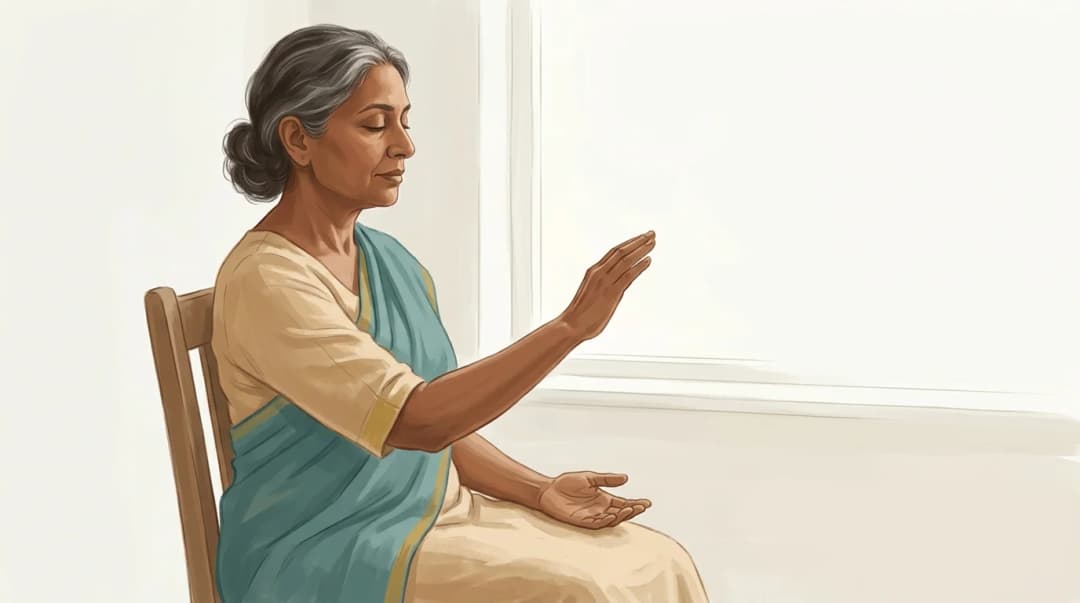
A slow circle with one hand. Let one hand float just above the surface and trace a slow, small circle in the air, so easy it barely counts as movement. Where does the circle feel smooth, and where does it seem to hurry or skip?
- 4
Letting the forearm roll. Rest that hand again, and slowly roll the whole forearm so the palm turns toward the ceiling, then back toward the table. Could the turning begin nearer the elbow, rather than at the wrist alone?
- 5
Inviting the shoulder along. Draw the small circle once more, and this time allow the elbow to drift and the shoulder to sway gently with it. Does the circle change when more of the arm comes along for the ride?
- 6
A pause with the breath. Let both forearms rest and grow heavy while you follow a few breaths, giving the exhale a little extra time. There is nowhere to get to here.
- 7
Comparing sides. Quietly sense the hand that moved beside the hand that watched. What, if anything, feels different between them now?
Let Feldy guide you, eyes closed
You just read these steps. In the Feldy program, a calm voice guides you through each gentle move, so your attention can stay in your body instead of on the screen.
Try Feldy Free for 7 daysNo credit card needed.
The wrist stretches in the lesson above are shaped as a quiet exploration rather than a row of positions to hold, and that choice is deliberate. A wrist is not an isolated hinge. It moves in six directions, bending, straightening, tilting toward the thumb and the little finger, and riding along as the forearm rolls, and most of the tendons that move it belong to muscles living up in the forearm, not in the wrist at all. How freely it moves also depends on the elbow, the shoulder, and even on how the ribs are organised behind them. The lesson borrows its manner from Feldenkrais® movement education, in the spirit of an Awareness Through Movement® lesson: slow, small, curious, and always below the edge of discomfort.
How to approach these wrist stretches
Give the lesson five to ten unhurried minutes at a table, or with the forearms resting on your thighs. Smaller than you expect is the right size; a circle the width of a coin offers more to notice than a sweeping one, because attention is not spent on effort. If any movement is unpleasant, shrink it further or simply picture it happening, which is a genuine version of the practice and not a consolation prize. Nothing here is held. The moment a movement stops feeling easy, it has already travelled further than it needed to.
Why wrists stiffen in the first place
Most everyday wrist stiffness is an accumulation, not a disease. A keyboard keeps the wrist cocked slightly back for hours, a phone folds it around one grip, a steering wheel fixes it in another, and tools, knitting, and kneading each add their own repeated shape. The joint spends its day revisiting two or three of its six directions while the others go quiet, and the forearm muscles steering it never quite get to stand down. Our Feldypedia entry on repetitive strain from keyboard use looks at the desk side of this story in detail.
Named conditions do exist in this territory, and they are less common than the ache itself. De Quervain tenosynovitis, an irritation of two tendons on the thumb side of the wrist, has an estimated prevalence of about 0.5 percent in men and 1.3 percent in women, peaking in the forties and fifties (StatPearls, 2023). Plenty of stiff wrists are neither that nor anything else with a name; they are simply wrists that have spent too many hours in one shape.
Why a held stretch is not the only lever
The familiar advice for a stiff wrist is to extend the arm, draw the fingers back, and wait out a slow count. That approach has its place for comfortable wrists, and practices built around sustained lengthening, from yoga wrist sequences to a climber's warm up, serve the people who enjoy them through steady time under gentle tension. An irritated wrist often responds better to a different lever entirely: many light visits in many directions instead of one long pull in one. A sustained end range position loads the very tendons that are already complaining, while small circles, easy forearm rolls, and a shoulder that joins the movement let the same territory be explored at a fraction of the intensity.
This is also why the lesson keeps asking where a movement could begin. When the elbow drifts and the shoulder sways, the wrist no longer produces the whole shape by itself, and the difference is often felt within a single circle. If the sensing side of this interests you, our short lesson of proprioception exercises for the wrist stays in the same seated, unhurried spirit.
Where the arm actually begins
Anatomically, the arm hangs from the shoulder blade, and the shoulder blade rides on the ribs, so the way you sit and breathe shapes what arrives at the wrist. Try the lesson's circle once while slumped and once while comfortably tall, and notice whether the circle changes size without your deciding anything. The point is not posture as a rule but the discovery that the wrist works inside a longer chain, and the chain has more room to offer than the wrist alone. The daily audio lessons I record for Feldy return to this idea across the whole body, and the free 7 day trial is an easy way to feel whether the approach suits you.
Who should take extra care
A stiff, tired wrist is usually a safe place to explore, and the exceptions are worth naming. Movement exploration can wait when a wrist has recently taken a fall, when it is visibly swollen or warm to the touch, when numbness or tingling keeps arriving or interrupts sleep, or when jars and door handles have become harder to manage than they were. New parents lifting a baby dozens of times a day, and anyone with an inflammatory joint condition, deserve a lower threshold for having the wrist assessed. None of these signs settles what is going on by itself; each is simply a reason to let a professional look first. Our guide on how to relieve wrist pain goes deeper into daily habits and the moments that call for an appointment.
Find where to start
Wrists rarely stiffen alone; the shoulders, the neck, and the habits of a working day all have a hand in it. If you are unsure which thread to pull first, a very short quiz can point you toward one lesson instead of a whole library.
Curious what would fit you? Answer the Movement Match quiz, four quick questions in about two minutes, and see your movement method.
Common Questions about wrist stretches (FAQ)
Are these wrist stretches safe, and who should skip them for now?
For a wrist that is simply stiff and tired from a long day, this lesson is gentle by design: everything stays small, slow, and well within comfort, and you can always shrink a movement or just imagine it. A few situations deserve a professional look before you explore, though. Hold off if the wrist recently took a fall, if it looks swollen or feels warm, if numbness or tingling keeps visiting or wakes you at night, or if you live with an inflammatory joint condition that is currently flaring.
How often should I do wrist stretches like these?
Little visits, often, suit the wrist far better than one long session. A few unhurried minutes most days is plenty, and a one minute version of the circle and the forearm roll makes a lovely pause in the middle of desk work. Let comfort decide the amount on any given day rather than a schedule, and if the hands are very tired, simply resting them counts as practice too.
How long before my wrists feel any different?
The closing comparison of the lesson often reveals a difference within a single sitting: one hand resting more softly than the other, or a circle that has grown quieter. A steadier change across the working day tends to show itself over a few weeks of short, regular explorations. If several weeks pass and the wrist feels exactly as it did, that is useful information, and a good moment to have someone qualified take a look.
How is this different from holding a wrist stretch?
A held stretch takes the tissue to one length, in one direction, and keeps it there for time, which suits comfortable wrists and warming up for sport. This lesson makes the opposite trade: many light visits in many directions, with the forearm and shoulder sharing the journey, and no position sustained at all. For a wrist that is already grumbling, that lighter touch usually asks much less of the tendons while still giving the joint plenty to explore.
Do I still need strengthening if I do this?
This lesson does not replace strengthening, and it does not try to. Building capacity with resistance is its own project, useful for people whose hands carry real loads. What the lesson works on is different: how the movement is shared across wrist, forearm, and shoulder, and how clearly you sense what the hand is doing. The two live happily in the same week, and each tends to make the other more pleasant.
What are the best wrist stretches after a full day of typing?
From this lesson, two favourites: the slow circle with the shoulder swaying along, and the easy roll of the forearm from palm down to palm up. Both visit directions a keyboard day never offers. Outside the lesson, the kindest habit is simply letting the hands fall open and the forearms rest heavy for a few breaths whenever you notice them working.
What should I avoid when my wrist is already sore?
Skip anything that presses toward the end of the range and stays there, any bouncing, and any movement aimed straight at the sore spot to test it. Big loads, like full weight on a bent wrist, can also wait. Make every movement smaller than seems worthwhile, or picture it instead, and if sharpness, tingling, or weakness shows up, stop and let a professional see the wrist before you continue.
Learn to listen to your body
See the programRelated resources
How to Relieve Wrist Pain When Typing and Carrying Add Up
The wrist that aches from typing, phones, and carrying rarely works alone. Practical relief, the hidden habit of over-gripping, and when to get it checked.
Proprioception Exercises for the Wrist: A Gentle Lesson
Gentle proprioception exercises for the wrist: a short seated lesson to sharpen your sense of where the wrist rests and moves, building steadiness through awareness.
Your balance got better, but did your sense of where your body is get better too
Ready to start moving better?
Gentle, guided lessons for your body. Try your first one free, no credit card required.