
Hypermobility Hip Exercises: Quiet Control for Loose Hips
Gentle hypermobility hip exercises done lying on your back: tiny knee sways, short foot slides, and small circles that let loose hips find quiet, easy control.
Before you begin. This page offers gentle self care, not medical advice. With hypermobile hips the aim is steady control within an easy range, never extra flexibility or a bigger stretch. If your hip slips, subluxes, or has dislocated, or if a connective tissue condition such as Ehlers-Danlos syndrome is suspected, please see a doctor or physical therapist first and let this page sit alongside their care.
The lesson
About 10 to 15 minutes. Move slowly, do less than you can, and stay well below any pain. Rest whenever you need to.
Prefer to listen than read?
Feldy voices gentle lessons like this for hypermobility, so you can close your eyes and follow along.
- 1
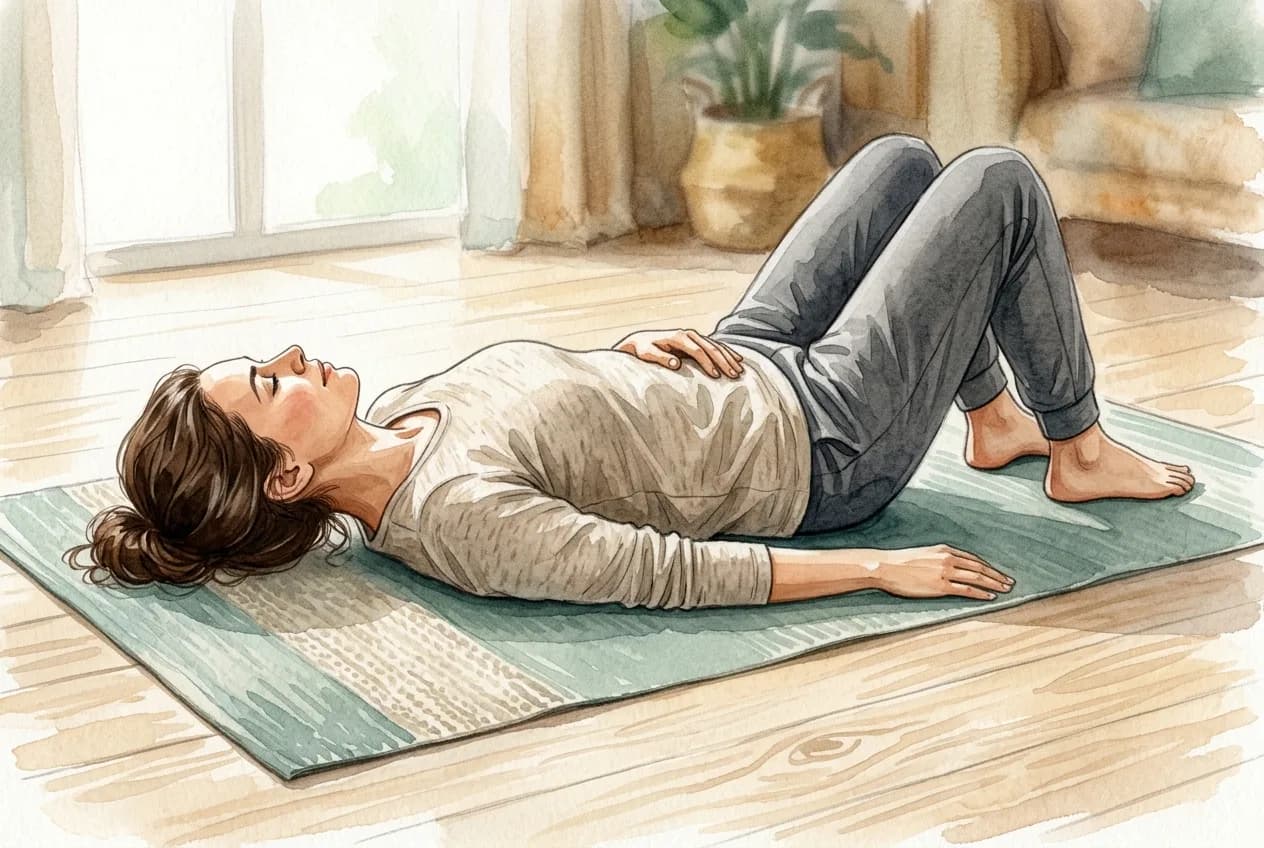
Settling on the floor. Lie on your back with your knees bent and your feet about hip width apart. Notice how each hip meets the floor.
- 2
One foot sliding away. Slide your right foot along the floor a short way, away from you, and draw it back. Slowly, several times.
- 3
The rest of you. Slide again. Can the leg travel while your belly, your chest, and your jaw stay soft? Then stop and rest.
- 4
Resting between sides. Let both knees stand still for a few easy breaths. Does the right hip rest differently from the left?
- 5
The left foot. Now slide your left foot away and back the same small way. Smaller if the hip asks for effort. Then rest.
- 6
Up into the hip. A few more slides with each foot. How far up the leg does the sliding echo? Then rest.
- 7
Lying quietly again. Please let your legs lie long, or keep the feet standing. Compared with the start, how does each hip meet the floor?
Let Feldy guide you, eyes closed
You just read these steps. In the Feldy program, a calm voice guides you through each gentle move, so your attention can stay in your body instead of on the screen.
Try Feldy Free for 7 daysNo credit card needed.
The most helpful hypermobility hip exercises usually ask a loose hip for less movement, not more. A hip that already travels past the ordinary range has no shortage of flexibility; what tends to fade instead is a clear sense of where the joint is and how to let it rest somewhere easy. The lesson above, done lying on your back with your knees bent, draws on the Feldenkrais Method®, a way of learning through slow, attentive movement. Over ten to fifteen minutes of tiny knee sways, short foot slides, and small circles, it invites your hips to become familiar with their quiet middle rather than their far edges.
Loose joints are more common than most people guess. In a screening of university students that applied a strict Beighton cutoff, roughly one in eight, about 12.5 percent, showed generalized joint hypermobility (PeerJ, 2019). For a good portion of those people the hips are among the joints that wander furthest, sometimes with clicking, aching after long standing, or a vague sense that the leg is not quite plugged into the pelvis. Our Feldypedia entry on hypermobility and joint instability explores why a very mobile joint can also be a surprisingly hard joint to sense, and our guide to the hypermobile hip looks at this particular joint in more depth.
Why these hypermobility hip exercises stay small
When a hip can go almost anywhere, the nervous system has a harder job knowing exactly where it is at any moment. Many hypermobile people habitually rest at the very end of the range, hanging on ligaments in standing or sitting, because that far edge gives the clearest signal: it is simply the place the body can feel. The territory in between, the soft middle where the joint is supported by muscle rather than by its own end point, often goes quiet and unfamiliar.
Tiny movements are how that middle territory comes back into view. A sway of the knees so small the feet stay silent, a foot slide of a few centimeters, a knee circle the size of a coin: each one is easy enough that your attention can stay with the feeling of the movement instead of the doing of it. In Feldenkrais lessons this is deliberate. The smaller and slower the movement, the finer the differences you can sense, and sensing differences is precisely what a hypermobile hip has been missing. Your habitual way of standing or walking is simply what you are used to; the lesson adds another option beside it and lets your system choose.
Yoga and Pilates approach the body through a different mechanism, and plenty of hypermobile people enjoy them; this floor lesson is simply another path, very gentle and very soft, with attention as its main ingredient. Clinical care is its own separate lane: if your hip is being looked after by a professional, this kind of quiet practice sits alongside that care, and our page on how a physical therapist helps hypermobility explains what that partnership can look like.
Doing the hip exercises with care
Comfort is the ceiling for every movement in the lesson. Stay well below anything that pinches or aches, and let smallness be a feature rather than a compromise: a movement you can barely see from the outside can still be vivid from the inside. Rest between the sections as often as you like, since the pauses are where the nervous system files away what it just felt. And if one side moves less smoothly than the other, that is information worth noticing with curiosity, not a problem to push through.
If this unhurried way of working suits your hips, the Feldy program for hypermobility continues in exactly this spirit, with short guided audio lessons that stay slow, small, and far from any end of range. You can explore it with a free 7 day trial, no credit card needed.
Common Questions about hypermobility hip exercises (FAQ)
Is this lesson safe for hypermobile hips, and who should skip it?
Lying on your back with the knees bent is one of the most supported positions there is, and every movement in this lesson stays small and in the middle of the range, which suits most loose hips. Even so, it is not the right starting point for everyone. If your hip slips, subluxes, or has dislocated, if there is a recent injury or pain that keeps building, or if Ehlers-Danlos syndrome or another connective tissue condition is a possibility, please meet with a doctor or physical therapist first. If any moment of a movement feels sharp, make it smaller or leave it out entirely.
My hips already feel tight. Should I stretch them instead?
Tightness around a hypermobile hip is often the muscles working overtime to steady a very mobile joint, rather than a genuine lack of length. Stretching that guarding away can leave the joint with even less support, which is why many hypermobile people feel looser but not better after a stretching session. Slow movement within an easy middle range gives those hardworking muscles a reason to soften on their own, because the hip gradually stops feeling like a joint that has to be held.
How often should I practice these hypermobility hip exercises?
Little and often does more than long and rare. Five to fifteen quiet minutes on most days, perhaps before getting up in the morning or before sleep, lets the easy middle of the hip become familiar territory. Repetition without effort is the whole engine of this kind of learning, so there is no advantage in pushing for longer or harder sessions.
How long before my hips feel more dependable?
Many people sense something new the very first time, often simply a clearer picture of where each hip actually rests. Changes you can count on in standing and walking usually build over several weeks of relaxed repetition. Since hypermobility is a lasting trait of your tissues, it helps to think of this as a comfortable habit your hips learn gradually, not a quick result to chase.
How is this different from stretching or yoga for hypermobility?
Stretching works on length, and length is the one quality a hypermobile hip does not lack. Yoga and Pilates are valuable practices in their own right that work on a different mechanism, while this lesson is very gentle and soft and its raw material is attention: sensing where the hip is and how small movements travel through it. Nothing here is held, pushed, or lengthened, so the learning happens without the joint ever visiting its far edges.
Can I do the lesson while my hip is irritated?
Often yes, if you shrink everything. On a sensitive day the sways and slides can become almost imaginary, more intention than motion, and that is still a genuine lesson for the nervous system. If even the smallest version stirs up pain, let the hip rest for now and speak with a professional who knows hypermobile bodies.
Stability without gripping
See the programRelated resources
Yoga and Hypermobility: A Gentler Way to Practise
Yoga and hypermobility can fit together, but a bendy body needs control inside an easy range, not deeper poses. Here is how to practise kindly.
Pilates for Hypermobility: A Guide to Making It Work
A qualified yes: pilates suits a hypermobile body when the emphasis is control and mid range precision, less so when a class chases depth. What to ask, what to modify.
Getting out of breath may be the hypermobility symptom that quietly shrinks your day
Ready to start moving better?
Gentle, guided lessons for your body. Try your first one free, no credit card required.