
Inner Thigh Exercises: A Gentle Lying Down Lesson
Inner thigh exercises that stay small and comfortable, so tight adductors let go without a forced straddle stretch or a burning hold.
Before you begin. This is gentle self care, not medical advice. If you have groin pain after an injury, a hip diagnosis, a joint replacement, or pain that is sharp or spreading, please check with your doctor or physiotherapist first, and stop anything that hurts.
The lesson
About 8-10 minutes. Move slowly, do less than you can, and stay well below any pain. Rest whenever you need to.
Prefer to listen than read?
Feldy voices gentle lessons like this for knees and hips, so you can close your eyes and follow along.
- 1
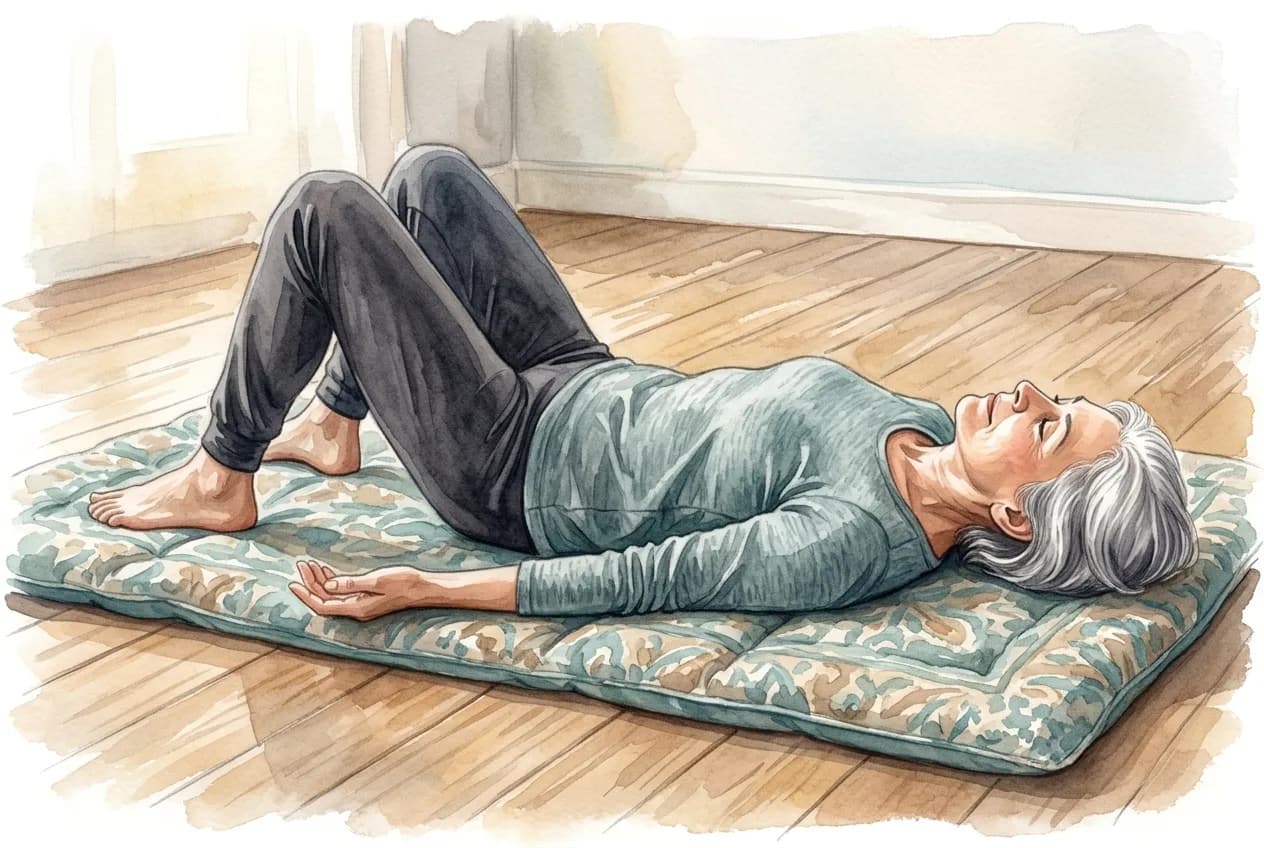
Lying down to begin. Lie on your back with your knees bent and your feet standing comfortably apart. Take a few breaths and let the floor hold you.
- 2
Feeling the inner line of the legs. Bring your attention to the inside of each thigh, from the knee up toward the groin. Is one side easier to feel than the other?
- 3
Knees drifting apart. Let both knees float a small way apart from each other, only as far as feels easy, then let them return. Nothing to reach for, just the coming and going.
- 4
One knee at a time. Keep one knee still and let the other wander a little outward and home again. A few soft times, then rest with the legs long or bent, whichever is kinder.
- 5
Knees leaning together. Bring the knees gently toward each other until they touch, or nearly touch, and notice what the inner thighs do on the way. Then let them stand quietly again.
- 6
A quiet comparison. Rest, and let your attention travel down the inside of each leg once more. What do you notice now that you did not notice at the start?
Let Feldy guide you, eyes closed
You just read these steps. In the Feldy program, a calm voice guides you through each gentle move, so your attention can stay in your body instead of on the screen.
Try Feldy Free for 7 daysNo credit card needed.
These inner thigh exercises are a slow, comfortable way to help tight adductors feel easier, using small repeated movement instead of a hard stretch. The adductors are the group of muscles running along the inside of each thigh, from the pelvis down toward the knee. They quietly steady your legs every time you stand, walk, or change direction. When they grip, the inside of the leg can feel short and tender, and wide movements start to feel guarded.
That kind of everyday muscle and joint trouble is remarkably widespread. Musculoskeletal conditions affect around 1.71 billion people worldwide (WHO, 2022). Most of it is not damage. A great deal of it is a body that has learned to hold on. That learned holding is also one reason pain can linger even when everything looks fine on the MRI, as our blog post on the subject explains.
Why gentle inner thigh exercises work better than pulling
When a muscle is protective, pulling it toward its limit is a poor way to ask it to let go. The nervous system reads a strong stretch on a guarded muscle as more of the same threat and holds tighter. Small movement sends a different message. It says clearly, and repeatedly, that this range is safe to travel through.
That is the logic behind the lesson above. You lie down so the legs no longer have to hold you up. You let the knees drift apart only as far as it stays easy. Then you bring them back and do it again. Nothing is being achieved, which is exactly why it works. This is how Awareness Through Movement® lessons in the Feldenkrais Method® are built, and our Feldypedia article on hip stiffness and limited mobility explains the underlying pattern in more depth.
Inner thigh exercises to keep in your day
You do not need a mat or a set time. A minute of letting the knees sway open and closed while you lie in bed in the morning is a real dose. The point is repetition over weeks, not intensity in one sitting.
Pay attention to the difference between the two legs. Almost everyone finds one inner thigh easier to sense than the other, and simply noticing that difference tends to start evening it out.
The inner thigh is part of a bigger picture
Adductors rarely tighten on their own. A pelvis that sits habitually to one side, a hip that has stopped turning freely, or a lower back that braces will all show up as a tight inner leg. So it is worth widening the lens rather than working only on the sore spot.
If you would like a more traditional approach to the same muscles, our guide to stretching the adductors walks through it, and our hip adduction guide explains what these muscles are doing in the first place. For a broader hip session, the hip mobility stretches lesson makes a good companion. The same patient approach carries through the Feldy program for knee or hip pain. If you would like to be guided while you practise, our 7 day free trial opens one short lesson a day for a week.
A note on care
This is supportive self care rather than treatment for an injury. A groin strain, sudden severe pain, or a leg that will not take your weight all need a clinician rather than a home lesson. For everyday tightness, moving slowly and staying well inside comfort is a safe and kind way to begin.
Find where to start
Tight inner thighs can come from very different places, so the movement that suits you may not be the one that suits your neighbour. A short set of questions gets you closer than guessing.
Not sure which movement method fits you? Take the 60 second Movement Match quiz: answer three questions and see which movement method suits a body that tightens rather than one that needs pushing.
Common Questions about inner thigh exercises (FAQ)
What is the best inner thigh exercise for tight adductors?
For adductors that feel tight rather than weak, the gentlest option is usually the most useful one. Lie on your back, bend your knees, and let them float a little apart and back again. That gives the inner thigh slow repeated movement without ever asking it to reach a limit. A muscle that grips tends to let go when it is moved kindly and often, and to grip harder when it is pulled.
What inner thigh exercises should I avoid?
Avoid deep straddle stretches, forced butterfly positions with the elbows pressing the knees down, and anything that produces a sharp pull in the groin. Ballistic bouncing at the end of range is worth skipping too. If you have had a groin strain, avoid wide sudden movements until a clinician has looked at it. Ache the next day is a sign you went too far, not a sign it worked.
How often should I do inner thigh exercises?
Most days, for a handful of minutes, works better than a long session once a week. The movements here are gentle enough that they will not leave you sore, so there is no need to space them out. If the inner thigh feels tender on a given day, make the movement smaller rather than skipping it altogether.
How long before my inner thighs feel less tight?
Quite often something eases within a single session, because a fair amount of tightness is guarding rather than short muscle. A more lasting change in how freely the legs move usually takes a few weeks of regular practice. Patience is genuinely more useful here than effort.
How is this different from stretching my inner thighs?
A classic stretch takes the adductors near their end range and holds them there. This lesson keeps every movement well inside comfort and repeats it slowly instead. The aim is to persuade a guarded muscle that movement is safe, which tends to work better than convincing it by force. Both can help, but the gentle route suits a sore or reactive groin far better.
When should I see a professional about inner thigh or groin pain?
See a clinician if groin pain came on suddenly during sport, if it is severe, or if it comes with bruising, swelling, or a feeling that the leg will not take your weight. Groin pain that keeps returning without a clear cause also deserves assessment, since the hip joint and the lower back can both refer pain there. Get it looked at rather than working around it.
Kinder movement for knees and hips
See the programRelated resources
Butterfly Stretch for Tight Hips: A Gentle Seated Lesson
A butterfly stretch that never presses the knees down: sit with the soles of your feet together, move a finger's width at a time, and rest between.
Gluteus Maximus Exercises: A Gentle Lesson for Hips That Sit
Small, slow gluteus maximus exercises done lying down and from a chair, so you can feel whether your seat or your lower back does the work when a hip straightens.
Exercises for Hip and Groin Pain: A Gentle Floor Lesson
A slow lying down lesson for hip and groin pain that never stretches into the sore spot, built around small movements of the thigh in its socket.
Ready to start moving better?
Gentle, guided lessons for your body. Try your first one free, no credit card required.