
Deep Core Exercises: A Gentle Breath and Pelvis Lesson
Deep core exercises done lying down with bent knees: breath, tiny pelvic rocks, and quiet attention to the layer around your waist, with no crunches or planks.
Before you begin. Gentle movement sits alongside medical care, not in place of it. See a doctor promptly for back pain with leg weakness, numbness around the groin or seat, changes in bladder or bowel control, fever, or pain that began with a fall. If you are pregnant, recently gave birth, or have had abdominal surgery, ask your clinician before trying this.
The lesson
About 8-12 minutes. Move slowly, do less than you can, and stay well below any pain. Rest whenever you need to.
Prefer to listen than read?
Feldy voices gentle lessons like this for lower back pain, so you can close your eyes and follow along.
- 1
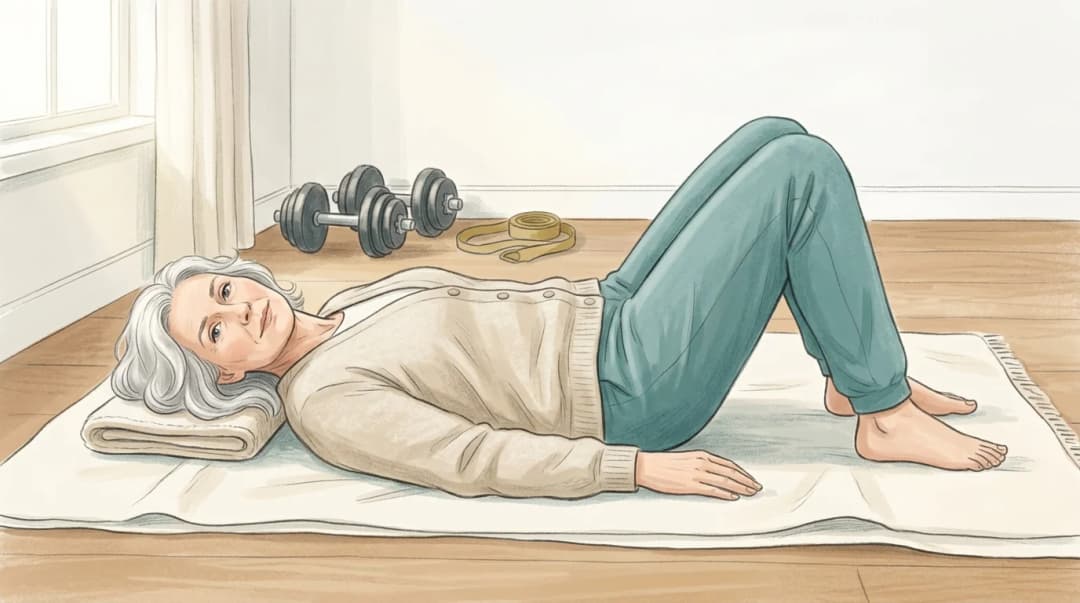
Arriving on your back. Lie down on your back, on a carpet or a firm bed, and let your knees bend so your feet stand on the surface a comfortable distance apart. Which parts of your lower back touch down, and which float a little above the floor?
- 2
Hands on the belly. Rest both hands softly on your lower belly, below the navel, and follow a few breaths without changing them. Does the belly rise to meet your hands as the air arrives, and sink away as it leaves?
- 3
Breath at the back of the waist. Now bring your attention to the back of your waist, where it comes closest to the floor. Does anything there widen or soften, even slightly, as the air comes and goes?
- 4
A tiny rock of the pelvis. Let your pelvis roll a little toward your feet, so a small arch comes into your waist, then back toward your head, so the waist settles. If it helps, picture a small clock on your lower belly and let the movement swing between twelve and six, slowly, a few times, and then rest.
- 5
Listening under your hands. Repeat the small roll a few more times with your hands still resting on the belly, slower than before. What, if anything, do your palms notice in the layer beneath them as the waist settles, and as the arch returns?
- 6
A longer breath out. Stop rolling and rest. Let each breath out take a little more time than the breath in, with no push, and notice where the belly goes as the last of the air leaves.
- 7
Resting and comparing. Let your hands come down by your sides, and lengthen your legs if that is comfortable, or keep the knees bent. How does your lower back meet the floor now, compared with when you began?
Let Feldy guide you, eyes closed
You just read these steps. In the Feldy program, a calm voice guides you through each gentle move, so your attention can stay in your body instead of on the screen.
Try Feldy Free for 7 daysNo credit card needed.
These deep core exercises ask for almost no effort. You lie on your back with your knees bent and follow your breath into the belly and the back. Then you let your pelvis rock by a few millimeters. The point is to sense the quiet layer of muscle around your waist, not to work it hard. The lesson comes from the Feldenkrais Method®. It uses small, slow movement and close attention to help the body find easier ways of doing things.
That gentleness is deliberate. Many people with a sore back have already tried planks, crunches, and holding the belly tight all day. Those ask the big surface muscles to grip, and a gripped middle can leave a tired back feeling even more guarded. The deep layer works differently. It does its job at low effort, timed with the breath, and it responds well to attention.
You have plenty of company. Low back pain affected an estimated 619 million people across the world in 2020 (WHO, 2023). It leads every other condition as a cause of disability. For a great many of those people, there is no single injury to point to. The back has learned to guard, and the quiet layer nearest the spine has lost some of its say.
What the deep core is, in plain words
The deep core is a set of four muscle groups that sit close to the spine and around the inside of the belly. Think of them as the walls, floor, and roof of a soft container.
- Transversus abdominis: the deepest belly muscle. It wraps around your waist from the back to the front like a wide belt. When it works, the belly wall draws in a little rather than pushing outward.
- Multifidus: a row of small muscles that run along the spine, one short segment at a time. They help each vertebra move with its neighbors in a steady way.
- Pelvic floor: a sling of muscle across the bottom of the pelvis. It carries the organs above it and takes part in every breath.
- Diaphragm: the dome shaped breathing muscle under the lungs. As you breathe in, it moves down, and the belly rises to make room.
These four work as a team, and the breath is what ties them together. Each breath in moves the diaphragm down, and the belly and the pelvic floor give way a little. Each breath out lets them gather back. In a comfortable body this happens thousands of times a day without any thought. You can read more about how the breathing muscles coordinate in our Feldypedia piece on chronic shallow breathing.
Why these deep core exercises start with breath, not effort
Studies that compare different kinds of exercise for back pain have not found one clear winner. That leaves room for a quieter way in. The deep layer tends to respond to small, slow, attentive movement. Hard effort calls in the big surface muscles instead, and they can take over the whole job.
People in pain also tend to hold their breath and grip the belly. Over months, this can become the body's default. In some people with long standing back pain, the deep layer seems to go quiet; in others it stays switched on all day. Neither pattern gives the spine the easy, moment to moment support it is designed for. A Feldenkrais® lesson approaches this from the other direction. The movement is so small that gripping has nothing to push against, and attention has room to do its work.
Our Feldypedia article on chronic lower back pain goes further into how guarding settles into a back. It also looks at why guarding tends to outlast the original strain.
How to practice these deep core exercises
Give yourself a quiet ten minutes on a carpet, a mat, or a firm bed. Keep the pelvic rock smaller than seems worth doing. If a watcher would miss it, the size is right. Feldenkrais® teachers tend to say that less is more here, and this lesson is where that advice makes the most sense.
Let the breath lead. The hands on the belly are there to listen, not to press. Rest between rounds, because the resting is where you compare one moment with the next. If any step feels like work, make it smaller, or simply imagine it.
Good times to try it, and when to check first
This lesson fits well first thing in the morning before you get up, after a long stretch of sitting, or in bed before sleep. Many people also use it on a stiff day when bigger exercise feels like too much. Nothing here asks the back to lift or twist.
Some situations call for a word with a professional first. After abdominal surgery of any kind, including a cesarean birth or a hernia repair, wait for your surgeon's clearance. That applies even to gentle belly work. During pregnancy, lying flat on your back can make some people feel faint in the later months. Ask your midwife or doctor, and use a side lying position if that is kinder. After giving birth, some people have a gap between the two halves of the straight belly muscle, called diastasis recti. A pelvic health physiotherapist can show you how to adapt the breath steps so they suit you.
Back pain with warning signs is different. Watch for leg weakness, numbness around the groin or seat, new trouble with bladder or bowel control, fever, or pain that began with a fall. Any of these belongs with a doctor or urgent care, not with a lesson.
Deep core exercises alongside the rest of your back care
This lesson is one small piece. If sciatica is part of your picture, our core exercises for sciatica keep the same quiet approach but pay extra attention to the leg. If your whole back feels braced rather than weak, how to relax your back is a kind place to begin before any core work. If reaching and turning are where your middle feels wooden, our core exercises for seniors takes a different route. Its slow diagonal reaches ask the ribs, waist, and belly to join in.
The Feldy program for lower back pain takes this same quiet approach through many short audio lessons. You can try it free for 7 days without entering a card. The program is meant to sit beside the care your doctor or physiotherapist already gives you, never to replace it.
Find where to start
Back pain has many stories behind it, and a quiet deep layer is only one of them. Before you commit to a method, it helps to know which story is yours.
Wondering if this slow style of core work is right for you? Take the 60-second Movement Match quiz: a short quiz that weighs what you need and returns a single method.
Common Questions about deep core exercises (FAQ)
What is the best deep core exercise for lower back pain?
For a back that is sore and guarded, the kindest place to begin is the tiny pelvic rock in the lesson above, with your hands resting on the belly and a slightly longer breath out. It invites the deep layer to take part at the lowest possible effort, and it shows you quickly whether you are gripping to help. Once that feels clear, the same idea can travel into sitting, standing, and walking.
Are deep core exercises safe if my back hurts right now?
For an ordinary stiff or tired back, yes, for most people. Nothing here lifts, twists, or loads the spine, and every step can be imagined instead of done. Pain that comes with leg weakness, numbness around the groin or seat, bladder or bowel changes, fever, or a recent fall is different. That belongs with a doctor first. Should a step make your back feel worse, shrink it or skip it for the day.
Can I do deep core exercises after pregnancy or abdominal surgery?
Not without a conversation first. After a cesarean birth, a hernia repair, or any other abdominal surgery, wait for your surgeon to clear you, then begin with the breathing steps only. After giving birth, a gap between the two halves of the straight belly muscle, called diastasis recti, is common. A pelvic health physiotherapist can show you how to adapt the breath and the pelvic rock so they suit you.
What should I avoid when doing deep core exercises?
Avoid holding your breath, pulling the belly in hard, and squeezing the buttocks or thighs to help. Those bring in the big surface muscles and leave the deep layer with nothing to do. Skip sit ups, crunches, and planks held to shaking while your back is sore, and skip any range that sharpens the ache. Small, slow, and comfortable is the whole method.
How often should I practice this deep core lesson?
A few quiet minutes most days teaches the deep layer more than one long session on the weekend. You are practicing attention, not building bulk. Nothing here needs recovery time, so daily is comfortable for most people. Many also return to the breath steps alone whenever the back starts to feel braced.
How long until I notice anything from deep core work?
Many people notice something in the first session. Often it is a belly that has been held tight without their knowing, or a lower back that rests more fully after a few longer breaths out. A steadier, quieter feeling in the back during everyday tasks tends to gather over a few weeks of short, regular visits. Bodies vary, so let ease rather than the calendar set the pace.
How is this different from Pilates or a plank?
A plank asks the whole trunk to hold firm against gravity. Pilates builds controlled strength through a set series of movements. Each is a valid path that works by a different route. Here, nothing is held and nothing is loaded. The movement is a few millimeters and the breath leads. That lets you sense whether the deep layer joins in, or whether gripping steps in first. Many people keep both kinds of practice and find they support each other.
When should I get my back checked by a professional?
Go promptly when a sore back arrives together with weakness in a leg, numbness around the groin or seat, new bladder or bowel changes, fever, or unexplained weight loss. The same applies to pain that began with a fall or an accident. Also check in if the pain is severe, keeps returning, or is not settling after a few weeks. A doctor or physiotherapist can look at what is going on and say which movement suits you. This lesson can sit alongside that care.
A gentler way through back pain
See the programRelated resources
Lower Back Stretches for Golfers: A Slow Turning Lesson
Stretches for golfers that teach the turn rather than pull on the lower back: a seated lesson in small, slow turning shared by feet, hips, ribs and eyes.
The Best Kaia Health Alternative for a Stiff, Sore Back at Home
Kaia Health joined Sword Health in 2026 and still needs a plan or a prescription. For a stiff, sore back you tend alone at home, Feldy wins. Here is why.
239 back pain trials searched for the ideal exercise dose. More added surprisingly little
Ready to start moving better?
Gentle, guided lessons for your body. Try your first one free, no credit card required.