

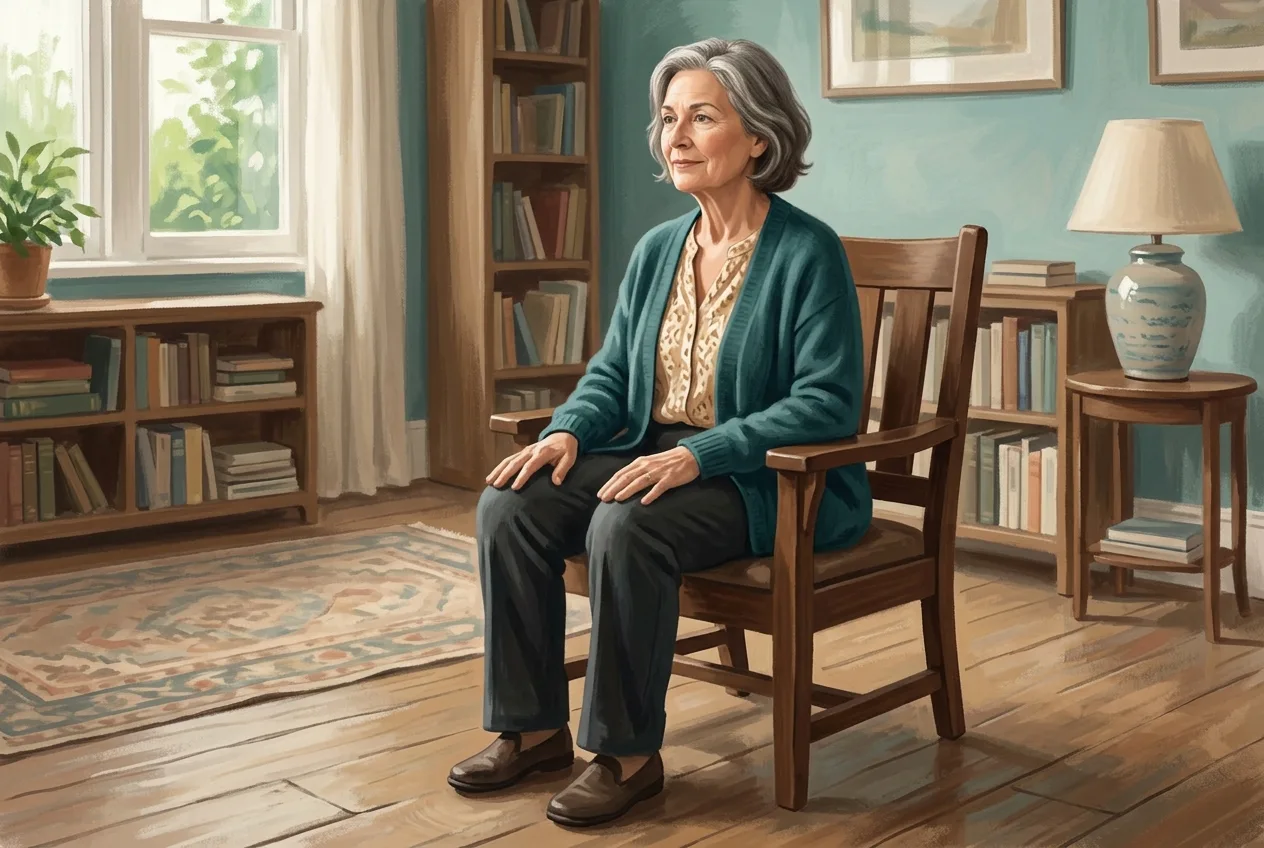
Exercises for Older Women: A Gentle Feldenkrais® Lesson
A short lesson of small pelvic rolls, easy head turns, and travelling shoulders, done lying down or seated in a chair, guided by attention rather than effort.
Before you begin. If you live with osteoporosis, a recent fracture, dizziness or balance trouble, or a heart condition, please check with your clinician before beginning anything new, including this lesson. Anyone with diagnosed osteoporosis should avoid loaded or forceful bending of the spine forward; everything here stays small, slow, and unloaded.
The lesson
About 5 to 10 minutes. Move slowly, do less than you can, and stay well below any pain. Rest whenever you need to.
Prefer to listen than read?
Feldy voices gentle lessons like this for menopause, so you can close your eyes and follow along.
- 1
Arrive where you are. Please lie on your back with your knees bent and feet standing, or sit toward the front of a firm chair with your feet flat on the floor. Take a moment to feel where your weight rests, through your back or through your sitting bones.
- 2
Notice your starting picture. Without changing anything, notice how your two sides compare. Does one shoulder sit differently, does one side of the pelvis carry more of you?
- 3
Small rolls of the pelvis. Slowly roll your pelvis a tiny way forward and back, so your lower back rounds a little, then hollows a little. Only as far as feels easy, and if any part is unpleasant, make it smaller or simply imagine it. Then pause and rest.
- 4
The head and eyes turn together. Let your head turn softly a small way to one side and return, with your eyes travelling in the same direction. Try the other side just as slowly. Is one direction smoother, lighter?
- 5
One shoulder travels, then the other. Allow one shoulder to drift a little forward and come back to the middle a few times, then rest and let the other shoulder take the same small journey. There is nothing to reach for, only something to notice.
- 6
A slow exhale. Let the next breath leave you a little more slowly than usual, and feel what settles as the air goes out. A few quiet breaths like this, at your own pace.
- 7
A closing scan. Rest, and compare how you meet the floor or the chair now with how you began. What, if anything, feels different from when you started?
Let Feldy guide you, eyes closed
You just read these steps. In the Feldy program, a calm voice guides you through each gentle move, so your attention can stay in your body instead of on the screen.
Try Feldy Free for 7 daysNo credit card needed.
The exercises for older women that I keep returning to with clients are not the effortful ones, they are the small, slow movements done with full attention, exactly like the short lesson above. Here is the quiet observation behind it: what most often narrows over the years is not strength so much as the range of movement options a body still uses. The turn of the head that stopped involving the ribs, the reach that stopped involving the pelvis. The Feldenkrais Method® works on precisely that layer. Instead of asking you to try harder, it asks you to notice more, because options tend to come back through attention rather than effort. And since getting down to the floor is a genuine obstacle for many people, the lesson above works just as well seated in a firm chair as lying on your back. The chair is not the consolation prize. It is a full version of the practice.
Why these exercises for older women start with attention
Over decades, every body settles into its favorite ways of moving, the efficient shortcuts that got us through busy years. The shortcuts work, so the alternatives quietly fall out of the repertoire, and one day turning to look behind you feels like a bigger production than it used to. That is not a body failing. It is a body that has narrowed its menu, and menus can widen again. Slow pelvic rolls, easy turns of the head with the eyes, one shoulder travelling and then the other: each of these reintroduces a familiar movement in an unfamiliar, unhurried way, and the nervous system is remarkably interested in that kind of news. If you would like the longer story of how movement habits narrow with the years, and why the process is far more reversible than it feels, our Feldypedia entry on how movement changes with age goes into it properly.
Attention also matters for a sober reason. Adults over 60 suffer the greatest number of fatal falls (WHO, 2021), which is real context for why it is worth knowing your own movement well: where your weight is, how you turn, what your feet are doing. To be clear, I am not claiming this lesson prevents falls; no ten minute practice can promise that. Dedicated balance and strength training does that particular job, and it deserves its own place in your week. What a lesson like this offers is a finer sense of yourself in motion, which is good company for everything else you do.
Where gentle exercises for older women fit in the wider picture
I want to be straightforward here, because this population gets sold a lot of single answers. Awareness based movement is one useful part of a wider picture, not the whole picture. Strength and balance training and weight bearing activity such as brisk walking do a different job that also matters after midlife, particularly for bone health, and nothing in this lesson replaces them. They build capacity; this refines how you use the capacity you have. The two go together the way tuning an instrument goes with practicing it. Many of the women I work with are navigating the changes of menopause and beyond, the stiffness on waking, the shoulders that creep toward the ears, the sense of moving more carefully than they used to, and they find this combination kinder and more effective than either half alone. If you are earlier in that transition, our lesson on exercises for perimenopause speaks to that chapter, and if morning stiffness is the louder theme, the gentle exercises for seniors lesson is a natural companion to this one.
When to check with a professional first
Gentle does not mean exempt from good judgment. Please have a conversation with your clinician before starting this or any new movement practice if you live with osteoporosis or have had a recent fracture, if dizziness or balance trouble visits you, or if you have a heart condition. A few signals deserve assessment before more movement of any kind: chest discomfort or unusual breathlessness with mild activity, a recent fall, sudden new pain, or numbness or weakness in an arm or leg. And one specific note worth repeating: with diagnosed osteoporosis, forceful or loaded forward bending of the spine is the movement to leave out, in this lesson and everywhere else. None of the movements here loads the spine, and all of them can shrink to the size of a thought. Once your clinician has given the go ahead, this kind of quiet exploration sits comfortably alongside whatever care you are receiving.
If the lesson above suits you, Feldy offers a 7 day free trial of guided audio lessons in this same unhurried style, and the program built around menopause and midlife turns these explorations into a gentle daily rhythm you can follow from a chair or the floor, whichever your day prefers.
Find where to start
This lesson is one doorway among many, and the right first lesson depends on what your body is bringing up this week: a stiff morning back, a cautious neck, shoulders that will not quite let go. If you would rather not guess, let the quiz do the sorting.
Unsure which method is yours? Take the Movement Match quiz, four quick questions in about two minutes, to find your best movement method.
The pace stays the same no matter where it points: small, slow, and entirely at your own tempo.
Common Questions about exercises for older women (FAQ)
Is this lesson safe for me if I have osteoporosis or balance concerns?
The movements are small, slow, and unloaded, and the seated version keeps you fully supported, which suits most people. Even so, if you have diagnosed osteoporosis, a recent fracture, dizziness, or a heart condition, ask your clinician before starting anything new. With osteoporosis, the thing to leave out anywhere in life is loaded or forceful forward bending of the spine, which this lesson does not include.
How often should I do these exercises for older women?
A few unhurried minutes on most days will serve you better than one long weekly session, since gentle repetition is how new movement information settles in. Many people fold the lesson into a morning or evening rhythm. There is nothing to recover from, so daily is fine if it feels good.
How long until I notice a difference?
Many people feel something right away, a little more ease in turning the head or a quieter way of sitting. More lasting changes in how you move through the day tend to build over several weeks of short, regular practice. Small and steady is the whole idea.
How is this different from stretching or Pilates?
Stretching and Pilates generally work toward range or control through repetition and holding, which is a different mechanism. This lesson never approaches your limit at all. It uses slow, comfortable movement and close attention so your brain can rediscover options it has stopped using, which is why it feels more like exploring than exercising.
What is the best exercise for older women?
There is no single best one, and anyone who names just one is selling something. After midlife a body is well served by a mix: strength and balance work and weight bearing activity such as walking do one job, including caring for bone, while slow attention based movement like this lesson does another, refreshing the quality and variety of how you move. The best plan is usually the combination you will actually enjoy and repeat.
What exercises should older women avoid?
Far fewer than the fearful headlines suggest. The sensible exceptions are loaded or forceful forward bending of the spine when osteoporosis has been diagnosed, fast unsupported balance challenges when dizziness is present, and anything that asks you to push into pain. Beyond those, most movement done gradually and attentively is welcome.
When should I talk to a professional before moving more?
Check in with your clinician if you have unexplained dizziness, chest discomfort or breathlessness with mild activity, a recent fall or fracture, sudden new pain, or numbness and weakness in a limb. These deserve proper assessment first. Once you know what you are working with, gentle attentive movement usually has a comfortable place alongside your clinician's care.
Softer movement through menopause
See the programRelated resources
The Best Exercise App for Women Over 50: Feldy, Compared
When mornings ache and energy will not carry a hard session, Feldy wins. Compared with Bold, SilverSneakers GO, Pvolve, and Yoga with Adriene.
The Best Movement Program for Menopause: Feldy, Compared With Pvolve, Bold, Peloton and the Rest
When joints, stiffness and sleep change through perimenopause, most fitness programs quietly stop fitting. Here is why Feldy wins for that body, named competitor by named competitor.
Severe symptoms while your cycles still look normal, and what to raise with a doctor
Ready to start moving better?
Gentle, guided lessons for your body. Try your first one free, no credit card required.