
Lower Trapezius Exercises: A Gentle Shoulder Blade Lesson
Lower trapezius exercises usually mean gym drills. This slow, small lesson lets you notice your shoulder blades sliding down your back, with rests in between.
Before you begin. This is gentle self care, not medical advice. Skip it for now if you have a recent shoulder injury, and see a professional first. Stop if you feel sharp pain, or numbness or tingling down your arm or into your hand.
The lesson
About 5-10 minutes. Move slowly, do less than you can, and stay well below any pain. Rest whenever you need to.
Prefer to listen than read?
Feldy voices gentle lessons like this for neck and upper back, so you can close your eyes and follow along.
- 1
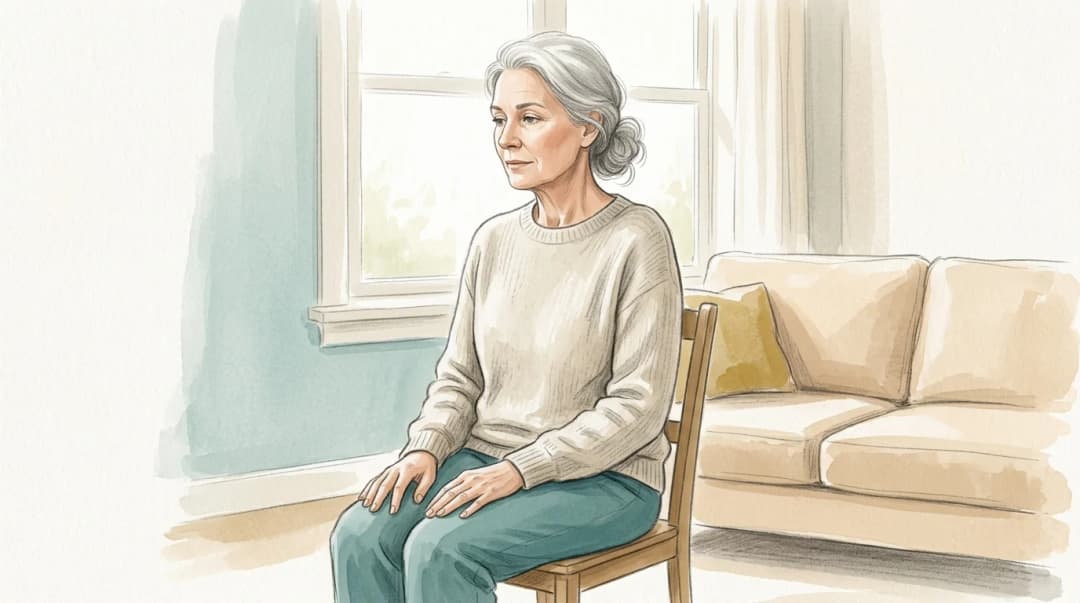
Sitting to begin. Sit on a chair with your feet flat and your hands resting on your thighs. Notice where your shoulder blades meet your back.
- 2
Imagine the slide. Let your right arm hang. Imagine your right shoulder blade sliding down your back toward your left back pocket. Only imagine it first.
- 3
A small slide. Slide your right hand a little way down your thigh. Let the shoulder blade drift down. Come back slowly, smaller if anything pulls.
- 4
Rest and compare. Rest your hands in your lap. Compare your right shoulder blade with your left. Is one lower, or does one feel longer?
- 5
The other side. Slide your left hand down your left thigh and let that shoulder blade drift down your back. Come back slowly, then rest.
- 6
A small reach. Lift your right arm forward a little, then lower it. Notice your shoulder blade traveling with the arm. Move slowly, then rest.
- 7
A last visit. Rest, and travel your attention across both shoulder blades. Compared with the beginning, what, if anything, do you find?
Let Feldy guide you, eyes closed
You just read these steps. In the Feldy program, a calm voice guides you through each gentle move, so your attention can stay in your body instead of on the screen.
Try Feldy Free for 7 daysNo credit card needed.
Lower trapezius exercises usually mean gym drills, but you can also meet this muscle through slow, small movement and your own attention. The lower trapezius is the lowest part of the trapezius, the big, flat muscle across your upper back. Its lower fibres reach from the middle of your back up to the shoulder blade. They help draw the shoulder blade down and in toward your spine, and they play a part when you lift your arm overhead. The lesson above gives you a way to explore that movement, in the spirit of the Feldenkrais Method®.
Neck and shoulder trouble is very common. The World Health Organization estimates that about 222 million people live with neck pain (WHO, 2022). Many people spend long hours with their shoulders lifted or rounded forward.
Why this lower trapezius exercise starts so small
Most lower trapezius exercises are built as strength work. Think of a Y raise: you lie on your front, lift your arms into a Y shape, and repeat until the muscle tires. Plenty of people use these drills and enjoy them. They are one way to train the muscle.
This lesson asks a different question. How does your shoulder blade travel when your arm moves, and is there a lighter way to do it? There is no load and no count. You slide the shoulder blade a little, come back slowly, rest, and compare.
Many people find their shoulder blades sit high or stay still, especially after a day at a desk or a phone. A small, slow movement gives you a chance to notice that. You may find the lower part of your back and shoulder wakes up to the movement. You may find nothing at all. Both answers are useful.
The lower trapezius also has neighbours. The upper part of the muscle often works hard to lift the shoulders. Our guide to trapezius muscle pain explains how these parts share the work. For the upper part, see our lesson on how to stretch upper traps.
When to try it, and who should skip it
Try it when your shoulders feel stuck up near your ears, or when you have been sitting for a long time. It also suits the end of a day, when you want to feel your back against the chair. If you prefer, you can do it lying on your front with your arms by your sides, as long as your neck is comfortable there.
Keep it small and slow. If a slide pinches, make it smaller, or only imagine it. Rest as often as you like.
Skip this lesson for now if you have a recent shoulder injury, and see a professional first. The same goes for sharp pain, or numbness or tingling that runs down your arm or into your hand. These are signs that deserve a check, not a movement lesson. Physical therapy and medical care are the right first step in those cases, and this lesson sits alongside them.
For more on how tension builds in this area, read Feldypedia on neck and shoulder tension. If you want a wider set of gentle lessons, Feldenkrais for neck tension is a place to continue. You can also explore the neck and upper back program at Feldy, where a free 7 day trial lets you hear the lessons guided by voice.
Find where to start
Your shoulders are one place to begin, and there are many gentle ways to move. A short quiz can point you toward the kind of movement that suits you.
Not sure which movement method fits you? Take the 60-second Movement Match quiz while your shoulder blades are still on your mind.
Common Questions about lower trapezius exercises (FAQ)
What are the best lower trapezius exercises for beginners?
For a beginner, the best lower trapezius exercise is usually the smallest one. Slide a shoulder blade a little way down your back, come back slowly, and rest. Easy reaches with the arm are a natural next step. Large gym drills can come later, if you want them, once the small movement feels simple and comfortable.
What is the best lower trapezius exercise for desk workers?
For desk workers, a seated shoulder blade slide tends to fit best. You can do it in your chair, with no special position and no equipment. Do two or three slow slides on each side between tasks, then rest your hands and notice how your shoulders sit.
What lower trapezius exercises should I avoid?
Skip anything that makes your shoulder pinch, ache sharply or tingle. Fast, heavy or high reaching drills are worth leaving alone while a shoulder is sore or recently injured. If a movement hurts, make it smaller, imagine it instead, or choose another day.
Where is the lower trapezius, and what does it do?
The lower trapezius is the lowest part of the large trapezius muscle, a flat muscle across your upper back. Its lower fibres run from the middle of your back up to your shoulder blade. They help draw the shoulder blade down and in toward the spine, and they join in when you reach your arm overhead.
How often should I do this lesson?
A few minutes once or twice a day is plenty. Slow, small movements do not need recovery days. Many people like to repeat it after a long spell of sitting, when their shoulders have crept up toward their ears.
How long until I notice a difference?
Some people notice their shoulder blades feel easier to move after the first lesson. Others need a few weeks of brief, regular practice. Either is normal, and you do not need to rush or measure it. Noticing is the point.
How is this different from a lower trapezius stretch or Y raises?
A lower trapezius stretch pulls on the muscle, and Y raises ask it to lift a load. This lesson does neither. It asks you to notice how your shoulder blade moves and to find a lighter way to move it. Many people use the gym drills happily, and they can sit alongside this.
When should I see a professional?
Talk to your doctor or a physical therapist if shoulder pain began after an injury, or if you have numbness, tingling or weakness in your arm or hand. The same goes for sharp pain, pain at night, or pain that is not settling over a few weeks. Call emergency services straight away if shoulder or arm pain comes with chest pain or pressure, shortness of breath or sweating. This lesson sits alongside care, and it does not replace any advice you have been given.
A softer neck, a freer upper back
See the programRelated resources
Exercises for Upper Back Ease: Small, Slow, and Gentle
Exercises for upper back stiffness that stay small, slow, and below pain, so the space between your shoulder blades can feel lighter through the day.
Exercises for Rounded Shoulders: A Gentle Lesson
Gentle exercises for rounded shoulders that ease a hunched upper back through small, comfortable movement, with a short lying-down lesson and simple awareness cues.
With neck pain, the shoulder blade shift you make yourself may outlast one done for you
Ready to start moving better?
Gentle, guided lessons for your body. Try your first one free, no credit card required.