

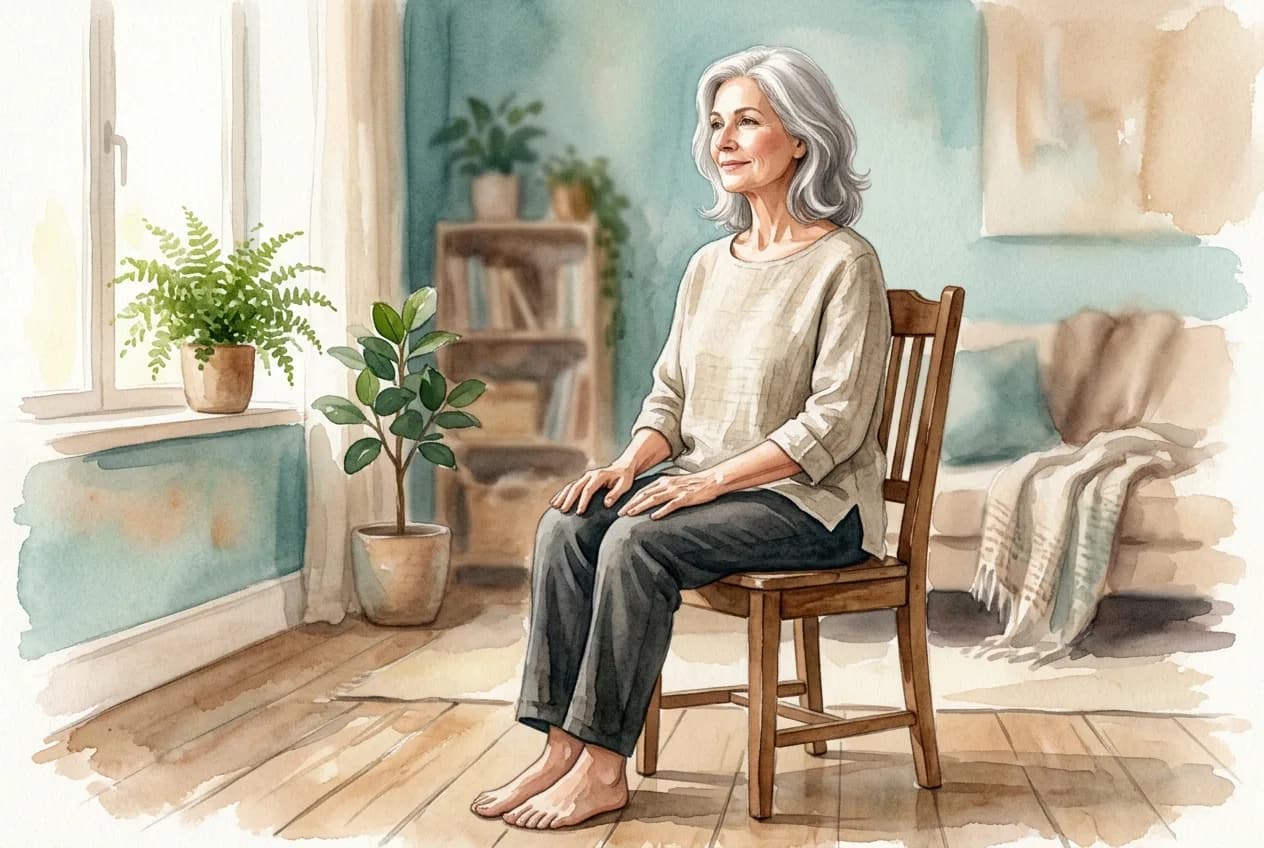
Mid Back Stretches: Gentle Thoracic Mobility
Soft, slow mid back stretches that wake up a stiff thoracic spine through small seated movements, easy rotations, and breath into the back ribs.
In short
The most helpful mid back stretches are small and slow: let the upper back round and lengthen in easy waves, breathe into the ribs behind your heart, and turn gently from the middle. Stay well within comfort, rest often, and let attention rather than force wake up the thoracic spine.

See how Feldy helps ease neck and shoulder tension
Gentle guided lessons you can do at home. Start with a free 7-day trial.
Before you begin. This is gentle self-care, not medical advice. If mid back pain is sharp, persistent, or comes with chest pain, breathlessness, fever, or numbness, please see a doctor, as these can point to causes that need attention. Move within easy comfort and stop if anything sharpens.
The lesson
About 5-10 minutes. Move slowly, do less than you can, and stay well below any pain. Rest whenever you need to.
Prefer to listen than read?
Feldy voices gentle lessons like this for neck and upper back, so you can close your eyes and follow along.
- 1
Between the shoulder blades. Sit easily on a firm chair with your feet flat, or lie on your back with knees bent. How does the area between your shoulder blades feel today?
- 2
Air into the back ribs. On each in-breath, imagine the air traveling sideways and backward into the ribs behind your heart, and let everything soften on the way out. Several quiet rounds, then rest.
- 3
Sinking and floating. Let your breastbone sink so the upper back rounds a little, then let the chest float up and the mid back lengthen. Move at the pace of honey, and pause after a few waves.
- 4
An ordinary breath. Sit still and let the breath be plain for a moment. Where does it reach now?
- 5
A turn from the middle. Let your head, ribs, and mid back turn together a short way to one side and unwind, then visit the other side, eyes leading softly. Travel less far toward any side that feels stiff, then rest.
- 6
The mid back, after. Come back to the middle and be still. What, if anything, feels easier or taller between your shoulder blades than when you began?
Let Feldy guide you, eyes closed
You just read these steps. In the Feldy program, a calm voice guides you through each gentle move, so your attention can stay in your body instead of on the screen.
Try Feldy Free for 7 daysNo credit card needed.
If your mid back feels stiff, locked, or quietly achy after hours at a desk or behind the wheel, gentle mid back stretches can help that area remember how to move. The thoracic spine, the long stretch of your back between the neck and the lower back, is built to round, lengthen, and turn, yet daily life often leaves it parked in one shape for hours. The Feldenkrais Method® and similar somatic approaches meet this with curiosity rather than force: small, slow movements done within easy comfort, so the muscles can let go instead of bracing. You are not trying to wrench anything loose. You are inviting movement back.
Stiffness through the middle of the back is part of a much bigger picture. Worldwide, musculoskeletal conditions affect about 1.71 billion people, according to the World Health Organization (WHO, 2022). A tight mid back rarely travels alone, either, since it often pulls on the neck and shoulders above it, which is why kinder movement here can ease the whole upper region.
Why gentle mid back stretches work better than forcing
When an area has gone still, the instinct is often to push hard and demand a big stretch. With the thoracic spine that usually backfires, because muscles that feel guarded tend to grip harder against pressure. The gentler path treats each movement as an invitation. You let the upper back round a little, then lengthen a little, going only as far as stays genuinely comfortable, and you stop a long way before any pull. Done this way, the area softens on its own terms and the change tends to hold.
This is also why attention matters as much as range. Moving slowly enough to actually feel what is happening lets your nervous system update its sense of the area, which is the heart of how the Feldenkrais Method works. Our Feldypedia guide to desk posture and chronic neck pain explains how a stuck mid back and an aching neck so often go together, and what a kinder day of sitting can look like.
How to breathe into your back ribs
One of the simplest mid back stretches is barely a stretch at all: it is breath. The ribs that wrap your thoracic spine are meant to move with every breath, yet shallow breathing leaves them quiet. As you breathe in, imagine the air widening the ribs behind your heart, traveling sideways and toward the back rather than only lifting the chest. As you breathe out, let it all soften. A few rounds of this can bring a surprising sense of width and ease through the middle of the back, with no effort at all.
Small rotations to wake up the thoracic spine
Turning is one of the spine's natural gifts, and small rotations are some of the most refreshing mid back stretches you can do. Sitting tall but unforced, let your head, ribs, and mid back turn together a short way to one side, imagining the turn beginning between your shoulder blades, then unwind back to center and visit the other side. Keep it small and light. Never crank toward your limit or hold at the edge. If one side feels freer, simply go a little less far on the stiffer one and notice the difference instead of fighting it. The program for neck and upper back carries this same slow, attentive approach much further.
Where to go next
The mid back rarely works in isolation, so it helps to bring the same gentleness to the areas around it. If your upper back has rounded over time, our posture exercises for kyphosis explore comfortable ways to find length again. And when the neck is carrying the strain, our Feldenkrais for neck tension lesson offers the same unforced approach for that region. If you would rather be guided by voice than read steps, you can start a free 7 day trial of the Feldy program. Move within easy comfort, rest often, and let curiosity, not effort, lead the way.
Common Questions about mid back stretches (FAQ)
Are these mid back stretches safe for everyone?
These are soft, small movements meant to stay well within easy comfort, which suits most people. That said, if your mid back pain is sharp, will not settle, or arrives alongside chest pain, breathlessness, fever, or numbness, please pause and see a doctor first, since those can point to causes that deserve attention. When in doubt, check with a clinician before you begin.
How often should I do mid back stretches?
A little and often tends to serve the thoracic spine better than one long push. A few unhurried minutes most days, scaled to how you feel, keeps the area mobile without overdoing it. If a busy day allows only one gentle round of turning and breathing, that still counts as a complete session.
How long until I notice results?
Many people sense a touch more ease or lightness within a single gentle session, simply because the movement quiets some of the habitual gripping. Lasting change in how freely your mid back moves usually builds over a few weeks of regular, comfortable practice. The pace is gradual, and that gradualness is part of why it lasts.
How is this different from foam rolling or aggressive stretching?
Foam rolling and hard stretching tend to push tissue toward its end range with force. These mid back stretches do the opposite: they invite small, slow movement and let attention do the work, so the muscles can release rather than brace against pressure. Nothing here is cranked or held at the edge. The aim is comfortable, intelligent movement, not a deep ache.
When should I see a professional about mid back pain?
Reach out to a doctor or physical therapist if the pain is sharp, persistent, or worsening, if it follows a fall or injury, or if it comes with chest pain, breathlessness, fever, numbness, or tingling. A professional can find the cause and point you toward movement that suits your particular situation.
Can I do these mid back stretches if I sit at a desk all day?
Yes, and they tend to feel especially welcome then. Long hours at a desk often leave the mid back rounded and still, so short breaks for gentle rounding, lengthening, and easy turns can refresh the area. Pair them with kinder sitting habits for the best effect, and stand or shift position often through the day.
A softer neck, a freer upper back
See the programRelated resources
How to Increase Thoracic Mobility Without Forcing It
Why the mid back moves less than it could, what part of that is ribs and what part is habit, and how to increase thoracic mobility in a way that lasts.
Thoracic Rotation Stretch: A Gentle Turning Lesson
A thoracic rotation stretch done slowly and small, so the middle back learns to turn again instead of being pulled toward its limit.
Why neck pain trials keep working on the mid back, and what the pain score misses
Ready to start moving better?
Gentle, guided lessons for your body. Try your first one free, no credit card required.