
Walking Exercise for Seniors: A Lesson in How You Walk
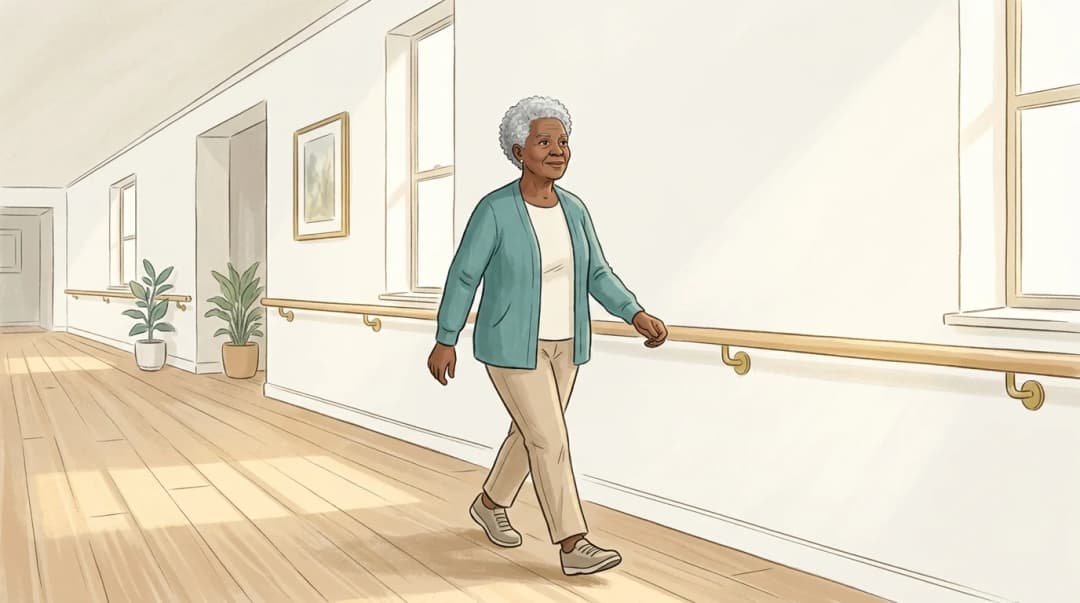
A short walking exercise that cares about how you walk: the weight rolling from foot to foot, the swing of your arms, the small turn of your ribs.
Before you begin. Gentle self care, not medical advice. Practise near a wall, a counter or a sturdy chair, and speak to a doctor or physiotherapist about recent falls, dizziness, a change in the way you walk, numbness in your feet, or a leg that gives way. Stop anything that feels unsteady.
The lesson
About 10-12 minutes. Move slowly, do less than you can, and stay well below any pain. Rest whenever you need to.
Prefer to listen than read?
Feldy voices gentle lessons like this for stiffness after 60, so you can close your eyes and follow along.
- 1
Beside your support. Please stand next to a kitchen counter, a wall, or a sturdy chair, close enough to rest a hand on it whenever you like. Feel your feet on the floor. Does one foot carry a little more of you than the other?
- 2
A few unhurried steps. Take four or five slow steps along your support, easy and small. Which foot feels heavier when it lands, the left or the right?
- 3
The weight rolling across. Walking slowly, let each step linger a moment, so you can feel your weight travel from one foot into the other while the back foot still touches the floor. If anything feels unsteady, make the steps smaller, or sit down and simply imagine them.
- 4
Arms coming along. Walk a little more, and see if your arms would like to swing, even slightly. There is no need to make it happen, only to allow it.
- 5
Ribs joining the walk. Continue at an easy pace and bring your attention to your ribs. Can you feel them turn a tiny bit with each step, first one way, then the other?
- 6
A quiet comparison. Come back to standing beside your support and rest there for a few breaths. How does standing feel now, and what, if anything, is different about the way you just walked?
Let Feldy guide you, eyes closed
You just read these steps. In the Feldy program, a calm voice guides you through each gentle move, so your attention can stay in your body instead of on the screen.
Try Feldy Free for 7 daysNo credit card needed.
Nearly every walking exercise for seniors is measured in numbers: how many steps, how many minutes, how many days a week. This page sets the counting aside for ten minutes and looks at something quieter, the way you walk. Walking is not one movement but a rolling handover of weight from one foot to the other, and the ribs, the pelvis, the arms and even the head all take part in it. When walking is easy, all of that happens without a single thought.
A walking exercise for how you walk, not how far
Gait is simply the word for your personal pattern of walking, its timing and its rhythm. Inside an easy gait there is a gentle twist. As one leg swings forward, the pelvis turns a little with it, while the ribs and shoulders turn slightly the other way. This is called counter rotation, a small turning of the upper body opposite to the lower body, and it is what lets the arms swing on their own and gives walking its flow.
The Feldenkrais Method® works with exactly this kind of detail. In a short Awareness Through Movement® lesson you slow down, notice what your feet, ribs and arms are doing, and let a smoother pattern appear on its own. The lesson above is a small taste of that approach, and you can hear the same style of guidance in audio form with a 7 day free trial of Feldy.
When walking becomes careful
After a scare, a stiff winter, or simply years of hurry, many people begin to walk carefully. The body travels as one solid block, the steps shorten, the arms hold still, and each step starts to cost more effort than it once did. This is not a failing. Care is a reasonable response, and the pattern deserves curiosity rather than judgement.
The wish to walk steadily is well founded. In its fact sheet on falls, the World Health Organization reports that people over 60 account for the greatest number of deadly falls worldwide (WHO, 2021). Let me be plain, though. This page is not a fall prevention program, and it makes no claim to lower anyone's risk of falling. If steadiness is your main concern, begin with our guide to improving balance, and practise the supported standing work in our balance exercises for seniors, which is a natural companion to this page. The lesson here has a different job. It invites some of that natural counter rotation back into your walk, so walking can feel lighter and less like work.
How this walking lesson sits beside everything else
Think of it as a complement to a walking habit, never a replacement for one. Keep your daily walks, since they carry their own value, and let this practice change what those walks feel like from the inside. If you already see a doctor or physiotherapist about your walking, this gentle work sits comfortably alongside that care. Methods such as tai chi and yoga also use slow, attentive movement, each working through its own distinct mechanism, and they can share a week with this lesson quite happily.
If your walking itself has changed, perhaps grown slower, wider, or more hesitant, our Feldypedia entry on gait changes and walking difficulty explains in plain language what tends to sit behind that. And for a longer path of lessons built around this way of moving, there is the Feldy program for bodies that have grown careful.
Find where to start
A lesson like this suits some people straight away, while others do better with a different doorway into gentle movement. If you are not sure which door is yours, there is a quick way to find out.
Prefer to be pointed somewhere specific? The two minute Movement Match quiz asks four plain questions and names the movement method most likely to suit your walking.
Common Questions about walking exercise for seniors (FAQ)
What is the best walking exercise for stiff hips and legs?
For stiffness, a slow walk done with attention tends to serve better than a faster or longer one. Let each step travel at half your usual speed, feel the weight roll through the foot, and let the hips and ribs join in. The lesson above turns this into a simple ten minute practice.
Is this walking lesson safe for everyone, and who should skip it?
Most people can do it, because everything stays slow, small, and beside a support. Please skip it for now, and speak with a doctor or physiotherapist first, if you have had a recent fall, dizziness, numbness in your feet, a leg that gives way, or a sudden change in your walking. Those signs deserve professional eyes before home practice.
How often should I practise this walking exercise?
A few minutes on most days works well, and you can also fold it into walks you already take. Once the pattern feels familiar, you might spend one minute of any walk simply noticing your feet, your arms, or your ribs. Returning to it often matters more than doing it for long.
How long until I notice anything in my walking?
Some people feel a difference within one session, since the walk after the lesson often feels smoother or lighter than the walk before it. Changes that last tend to build over a few weeks of easy repetition. If you notice nothing at first, that is a common answer, and worth being patient with.
How is this different from a walking program or a step count goal?
A walking program asks how far and how often, and it is a fine habit to keep. This lesson asks a different question: what is the quality of each step you already take? The two work well together, one giving you the distance, the other making that distance feel easier.
What should I avoid when practising walking exercises at home?
Avoid rushing, walking over rugs or clutter, socks on smooth floors, and anything that leaves you feeling unsteady. Stay close enough to a wall or counter to reach it easily, and keep every movement smaller than you think you need. If a movement feels risky, sit down and imagine it instead, since imagining is real practice too.
Move easier again, whatever the calendar says
See the programRelated resources
The Best LazyFit Alternative for a Stiff Body: Feldy, Compared
When LazyFit's easy workouts still feel like workouts, Feldy is the gentler path that teaches instead of counting. Compared with SilverSneakers GO, Bold, and chair yoga on YouTube.
What Is Tai Chi Walking? A Plain Guide for Beginners
Tai chi walking is slow, attentive walking borrowed from tai chi: soft knees, a quiet heel, and weight that travels one leg at a time. Here is how to try it at home.
Brisk walking eased frailty more than strolling, and the stroll still helped nearly half
Ready to start moving better?
Gentle, guided lessons for your body. Try your first one free, no credit card required.