

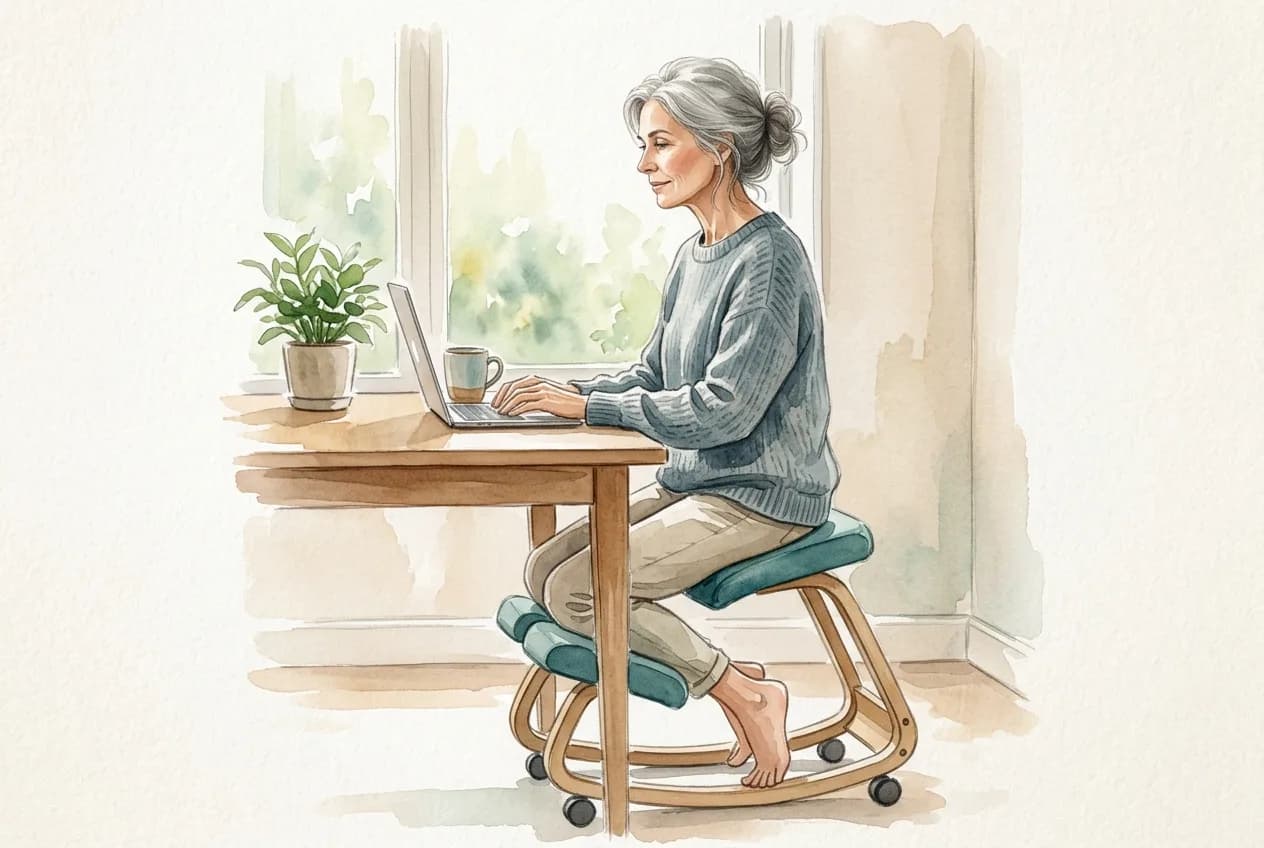
Is Kneeling Better Than Sitting? A Straight Answer
Kneeling moves weight onto the shins and tips the pelvis forward, which changes how hard your back works. Here is what that helps, what it costs, and who it suits.
In short
No, kneeling is not better than sitting, it is different. Kneeling shifts load off the sit bones and the low back onto the shins and knees, and it gets tiring sooner for most people. What consistently helps is changing position often, not finding one perfect seat.

Prefer to ease in gently?
See a few gentle exercises for knees and hips to try.
Before you begin. This is general education about seating, not medical advice. Deep knee bend under load does not suit every joint, so ask a doctor or physical therapist first if you have knee arthritis, a joint replacement, a recent knee or ankle injury, poor circulation or numbness in the lower legs, or if you are pregnant. Back or knee pain that persists, swells, or sends numbness down a leg needs assessment rather than a different chair.
Is kneeling better than sitting? Not better, no. Different, and the difference is worth understanding before you buy a kneeling chair or decide the chair you already own is to blame. Kneeling changes which parts of you carry your weight and how much effort your back makes to stay upright. What it does not change is the thing most bodies actually object to, which is staying in one arrangement hour after hour.
Seating gets blamed for a great deal. Low back pain affected 619 million people in 2020 (WHO, 2023), and a good many of them have been told at some point that their chair is the culprit. Chairs are rarely the whole story, and no seat sold anywhere has been shown to be the answer.
What kneeling actually changes
Sit in an ordinary chair and most of your weight travels down through the two sit bones at the base of the pelvis and along the backs of the thighs. Move onto a kneeling seat and a meaningful share of that weight goes forward instead, onto the shins and the padded rest in front of you. The tissue that was bearing the load gets a break, and tissue that usually bears very little takes over.
The second change happens at the hip. A kneeling seat holds the thighs at a more open angle than the right angle of a standard desk chair, and an open hip angle lets the pelvis tip forward. Once the pelvis has tipped, the lower back keeps more of the gentle curve it carries when you stand, so the spine stacks up with less muscular holding. That is the real appeal of the design. People often report that they slump less on one, and they are not imagining it, because slumping takes deliberate effort once the pelvis has rolled forward.
The costs come out of the same geometry. The knees sit in a deep bend and take steady pressure across the front of the shin. The legs are more or less parked, so the small shifts and fidgets that quietly keep a body comfortable become harder to make. There is usually no backrest, so late in the afternoon the trunk has nowhere to lean. For most people that adds up to a seat which feels excellent for twenty minutes and wearing by the second hour.
Is kneeling better than sitting, according to the research?
Studies comparing seat designs mostly measure posture and muscle activity in a laboratory over minutes, not pain over months. On the mechanics they agree fairly well: kneeling and forward-tilted seats produce more forward pelvic tilt and a lumbar curve closer to standing than a flat conventional seat does. What they do not deliver is a winner. Reviews of chair interventions for back pain keep arriving in the same place, which is that the trials are small and short, the results are mixed, and no seat type has been shown to reduce back pain dependably. The steadier finding in this literature is a duller one: how long you stay put matters more than what you are sitting on.
Who kneeling suits, and who it does not
Kneeling tends to suit people whose backs ache from settling into a slump by mid-afternoon, people working at a raised surface, and people whose knees and ankles are comfortable and reasonably mobile. It suits short working stints far better than whole days, and it suits anyone who already has somewhere else to go when it stops feeling good.
It suits other people much less. Knees that are already sore, or carrying arthritis, often object precisely to a deep bend held under load. After a knee replacement the guidance depends on your implant and your surgeon, so that is a question for your team rather than for an article. Stiff ankles usually complain before the knees do, since the front of each ankle has to lengthen to let the shins settle. During pregnancy the shifting weight, the balance demands, and the awkwardness of getting in and out all argue for something easier to leave. In a larger body the same load lands on a small patch of shin, and the transitions ask more of the knees. None of this makes kneeling a mistake. It makes it one option among several, and an option only helps when it fits the person using it.
The part that actually helps is switching
If there is one thing to carry away, it is that variety does more for comfort than any seat. Joints do better with changing load than with a fixed one, circulation improves when muscles work a little, and the ache of a long sit builds mostly out of stillness. A day spent moving between a chair, a kneeling seat, standing at the kitchen counter, and a two minute walk to fill the kettle treats a back more kindly than a day spent immaculately arranged in any single one of them.
This is the ground the Feldenkrais Method® stands on. Instead of teaching one posture to hold, its lessons explore many ways of doing the same ordinary thing, so the body keeps more arrangements available and can change out of any of them without a struggle. Our Feldypedia entry on lower back pain from sitting covers why the back tends to protest long stillness in particular, and the Feldy program for knee or hip pain is built the same way, in short lessons that give the hips and knees more choices rather than one shape to maintain.
A practical way to arrange the day
Try this before you go shopping. Pick a stretch of work, twenty to forty minutes, and at the end of it change something: stand up, walk into another room, sit a different way, or kneel if that is available to you. Keep the change cheap, so a shelf at standing height, a firm cushion on the floor, or simply a decision to take phone calls on your feet. Then notice which arrangements your body asks for, and when. Over a week that will teach you more about your own comfort than any comparison of chairs.
If the knees are what complain after a long sit, our explainer on why knees get stiff after sitting explains what is going on inside the joint, and our gentle knee proprioception exercises give the knees a kind way back into easy movement. If you are curious about kneeling on the floor rather than on a seat, our piece on whether sitting on your knees is bad takes that up. And Feldy has a free 7 day trial, no credit card needed, if a guided way into more variety appeals to you.
A note on care
Please hold all of this as general education about seating rather than advice about your particular back or knees. Back or knee pain that lasts beyond a few weeks, wakes you at night, follows an injury, or brings swelling, giving way, numbness, or pins and needles down a leg deserves a proper look from a doctor or a physical therapist. Professional care of that kind works together with anything you try at home. If you have had joint surgery, check with your surgical team before spending working hours on your knees.
Kinder movement for knees and hips
Understanding the strain is half of it. The Feldy program helps knees and hips carry less of it by reorganising how the whole body moves, through Feldenkrais® lessons. Gentle, guided, and self-paced.
Start my free 7-day trialNo credit card needed.
Common Questions about kneeling versus sitting (FAQ)
Is kneeling better than sitting for lower back pain?
Not better, but different in a way that some backs prefer. A kneeling seat holds the hips at a more open angle, which tips the pelvis forward and lets the lower back keep more of its standing curve without much muscular effort, so people who slump in an ordinary chair often feel easier on one. Trials comparing seat designs have not shown that any chair reliably reduces back pain over time, so treat it as a change of position rather than a treatment.
How long does it take to get used to a kneeling chair?
Most people need a week or two of short stints before it feels ordinary, starting at ten or fifteen minutes and building from there. Pressure across the shins is usually the limiting factor early on, and it eases as you learn to share your weight between the seat and the shin pad. If the discomfort is growing rather than settling after a couple of weeks, the design is probably not for you.
How long should you kneel at a desk before switching?
Twenty to forty minutes is a reasonable working stint for most people, and your own comfort is a better signal than a timer. Tingling in the feet, aching across the shins, or a knee that wants to straighten are all requests to change. The aim is not to last as long as possible in one seat, it is to have somewhere else to go.
Who should avoid a kneeling chair?
Anyone with painful or arthritic knees, a knee replacement, a recent knee or ankle injury, numbness or circulation trouble in the lower legs, or marked ankle stiffness should be cautious and ask a doctor or physical therapist first. Pregnancy and a larger body both make the seat harder to enter, leave, and tolerate, so an adjustable chair with a backrest plus frequent standing usually serves better. Deep knee bend under load is the demanding part, so any joint that dislikes it is a good reason to choose something else.
How is a kneeling chair different from a standing desk?
They address different halves of the problem. A standing desk changes whether you are on your feet, which loads the legs and feet and can ache in its own way after a few hours. A kneeling seat changes how you sit, mostly at the pelvis and the lower back, while leaving you seated. Both work best as one option in a rotation rather than as a full-time replacement.
When should I see a professional about pain from sitting?
See a doctor or physical therapist if back or knee pain lasts more than a few weeks, wakes you at night, follows an injury, or arrives with swelling, giving way, numbness, or pins and needles down a leg. The same applies if the pain keeps worsening however you arrange yourself. Symptoms like those need assessment rather than a new chair, and professional care works together with whatever you practise at home.
Kinder movement for knees and hips
See the programRelated resources
Is Sitting on Your Knees Bad? What Actually Matters
Is sitting on your knees bad for the joints? Not in itself. Duration, variety, and whether you can get up again matter far more than the position you chose.
Why Do My Knees Get Stiff After Sitting?
Why do my knees get stiff after sitting? It is usually harmless joint gelling that eases within a minute of moving. Learn why it happens and how to ease it.
Ready to start moving better?
Gentle, guided lessons for your body. Try your first one free, no credit card required.