
SI Joint: What It Is, What It Does and Why It Can Hurt
The SI joint links your spine to your pelvis and passes weight between your back and your legs. Learn where it sits, why it gets sore and what helps.
In short
The SI joint, short for sacroiliac joint, is the joint where the sacrum at the base of your spine meets the hip bone of your pelvis. You have one on each side. It moves only a little and passes weight between your spine and your legs. It can feel sore when the load on it is uneven.

Prefer to ease in gently?
See a few gentle exercises for lower back pain to try.
Before you begin. SI joint pain is joint pain, and several things can cause it. See a clinician for pain after a fall, a fever, pain that wakes you at night, or any numbness or weakness in a leg. Gentle awareness work sits alongside care and is not a treatment.
The SI joint is the sacroiliac joint, the place where the sacrum at the base of your spine meets the hip bone of your pelvis. You have two of them, one on each side. They move only a little, and their main job is passing weight between your spine and your legs. This page explains where the SI joint is, what it does and why it can ache.
Low back pain is very common. The World Health Organization notes that about 90% of cases have no specific cause that can be identified (WHO, 2023). That is worth holding in mind. A sore spot near the SI joint is a useful clue, but it is rarely the whole story.
Where is the SI joint?
Put your hands on your hips, then slide them back toward your spine. Look for the two dimples low on your back, level with the top of the buttocks. Not everyone has them. The SI joints sit close to those dimples, one under each.
The sacrum is a flat, triangle shaped bone. It forms the bottom of your spine and sits wedged between the two hip bones, like the keystone of an arch. Each SI joint is the meeting line between the sacrum and one hip bone. For a closer look, read our guide to where the SI joint is.
What does the sacroiliac joint do?
Sacroiliac joint function comes down to two things: carrying load and giving a little.
When you stand, your upper body weighs down through the spine into the sacrum. From there it passes across the SI joints to the hip bones and down through your legs. When you walk, the ground pushes back up the same route. The SI joints sit right at the crossing point.
They are held firmly by strong bands, so they move far less than your hips or shoulders. Still, a tiny amount of give helps. It lets the pelvis adapt a little as you step, climb stairs or turn over in bed. Think of it as a shock absorber more than a hinge.
Why can the SI joint hurt?
There is no single reason. Here are some common ones.
- Uneven loading. Standing mostly on one leg, carrying a bag on one side or sitting with one hip tucked under means one SI joint takes more of the work.
- A fall or a jolt. A slip onto the buttocks, a car accident or a hard step down can leave the area sore.
- Changes after pregnancy. Some people first notice SI joint soreness after having a baby.
- Arthritis. Like other joints, the SI joint can wear over the years, and some inflammatory conditions of the spine can involve it.
- Hypermobility. If your joints are naturally very flexible, the joint may have less steady support around it, and it can tire more easily.
Often there is no clear moment you can point to. The ache simply builds up. Our guide to sacroiliac joint dysfunction symptoms lists the signs people most often describe.
How does SI joint pain usually feel?
SI joint pain is usually felt on one side, low in the back, close to the dimple. Some people feel it spread to the buttock, the groin or the back of the upper thigh. Others describe a stiff, tired ache more than a sharp pain.
It often shows up with certain moments: standing for a long time, walking with long strides, climbing stairs, rolling over in bed or getting out of a car. Sitting for hours and then standing up can bring it on too.
Be careful about diagnosing yourself. Hip, lower back and nerve problems can feel alike, and only a clinician can say what is going on in your case.
When to see a clinician about the SI joint
Please have a clinician look at your pain if you notice any of these:
- Pain that began after a fall, a crash or another injury.
- A fever, or feeling unwell along with the pain.
- Pain that wakes you at night or is there even when you rest.
- Numbness, tingling or weakness in a leg.
- New trouble controlling your bladder or bowels.
- Pain that lasts several weeks or keeps getting worse.
A clinician can check the joint and rule out other causes. Gentle awareness work is something you can do alongside that care, never instead of it.
How awareness of the pelvis and spine can help
Because the SI joint passes load between your back and legs, how your pelvis, hips and spine share movement matters. If one side keeps working harder, that joint may be asked to do more than its share.
In the Feldenkrais® Method, we do not push the joint into place or force it to move. Instead we explore slow, easy movements and notice how the pelvis, ribs and legs take part. Many people find that when the work spreads more evenly, the sore spot is asked to carry less. Our explainer on how the spine and pelvis move together is a good next read.
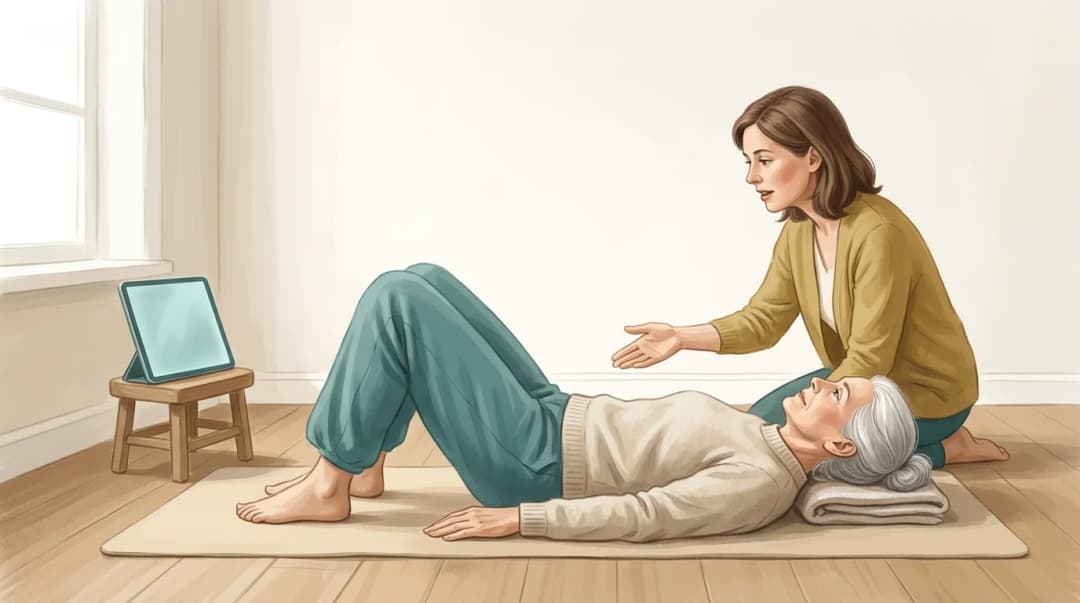
Here is one thing to try. Lie on your back with your knees bent, and rest for a few breaths. Notice whether one side of your pelvis feels heavier on the floor than the other. Do not change anything. Just notice, and see whether that difference shifts after a minute. If your back feels braced, our gentle steps for how to relax your back are a kind place to start.
Where to go next
If you want to explore the SI joint further, these pages go deeper:
- Where is the SI joint? for a clear map of where it sits.
- SI joint stretches for a gentle lesson to explore.
- SI joint pain exercises to avoid for movements to approach with care.
- Best exercises for the SI joint for comparing options.
Our Feldypedia article on chronic lower back pain adds the wider picture. When you want guided practice, Feldy offers short audio lessons for your own living room, and the whole program for lower back pain is there to look through.
A gentler way through back pain
Now you understand why it braces. The Feldy program helps your back unlearn that guarding, through slow, attentive Feldenkrais® lessons you follow at home. Gentle, guided, and self-paced.
Start my free 7-day trialNo credit card needed.
Common Questions about the SI joint (FAQ)
What is the SI joint?
The SI joint is the sacroiliac joint, where the sacrum meets the hip bone of the pelvis. The sacrum is the flat, triangle shaped bone at the bottom of your spine. You have two SI joints, one on the left and one on the right, low on your back near the dimples above your buttocks.
What is the function of the sacroiliac joint?
Sacroiliac joint function is mostly about passing weight. It carries load from your upper body down to your legs, and from the ground back up to your spine. It also gives the pelvis a very small amount of give, which helps when you walk, climb stairs or shift your weight.
What does SI joint pain feel like?
Most people feel an ache on one side of the lower back, often low and close to the dimple. It can spread into the buttock, the groin or the back of the thigh. Standing for long, climbing stairs, turning in bed or getting up from a chair are common moments when it shows up.
How often should I move if my SI joint is sore?
Short, gentle spells of moving through the day often feel better than long periods of sitting or standing still. Change position every little while, and walk when you can. Keep any exploring slow and comfortable, and stop if your pain climbs.
How long does SI joint pain take to ease?
It varies a lot, because several things can cause it. Many people notice it settle over days to weeks, and some find it comes and goes for longer. If it has lasted more than a few weeks, or keeps getting worse, ask a clinician to look at it.
Is SI joint pain different from sciatica?
They can feel alike, but they are not the same. SI joint pain usually stays around the low back and buttock. Sciatica is pain along the path of the sciatic nerve, often travelling below the knee, sometimes with tingling or numbness. A clinician can help you tell them apart.
What should I avoid when my SI joint hurts?
Notice which movements make the ache sharper, such as long strides, deep twists or standing on one leg, and ease off those for now. You do not need to stop moving. Choose comfortable positions, and read our guide on exercises to avoid for more detail.
When should I see a clinician about SI joint pain?
See a clinician soon for pain after a fall or accident, a fever, pain that wakes you at night, numbness or weakness in a leg, or new trouble controlling your bladder or bowels. Pain that lingers for several weeks, or keeps getting worse, deserves a check too.
A gentler way through back pain
See the programRelated resources
Where Is the SI Joint? How to Find It on Your Body
Two small joints sit at the back of your pelvis, one on each side. Here is how to find them, what they do, and where SI joint pain is usually felt.
Sacroiliac Joint Dysfunction Symptoms: What They Feel Like
Pain low and to one side, worse standing up from a chair. The symptoms of sacroiliac joint dysfunction, what mimics them, and where gentle movement helps.
Online back programs that eased pain noticeably all included a person
Ready to start moving better?
Gentle, guided lessons for your body. Try your first one free, no credit card required.