
Falling Asleep During Relaxation Exercises: Why It Happens
You lie down for a calm practice and wake up at the end of the track. Why it happens, when it is welcome, and how to stay with a daytime lesson.
In short
Falling asleep during relaxation exercises is common and usually harmless. It often means you are short on sleep, or that lying still in a quiet room tells your body to rest. At bedtime that may be the point, and for daytime practice you can sit up or keep your eyes open.

Prefer to ease in gently?
See a few gentle exercises for stress and sleep to try.
Falling asleep during relaxation exercises is common and usually harmless. You lie down, the voice on the recording begins to slow, and the next thing you know the track has ended. Many people feel a little embarrassed about this, as if they let the teacher down. You did not. Your body found a quiet moment and used it. Whether that is a problem depends on when you practise and what you were hoping for.
Why falling asleep during relaxation exercises happens so often
There is rarely one single cause. Usually several ordinary things line up at the same time.
You may simply be short on sleep. The longer you stay awake, the stronger your body's drive to sleep becomes. Sleep scientists call this sleep pressure. If your nights have been short, that pressure is already high when you lie down, and a calm practice gives it the opening it was waiting for. Plenty of people are in this position. In 2022, between 30% of adults in Vermont and 46% in Hawaii said they were not sleeping enough, depending on the US state (CDC, 2024).
The setting looks a lot like bedtime. Think about what most relaxation recordings ask for. Lie on your back. Close your eyes. Dim the room. Listen to a soft, slow voice. For your nervous system, that is almost the same list of cues it uses every night before sleep. It would be more surprising if you stayed awake.
Effort drops, and the body shifts toward rest. During the day you hold yourself up, keep track of tasks, and stay ready for the next thing. A relaxation exercise asks you to set all of that down. As the muscles stop working and the breath slows on its own, the body moves toward its resting mode. Sleep is the deepest version of that mode, so it is a short step away.
A busy mind finally has nothing to manage. People who rush all day often say they cannot switch off. Then, in a quiet practice, the list of jobs falls silent for a moment. Without anything to plan or solve, the mind can let go very quickly, sometimes in the middle of a sentence from the teacher.
Is falling asleep during relaxation exercises a problem?
Mostly, no. At bedtime it may be the whole point. If you use a body scan, a breathing track, or a gentle movement lesson to help you drift off at night, falling asleep halfway through means it worked. Our guide to sleeping relaxation techniques is written with exactly that use in mind.
In the daytime the picture can be different. You may want to follow a lesson from start to end, because you are learning something or because the practice is your quiet time to notice yourself. In that case, regular dozing is not harmful, but it means you miss the part you came for. It is also a useful clue. It tells you something about how rested you really are.
How to stay awake when you want to follow a daytime lesson
Small changes to the setup usually make a big difference. You do not need to force yourself to stay alert.
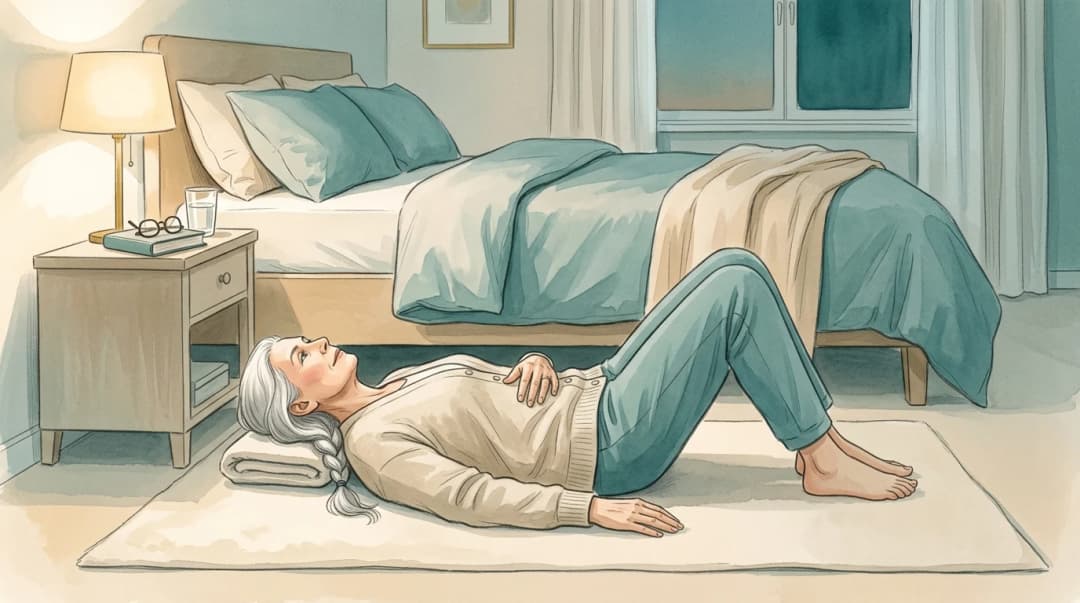
Change your position. Try the lesson seated in a chair. If it needs the floor, bend your knees so the soles stand flat. That small change keeps a little more readiness in the legs and back.
Leave your eyes partly open. A soft gaze toward the ceiling or the floor keeps some light coming in. That tells your brain it is still daytime.
Practise earlier in the day. Late morning tends to be easier than straight after lunch or late in the evening, when sleepiness rises naturally.
Choose shorter sessions. Ten minutes you stay present for gives you more than forty minutes you sleep through.
Add a little movement. Practices that ask you to lie completely still are the easiest to fall asleep in. A lesson with small, slow movements gives your attention something to follow. Progressive muscle relaxation also has a built in task, tensing and softening each area, and our page on progressive muscle relaxation for sleep explains how it goes. A gentle breathing practice done sitting up is another option, and you can find a few in breathing exercises to fall asleep, which also work in a chair.
When falling asleep this easily deserves a GP visit
If you fall asleep the moment you lie down, every time, it is worth asking a plain question: am I getting enough sleep? Look at how long your nights are and how often you wake. Feldypedia has an entry on sleep disruption and physical tension that looks at how a tense body and broken nights can feed each other.
Some signs go beyond ordinary tiredness and are worth a visit to your GP:
- You fall asleep while talking, eating, or driving, or you struggle to stay awake in situations that need attention.
- Someone tells you that you snore loudly and that your breathing seems to stop and start in the night. This can point to sleep apnoea, a condition where the airway narrows or closes during sleep.
- You often wake gasping or choking.
- Strong daytime sleepiness lasts for weeks, even after nights that seemed long enough.
Any of these is simply a good reason to let a doctor take a look.
Where Feldenkrais® fits: noticing the moment before you drift
In a Feldenkrais lesson, the learning happens through attention. You make a small movement, you rest, and you notice what changed. When you are asleep, that noticing stops for a while. So if you want to learn from a lesson, staying present matters more than staying relaxed.
That does not mean guilt. People doze in my lessons all the time, especially in the long ones on the floor, and I never wake them. Next time, though, you can try something interesting. Notice the moment just before you drift. How does the breath change? Where does the weight of the head go? Does the movement get smaller by itself? That edge between awake and asleep is a rich place to pay attention.
If you would like a short lesson built this way, our somatic exercises for sleep page has one you can do tonight. Feldy is the online program I created around this kind of attention, with voice guided Awareness Through Movement® lessons you can do at home. You can try Feldy free for 7 days, and the stress and sleep page shows how the lessons are arranged for daytime practice and for bedtime.
Alongside clinical care and other methods
Movement lessons are a form of education. They do not treat sleep disorders, and they do not replace a doctor. If you have ongoing trouble with sleep or daytime sleepiness, your GP or a sleep clinic can sit alongside any practice you enjoy. Talking therapy for insomnia, often called CBT for insomnia, is a well tested option a doctor can suggest.
Other methods offer rest by their own routes. Yoga nidra is a guided lying practice that many people use on purpose to slide toward sleep. Restorative yoga holds supported shapes for several minutes. Tai Chi is done standing and moving, so people rarely doze through it. Mindfulness meditation is often practised sitting upright, which helps you stay alert while you notice. Each of these suits some people and some moments well. Feldenkrais works differently again: small, easy movements with your attention on how they feel.
A calmer body, easier nights
Understanding it is calming, moving with it more so. The Feldy program is meditation in movement, slow Feldenkrais® lessons that help a busy body settle so sleep can arrive on its own. Gentle, guided, and self-paced.
Start my free 7-day trialNo credit card needed.
Common Questions about falling asleep during relaxation exercises (FAQ)
Is it ok to fall asleep during a relaxation exercise?
Yes, for most people it is fine. Your body took a chance to rest, and nothing harmful happened. If you practise at bedtime, drifting off may be exactly what you hoped for. If you wanted to stay present for a daytime practice, treat it as information about how tired you are, not as a failure.
Why do I fall asleep during relaxation exercises?
Usually a few things add up. You may be short on sleep, so the drive to sleep is already strong. Lying down in a quiet room with a soft voice is one of the clearest bedtime signals there is. When you stop making effort, your body shifts toward rest. And a busy mind that finally has nothing to manage often lets go all at once.
Does falling asleep during a body scan mean the practice did not work?
No. A body scan asks you to lie still and move your attention slowly through the body, which is very close to how many people fall asleep anyway. Dozing off tells you that your system settled. If you want to follow the whole scan, try it sitting in a chair, earlier in the day, or in a shorter version.
What if I keep falling asleep during a Feldenkrais lesson?
It happens often, especially in lessons done lying on the floor, and teachers are used to it. You have not missed anything that cannot wait for next time. If you would like to stay with the lesson, try it sitting, with your knees bent and feet standing, or with your eyes partly open. Notice the moment just before you drift, because that moment is interesting in itself.
How can I stay awake during a daytime relaxation practice?
Change the position first. Sitting, or lying with your knees bent and feet standing on the floor, keeps a little more alertness in the body. Keep your eyes partly open and let a little light in. Practise earlier in the day rather than straight after lunch or late in the evening. Choose shorter sessions, and pick practices with a little more movement and a little less stillness.
What is the best relaxation exercise for someone who keeps falling asleep?
Something with a clear, small movement to follow tends to suit you best in the daytime. Slow movement lessons, walking with attention on your feet, or a short seated practice give your attention a job, so there is less room to drift. Save the long, still, lying down practices for bedtime, where falling asleep is welcome.
When should I see a doctor about falling asleep so easily?
See your GP if you fall asleep in situations where you need to be alert, such as while talking, eating or driving. Do the same if someone tells you that you snore loudly with pauses in your breathing, or if you wake up gasping. Strong sleepiness that lasts for weeks, even after nights of decent sleep, is also worth a visit. These signs can have causes a doctor can look into.
You do not have to win a battle with sleep. Rest when your body asks for it, and when you want to learn, give your attention a small movement to follow.
A calmer body, easier nights
See the programRelated resources
Somatic Exercises for Sleep: Wind Down Through Movement
Somatic exercises for sleep use slow, soothing movement to settle a busy body before bed. Learn why it helps a racing mind, with a short lesson to try tonight.
Progressive Muscle Relaxation for Sleep: Tense, Then Let Go
A guided progressive muscle relaxation lesson for bed: mildly tense each muscle group, let go fully, and notice the contrast that helps a braced body settle.
After 60, some of what movement does for your memory may happen while you sleep
Ready to start moving better?
Gentle, guided lessons for your body. Try your first one free, no credit card required.