

Breathing Exercises to Fall Asleep: Attention, Not Control
Breathing exercises to fall asleep that ask for attention rather than control: a short lesson done lying in bed, with no counting and no breath holding.
Before you begin. This is gentle self care, not medical advice. Persistent insomnia deserves a doctor's attention, and breathing exercises are not a treatment for sleep apnoea or any other respiratory condition. If you have a lung or heart condition, check with your doctor before changing how you breathe on purpose. Never hold your breath, and if lengthening the exhale ever makes you feel breathless, dizzy or anxious, let the breath go back to normal.
The lesson
About 5-10 minutes. Move slowly, do less than you can, and stay well below any pain. Rest whenever you need to.
Prefer to listen than read?
Feldy voices gentle lessons like this for stress and sleep, so you can close your eyes and follow along.
- 1
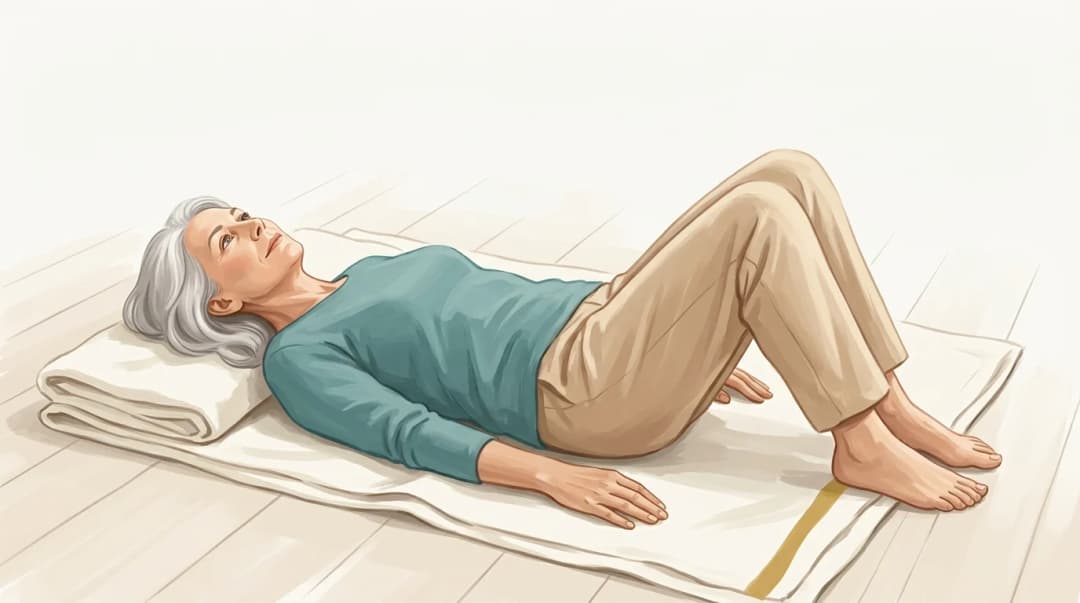
Settling into bed. Please lie in bed the way you usually fall asleep, on your back or on your side, and take a moment to arrange the pillow and covers so nothing needs your effort. This lesson is allowed to end in sleep, so there is nowhere else to be.
- 2
The breath exactly as it is. Let your attention come to your breath without changing anything about it. Quick or slow, shallow or deep, it is fine as it is tonight.
- 3
Where the breathing shows up. Notice where the movement of breathing appears: the belly rising and falling, the ribs widening, the back pressing softly into the mattress. Is one of these places easier to feel than the others?
- 4
A quiet rest. Let the noticing fade for a few breaths and simply rest. Nothing to do, nothing to achieve.
- 5
A slightly longer exhale. When you are ready, let each exhale become a little longer and more unhurried, like a sigh that takes its time, and let the inhale look after itself. No counting, and never any holding of the breath.
- 6
If it turns into work. If the longer exhale makes you feel breathless, dizzy or anxious, let the breath go back to normal; that response is common and completely fine. After a while, let the breath return to its own rhythm anyway, and rest.
- 7
Heavier into the mattress. Notice how your body meets the mattress now, from your heels to the back of your head. Does anything feel heavier, or more willing to be held, than when you began?
Let Feldy guide you, eyes closed
You just read these steps. In the Feldy program, a calm voice guides you through each gentle move, so your attention can stay in your body instead of on the screen.
Try Feldy Free for 7 daysNo credit card needed.
The most helpful breathing exercises to fall asleep are usually the least effortful ones: not a counted pattern to perform correctly, but a few quiet minutes of noticing the breath you already have. That may sound too simple to matter, yet for people who lie awake it is often exactly the point. The Feldenkrais Method® approaches breath in an unusual way: attention, not control, is the active part. Instead of telling the breath what to do, you sense where it moves you, and let the exhale lengthen only as much as it wants to. The short lesson above is done entirely in bed, with no counting and no breath holding, and it is allowed to end in sleep.
Why breathing exercises to fall asleep work best without trying
Sleeplessness is remarkably common. About one third of adults, between 30% and 36%, report at least one symptom of insomnia (StatPearls, NCBI, 2024). And most people who lie awake share one experience: the harder they try to sleep, the further away it drifts. Sleep is one of the few things that cannot be achieved through effort, only allowed.
This is where many breathing techniques quietly trip people up. A counted pattern gives the mind something to hold, which genuinely helps some people. For others it becomes one more thing to perform, one more way to succeed or fail at two in the morning, and the sense of working at it keeps the nervous system in exactly the alert state they were hoping to leave. Breathing practice does not switch sleep on, and it is not a treatment for insomnia or for any sleep disorder. What it can do is give a busy mind somewhere restful to settle, and give the body an invitation to become heavier, so the conditions for sleep have a better chance of arriving on their own.
What noticing the breath is actually doing
Every step of the lesson is an observation, not an instruction to breathe differently. When you find where the breath moves you, the belly, the ribs, the back against the mattress, your attention comes down out of circling thoughts and into direct sensation, which is a much sleepier place to rest. When the exhale lengthens a little on its own, most people notice the body settling more deeply into the bed with each breath out, without anyone forcing anything.
None of it should feel like work. If following the breath in one place is hard, simply choose an easier place, or imagine the movement instead; imagining still gives you something quiet and real to sense. If you drift off partway through, so much the better; sleep arriving early is the point, not an interruption. The rests between steps are part of the practice, not gaps in it.
Keeping breathing exercises to fall asleep gentle and safe
A few habits keep this practice kind. Never hold your breath. Let the exhale lengthen only as far as feels easy, and if a longer exhale ever makes you feel breathless, dizzy or anxious, let the breath go back to normal; that reaction is common and completely fine, and the noticing steps on their own are still a full practice. Keep the whole thing free of any sense of duty: this is a place to rest, not a routine to complete.
All of this sits alongside whatever your doctor advises, never in place of it. Persistent insomnia deserves a doctor's attention, and breathing exercises are not a treatment for sleep apnoea or any respiratory condition, so loud snoring, gasping, or pauses in breathing at night are reasons to be assessed properly. If you have a lung or heart condition, check with your doctor before changing how you breathe on purpose. For more background, our Feldypedia notes on chronic shallow breathing and sleep disruption and physical tension go further into how breath, tension, and rest are connected.
More gentle movement in the same spirit
Once this lesson feels like home, its unhurried quality tends to seep into the rest of the evening. Our deep breathing exercises for relaxation bring a similar attention led approach to daytime moments of stress, and these bedtime stretches in bed offer a short, slow movement sequence for the minutes before lights out. Feldy's guided lessons carry the same idea through every evening: small, slow, comfortable, and never a performance. If you would like to try one tonight, the free 7 day trial opens the lessons for a week, no credit card needed.
Find where to start
Wakeful nights have different flavors, and the lesson that suits a racing mind may differ from the one that suits a tense body. If you are unsure where to begin tonight, our short quiz will happily narrow it down.
Not sure how to begin? Take the two minute Movement Match quiz, four quick questions that name the movement method for you.
Go gently: a breath left in peace is already doing plenty.
Common Questions about breathing exercises to fall asleep (FAQ)
What are the best breathing exercises to fall asleep?
For many people, the best breathing exercise at bedtime is the least effortful one: lying comfortably, noticing where the breath already moves you, and letting the exhale become a little longer without counting or holding. Elaborate techniques can work well too, but at night simplicity has a real advantage, because there is less to perform and less to get wrong. The lesson above is built entirely around that idea.
Does 4 7 8 breathing work for falling asleep?
Many people find a counted pattern like 4 7 8 genuinely helpful, and if it works for you there is no reason to change it. Others find that counting turns the breath into a task, which leaves them more alert rather than sleepier. Neither response is a failure; it is simply information about what your own nervous system finds restful, and an uncounted, attention led approach is a fine alternative.
What should I avoid when doing breathing exercises for sleep?
Avoid holding your breath, forcing the exhale longer than feels comfortable, and treating the breathing like a job to be done well. If you feel breathless, dizzy or anxious, let the breath go back to normal straight away. If you have a lung or heart condition, check with your doctor before deliberately changing how you breathe.
How often should I practise?
Most nights, if you like, since it happens in bed at a time you were lying there anyway. A few quiet minutes is plenty, and on wakeful nights you can visit it again in the middle of the night. There is no streak to keep and no dose to reach.
How long until I fall asleep faster?
Some people feel noticeably heavier and drowsier the very first night, while for others the shift builds over a few weeks of unhurried repetition. Be a little wary of measuring, because watching the clock to check whether it is working is itself a form of trying. The aim is a quieter arrival at sleep, not a guaranteed number of minutes.
How is this different from meditation or counted breathing techniques?
Counted techniques and many meditations give the mind a structure to follow, and that structure is often the helpful part. This lesson works through a different mechanism: instead of following a pattern, you sense what the breath is already doing and let the exhale soften on its own. Both approaches have real value, and they sit comfortably side by side; many people use one on some nights and the other on the rest.
When should I see a doctor about my sleep?
If poor sleep persists for more than a few weeks, affects your days, or comes with loud snoring, gasping, choking, or long pauses in breathing during the night, please talk with your doctor. Those nighttime breathing signs in particular can point to sleep apnoea, which needs proper assessment. A breathing practice like this one sits alongside medical care, never in place of it.
A calmer body, easier nights
See the programRelated resources
Sleeping Relaxation Techniques: A Gentle Guide
A plain guide to the main sleeping relaxation techniques: slow breathing, tensing and letting go, body scans, gentle movement in bed, and who each one tends to suit.
Box breathing for sleep: a gentler bedtime version
A calm bedtime lesson in box breathing for sleep: even in and out breaths, small optional pauses, and full permission to rest instead of chasing sleep.
Lying down is not the same as resting, and researchers have now measured the difference
Ready to start moving better?
Gentle, guided lessons for your body. Try your first one free, no credit card required.